
What if a broken lease was viewed as a manageable business transition rather than a legal crisis? For many property owners, the sudden news of a tenant vacating early triggers immediate concerns about prolonged vacancies and the perceived complexity of the Landlord and Tenant Board. It’s understandable to feel a sense of urgency when your rental income is at risk. However, understanding exactly what happens if a tenant breaks their lease Ontario allows you to move from a position of uncertainty to one of strategic control.
We agree that the current regulatory environment, characterized by an LTB active caseload of over 36,000 applications, requires a disciplined approach to asset protection. This guide provides the clarity you need to navigate your legal obligations and financial rights under the Residential Tenancies Act. You’ll learn how to fulfill your mandatory duty to mitigate losses, manage the latest LTB filing requirements, and implement professional placement strategies to secure a qualified replacement tenant. By following this structured resolution, you can maintain the stability of your investment while ensuring full compliance with provincial law.
Key Takeaways
- Understand your rights under the Residential Tenancies Act (RTA) and how the legislation governs fixed-term lease terminations.
- Discover what happens if a tenant breaks their lease Ontario, including the specific financial liabilities of the tenant and your mandatory duty to mitigate losses.
- Identify the correct legal channels for early termination, such as using Form N11 for mutual agreements or navigating the lease assignment process.
- Implement a structured response plan that uses written documentation to clarify property condition expectations and remaining rent obligations.
- Learn how professional tenant placement services reduce vacancy periods and provide the oversight necessary to maintain asset stability during transitions.
The Legal Reality of Breaking a Lease in Ontario
Understanding what happens if a tenant breaks their lease Ontario begins with recognizing the lease as a formal business agreement. A broken lease occurs when a tenant vacates a rental unit before the specified expiry date of their fixed-term agreement without a legal justification. In the province, the primary legislation governing these interactions is the Residential Tenancies Act, 2006. This act establishes the rights and responsibilities of both parties, ensuring that the Ontario Standard Lease remains a legally binding contract. Unlike some consumer transactions, there is no 3-day cooling-off period for residential tenancies in Ontario. Once the document is signed, the commitment is immediate and enforceable.
As a landlord, knowing what happens if a tenant breaks their lease Ontario helps you protect your financial interests. When a tenant leaves early, they are effectively terminating their obligations without following the prescribed legal pathways. This creates a breach of contract. While the situation is frustrating, the law provides a structured framework for resolution. You aren’t left without recourse, but you must operate strictly within the bounds of provincial regulations to ensure your claims for compensation remain valid.
Fixed-Term vs. Month-to-Month Tenancies
Fixed-term leases provide a predictable revenue stream for a set duration, usually one year. Once this term expires, the tenancy doesn’t simply end; it automatically converts to a month-to-month arrangement under the same terms. For periodic or month-to-month tenancies, tenants must provide a minimum of 60 days’ written notice to terminate, with the date aligned to the end of a rental period. Breaking a fixed-term lease early without a mutual agreement or legal justification is a distinct violation that requires a different management strategy than a standard 60-day notice.
The Role of the Landlord and Tenant Board (LTB)
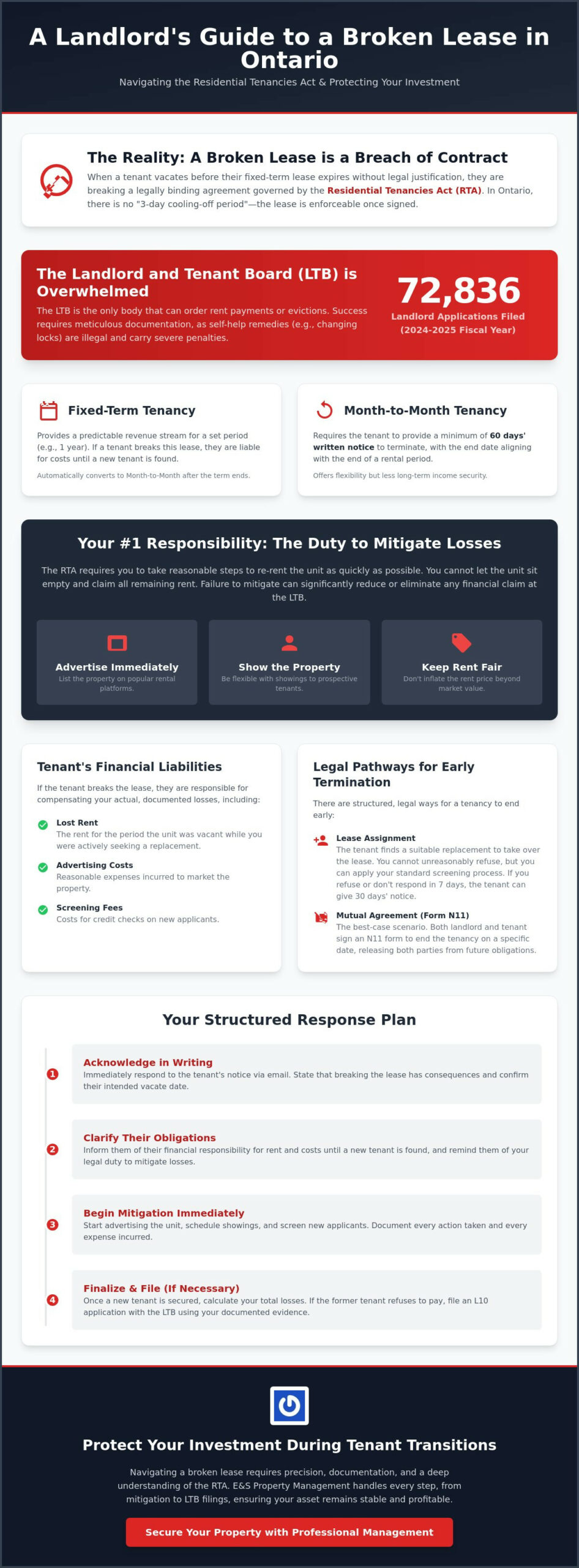
The Landlord and Tenant Board acts as the provincial adjudicator for all lease-related disputes. In the 2024-2025 fiscal year, landlords filed 72,836 applications, highlighting the high volume of cases the board manages. It’s the only body with the authority to order rent payments or official evictions. Landlords must avoid self-help tactics, such as changing locks or seizing personal belongings, as these actions lead to severe fines and legal liability. Success at the LTB depends entirely on documented communication. Every email, text, and notice serves as vital evidence in a future hearing, reinforcing the need for meticulous record-keeping from the first day of the tenancy.
When a Tenant Can Legally Terminate a Lease Early
While the Ontario Standard Lease is a binding contract, the law recognizes specific circumstances where a tenant may exit early without financial penalty. Understanding these exceptions is vital for landlords to determine what happens if a tenant breaks their lease Ontario versus when they are exercising a statutory right. Managing what happens if a tenant breaks their lease Ontario requires a balance of legal compliance and practical negotiation to ensure the property remains profitable.
One critical exception involves safety and privacy. Tenants experiencing domestic or sexual violence can terminate their tenancy with only 28 days’ notice by providing a specific LTB form along with supporting documentation. This is a non-negotiable legal right designed to protect vulnerable individuals. Additionally, if a landlord fails to provide the Ontario Standard Lease within 21 days of a written request, the tenant may withhold one month’s rent or choose to terminate the agreement. Consulting an official Landlord and Tenant Board guide provides a clear overview of these statutory protections and the required forms for each scenario.
The Lease Assignment Process
Assignment is distinct from subletting. In a sublet, the original tenant intends to return; in an assignment, they transfer their entire interest in the lease to a new person permanently. Under the RTA, a landlord cannot unreasonably or arbitrarily refuse a request to assign. However, you retain the right to vet the new applicant. You can apply the same rigorous screening standards regarding credit history and references used for the original tenant. If you refuse a general request to assign or don’t respond within seven days, the tenant gains the legal right to end the tenancy with 30 days’ notice. This process effectively transfers the liability to a new, qualified party, protecting your rental income.
Form N11: The Clean Break Solution
Form N11 is the official Agreement to End the Tenancy used when both parties voluntarily decide to part ways. This mutual resolution is often the most efficient path for a property owner because it sets a firm, agreed-upon date for vacating. It bypasses the uncertainty of LTB hearings and allows you to begin the transition immediately. To ensure the agreement is enforceable, both parties must sign it without any form of coercion. Utilizing a professional tenant placement service can help facilitate this transition by identifying a qualified new tenant quickly, often before the current one even departs, which maintains the momentum of your investment.
Financial Consequences and the Duty to Mitigate
When a tenant vacates a property before the fixed term expires, they remain technically liable for the rent until the lease ends. However, this liability isn’t an unconditional guarantee of payment. In Ontario, landlords are bound by a legal principle known as the “duty to mitigate.” This means you must take active, reasonable steps to re-rent the unit as quickly as possible to minimize the financial impact on the departing tenant. If a landlord fails to demonstrate a genuine effort to find a replacement, the Landlord and Tenant Board (LTB) may reduce or deny the claim for lost rent. Understanding what happens if a tenant breaks their lease Ontario requires recognizing that your financial recovery is directly tied to your proactivity.
Reasonable effort is a standard that the LTB scrutinizes during hearings. It generally involves advertising the unit at the same rental rate, conducting timely showings, and processing applications without undue delay. While tenant rights in Ontario protect renters from arbitrary penalties, landlords are entitled to recover actual damages. You cannot simply charge a flat “lease-breaking fee” or a penalty. Every dollar claimed must represent a documented financial loss resulting from the tenant’s early departure.
Calculating Recoverable Losses
Determining exactly what happens if a tenant breaks their lease Ontario involves calculating the specific costs associated with the transition. Landlords can typically seek compensation for the following:
- Lost Rent: The rent due from the date the tenant stopped paying until a new, qualified tenant begins their lease.
- Advertising Expenses: The actual costs incurred to market the property on listing platforms.
- Cleaning and Repairs: Costs required to return the unit to a rentable state, provided these go beyond normal wear and tear.
It’s vital to maintain a thorough file of all receipts and correspondence. You cannot use a broken lease as an opportunity to “upgrade” your tenant profile at the previous tenant’s expense; for instance, seeking a significantly higher rent that results in a longer vacancy may be viewed as a failure to mitigate.
The Ottawa Rental Market Context
In a high-demand market like Ottawa, the LTB’s expectations for mitigation are often higher. If vacancy rates are low, the board expects a unit to be filled relatively quickly. Taking several months to find a replacement in a competitive environment may signal a lack of reasonable effort to the adjudicator. Utilizing professional Ottawa tenant placement services serves as strong evidence of your mitigation efforts. This methodical approach ensures you find a qualified replacement with minimal downtime, effectively protecting the longevity of your investment and ensuring your actions stand up to legal scrutiny.
Step-by-Step Response Plan for Landlords
A disciplined response to an early vacancy prevents a minor inconvenience from becoming a major financial loss. When you receive notice that a tenant intends to vacate before their term expires, your first action must be a formal written acknowledgment. This document should clearly state the date the notice was received and confirm the tenant’s ongoing legal obligations regarding rent payments and the property’s physical condition. Understanding what happens if a tenant breaks their lease Ontario allows you to maintain order during a potentially chaotic transition while protecting your rights from the outset.
Once the notice is acknowledged, you must immediately initiate the re-rental process to satisfy your duty to mitigate, as discussed in previous sections. This involves more than just posting a single advertisement; it requires a proactive marketing strategy. You should also schedule a move-out inspection to assess any damages that go beyond normal wear and tear. Having a clear record of the property’s state ensures you can accurately claim for any necessary repairs or cleaning costs. Professional Full-Service Property Management can handle these transitions seamlessly, ensuring every step is documented and legally sound.
Documenting Your Mitigation Efforts
Success at a future LTB hearing depends entirely on the quality of your records. You should create a comprehensive log that tracks every inquiry, showing, and application received for the unit. Save copies of all advertisements posted on listing platforms to prove the unit was marketed at a fair and consistent rate. Documentation is the primary evidence required at the LTB to prove you met your legal obligations. Without this paper trail, proving what happens if a tenant breaks their lease Ontario and the extent of your subsequent losses becomes significantly more difficult.
Communicating with the Departing Tenant
Maintaining an approachable yet authoritative tone with the departing tenant can facilitate a smoother transition. Reassure them that you are actively working to find a qualified replacement, which is in their best interest as it reduces their total financial liability. Clear communication is also essential for scheduling showings while the tenant still occupies the unit; providing proper notice for entries keeps the relationship professional. If a qualified replacement is secured before the original tenant vacates, you can then finalize the transition using Form N11. This proactive approach ensures asset longevity and provides a predictable resolution for all parties involved.
How Professional Management Protects Your Investment
Managing a broken lease involves more than just understanding the law; it requires a high degree of administrative precision and strategic foresight. For many property owners, the administrative burden of filing LTB applications and coordinating rapid re-rentals is overwhelming. E&S Property Management acts as the steady hand during these complex transitions, providing the professional oversight necessary to maintain asset stability. Knowing what happens if a tenant breaks their lease Ontario is only the first step. Implementing a professional resolution ensures that your financial interests remain protected while you avoid the common pitfalls of self-management.
Our team specializes in navigating the complexities of the Residential Tenancies Act, ensuring that every action taken to mitigate losses is fully documented and legally compliant. By offloading the operational burdens of tenant communication and LTB filings, you gain the security of knowing your property is in the hands of seasoned experts. This proactive management style transforms a potential crisis into a controlled business transition, allowing you to focus on your long-term investment goals without the stress of daily conflict resolution.
The E&S Solution for Ottawa Landlords
With over 40 years of specialized experience in the Ottawa residential market, we understand the unique regional dynamics that influence vacancy rates and tenant behavior. When a lease is broken, time is the most critical factor. Our maintenance coordination team works to ensure the unit is rent-ready instantly, addressing any cleaning or repair needs immediately after the move-out inspection. This speed is essential for satisfying your legal duty to mitigate. We provide tailored support for various owner profiles, including Full-Service Property Management for Foreign Service members who require absolute reliability while they are stationed abroad. Our deep roots in the community allow us to leverage local networks to find replacement tenants faster than most individual owners can on their own.
Mitigating Risk Before the Lease Starts
The most effective way to manage a broken lease is to prevent it from happening through a rigorous Tenant Placement Service. Our professional screening process goes far beyond a simple background check. We conduct thorough credit inquiries, verify employment history, and speak directly with past landlords to build a complete profile of every applicant. A well-vetted tenant is significantly less likely to break a lease unexpectedly or cause property damage. By identifying high-quality candidates from the start, we enhance the longevity of your assets and reduce the likelihood of future LTB disputes. This disciplined approach to selection is the foundation of a stable and profitable rental portfolio. Protect your investment with E&S Property Management and secure the professional stewardship your property deserves.
Securing Your Rental Income Through Strategic Oversight
A broken lease doesn’t have to result in a financial crisis. By understanding exactly what happens if a tenant breaks their lease Ontario, you can move forward with a structured response that satisfies your legal duty to mitigate while protecting your asset’s longevity. Success in these transitions depends on your ability to document every action and identify a qualified replacement tenant without delay. Professional management transforms this operational burden into a predictable business process, ensuring your property remains a stable source of income.
Navigating the complexities of the Landlord and Tenant Board requires a disciplined and authoritative approach. With over 40 years of Ottawa property expertise, E&S Property Management provides the steady hand needed to oversee these transitions. We offer specialized support for DND and Global Affairs clients, providing a sense of security for owners who require reliable oversight from afar. Our 24/7 emergency maintenance response ensures your unit is always in peak condition and ready for immediate re-rental.
Let E&S Property Management handle your tenant transitions and benefit from our commitment to administrative efficiency and ethical stewardship. We’re ready to help you maintain the momentum of your investment with confidence and clarity.
Frequently Asked Questions
Can I keep the last month’s rent deposit if a tenant breaks the lease?
No, you cannot keep the last month’s rent deposit as a penalty for breaking a lease. Under the Residential Tenancies Act, this deposit can only be applied to the rent for the final month of the tenancy. If a tenant vacates early, the deposit must be used for the actual last month they are in possession of the unit. Any attempt to use it as a damage deposit or a penalty for early termination is legally unenforceable and can result in LTB orders to return the funds.
How much notice does a tenant have to give to break a lease in Ontario?
For a standard month-to-month tenancy, a tenant must provide at least 60 days’ written notice to end the agreement. However, if a tenant is in a fixed-term lease, they are technically committed until the end of that term. While there is no legal “notice period” that allows for a mid-term break, providing 60 days’ notice is a common professional courtesy that assists the landlord in fulfilling their duty to mitigate losses. Without a mutual agreement, the tenant remains liable for rent until a replacement is found.
What happens if a tenant moves out and stops paying rent without notice?
If a tenant vacates and stops paying rent without notice, you must immediately take steps to re-rent the unit to satisfy your legal duty to mitigate. Document the abandonment clearly and file an application with the Landlord and Tenant Board to recover lost rent and any damages. This is a critical part of understanding what happens if a tenant breaks their lease Ontario, as your right to compensation depends on your speed and documented effort in seeking a replacement tenant.
Can I sue my tenant for breaking their lease in Ontario?
Yes, you can seek compensation for financial losses through the Landlord and Tenant Board or Small Claims Court. If the tenant has already moved out, you can file an L10 application with the LTB for up to $35,000 in arrears and damages. For amounts exceeding this limit, the matter must be moved to the Superior Court of Justice. Professional documentation of all advertising costs, cleaning receipts, and lost rent is essential for a successful claim at any hearing.
Is a tenant responsible for finding a replacement if they leave early?
A tenant is not legally required to find their own replacement, but they have the right to request an assignment of the lease to a new party. If they suggest a qualified assignee, the landlord cannot unreasonably refuse the request. In many cases, it is in the tenant’s best interest to assist in finding a replacement to end their financial liability sooner. However, the ultimate legal responsibility to market the unit and mitigate losses rests with the property owner.
Can I charge a lease-breaking fee in my rental agreement?
No, you cannot charge a flat lease-breaking fee in Ontario, even if the tenant signs a contract agreeing to it. Such clauses are void and unenforceable under provincial law. Landlords are only entitled to recover actual out-of-pocket expenses that resulted from the breach. These include advertising costs, cleaning fees, and lost rent during the vacancy period. Charging arbitrary penalties can lead to significant fines from the Landlord and Tenant Board during an adjudicative review.
What if the tenant is breaking the lease due to maintenance issues?
If a tenant leaves due to maintenance issues, they must still follow the legal termination process or prove the unit was uninhabitable at the LTB. Tenants are generally encouraged to file a T6 application regarding maintenance rather than breaking the lease unilaterally. If a landlord has failed to maintain the property, the board may allow the tenant to end the lease early without penalty. However, this decision is made by an adjudicator based on evidence, not by the tenant alone.
How long does it take to get an LTB hearing for lost rent?
Wait times for LTB hearings remain longer than historical averages, though the board has been working to reduce a significant backlog. By September 23, 2025, the active caseload was reduced to 36,689 applications, down from a peak of over 53,000. While the board resolved over 108,000 applications in the 2024-2025 fiscal year, landlords should still prepare for a process that takes several months. Utilizing digital filing through the Tribunals Ontario Portal is now the standard for ensuring the most efficient resolution possible.


