
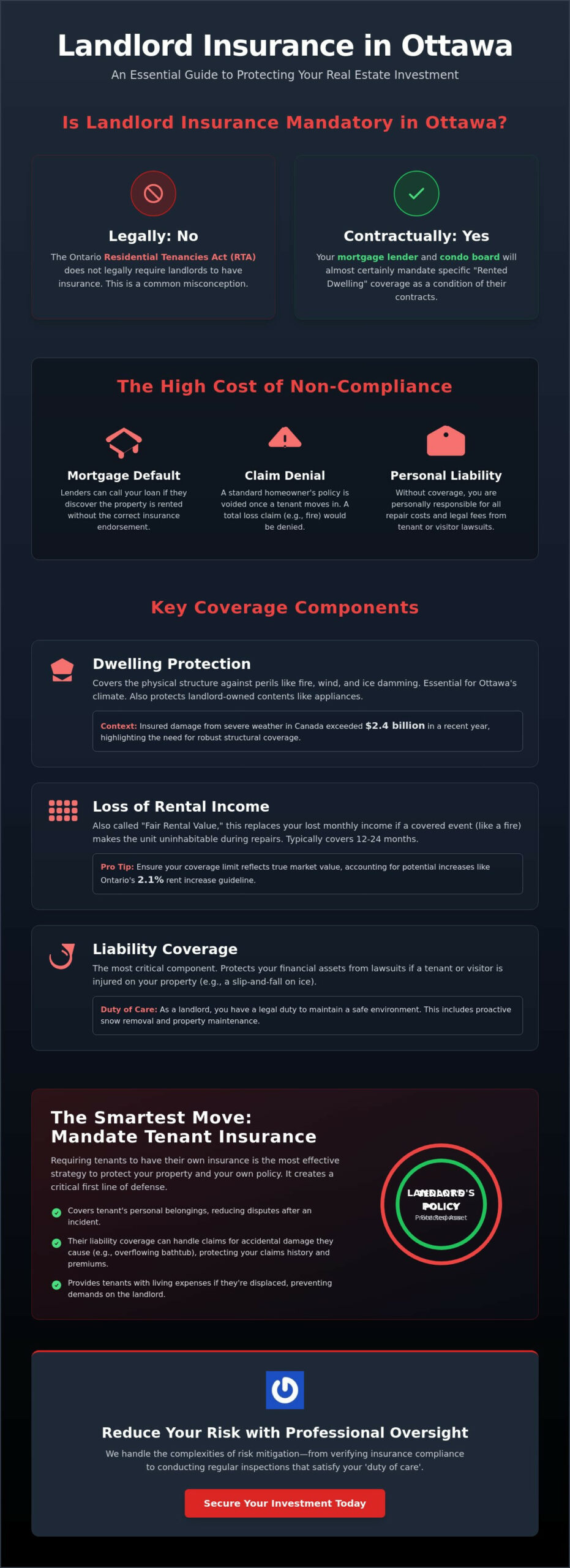
While many property owners assume the province mandates coverage, landlord insurance isn’t actually a legal requirement in Ontario. However, operating without it is a gamble that most mortgage lenders and condo boards simply won’t allow. Understanding the specific landlord insurance requirements Ottawa investors must navigate is the first step in securing your financial future. You likely already know that a standard homeowners policy fails to protect you once a tenant moves in. It’s stressful to watch premiums climb 15% to 25% higher than owner-occupied rates, especially when you’re also managing the 2026 rent increase guideline of 2.1%.
This guide provides the clarity you need to protect your assets and stay compliant. We’ll outline the essential legal and contractual insurance requirements for Ottawa landlords to ensure your investment remains secure. You’ll learn the difference between mandatory and recommended coverage, how to satisfy mortgage demands, and how professional oversight can lower your risk profile. Our methodical approach removes the guesswork from property protection, allowing you to focus on long-term growth while we handle the complexities of risk mitigation.
Key Takeaways
- Understand that while the Residential Tenancies Act does not legally mandate coverage, your mortgage lender and condo board likely have strict landlord insurance requirements Ottawa owners must fulfill.
- Identify the critical distinctions between dwelling protection for structural damage and Commercial General Liability to protect your financial assets against personal injury lawsuits.
- Learn how to navigate vacancy and unoccupied clauses to ensure your policy remains valid during tenant turnovers or while you are living abroad as an expat.
- Discover why making tenant insurance a mandatory requirement in your lease agreement is the most effective strategy for protecting your property and your claims history.
- Explore how professional oversight through regular property inspections and maintenance response satisfies your insurance “duty of care” and reduces overall liability.
Is Landlord Insurance Mandatory in Ottawa?
A common misconception among local investors is that provincial law dictates your coverage needs. In reality, the Ontario Residential Tenancies Act (RTA) does not legally require you to carry any specific policy. This legal silence often leads to confusion, but it doesn’t mean you’re free of obligation. While the government doesn’t mandate it, your financial and community partners certainly do. Meeting the landlord insurance requirements Ottawa lenders and condo boards set is a non-negotiable part of professional asset management. Without these protections, you leave your capital exposed to variables that can’t be managed through simple maintenance alone.
Legal vs. Contractual Requirements
The distinction between what is legal and what is contractual is where many owners get caught. If you have a mortgage on your rental property, your lender will almost certainly require a “Rented Dwelling” endorsement before they release funds. They view an uninsured rental as a high-risk asset and won’t fund the property without proof of specialized coverage. Similarly, Ottawa condo boards have their own set of bylaws that you must follow to remain in good standing. You must understand the “Standard Unit” definition within your condo corporation to know exactly what the building policy covers and what remains your responsibility. Relying on a standard homeowners policy is a dangerous trap. These policies are designed for owner-occupied residences; they typically become void the moment a tenant moves in. Proper rent insurance ensures that your protection remains active even when you aren’t the primary occupant.
The Consequences of Non-Compliance
Failing to maintain the correct coverage level isn’t just a minor administrative oversight. It can lead to a mortgage default if your lender discovers the property is being used as a rental without the proper endorsement. In the event of a fire or major flood, an insurer can deny a total loss claim if they weren’t informed of the tenant’s presence. This leaves you personally liable for the mortgage and the cost of repairs. Landlord insurance is a specialized policy for non-owner-occupied residential rentals. Without it, you face the full financial weight of personal injury claims or property damage. We focus on risk resolution by ensuring every asset in our care meets these rigorous standards before a crisis occurs. Professional oversight means we verify that your policy aligns with your current occupancy status, removing the operational burden of insurance tracking from your shoulders. This methodical approach ensures your investment remains a stable asset rather than a liability risk.
Essential Coverage Components for Ottawa Rental Properties
Building on the contractual obligations mentioned earlier, specific policy components must address the physical and financial risks inherent to the Ottawa market. Dwelling protection forms the foundation of any policy; it covers the structure against perils such as fire and wind damage. In 2025, insured damage from severe weather in Canada exceeded $2.4 billion, marking a significant year for climate-related losses. For Ottawa landlords, this coverage must account for local winter risks like ice damming and heavy snow loads. Even if a unit is unfurnished, contents coverage is necessary to protect expensive assets like appliances and window treatments that remain your property.
Protecting Your Rental Income
If a pipe bursts or fire damage occurs, the property may become uninhabitable for months. Loss of Rental Income, often called Fair Rental Value, ensures your cash flow continues during the restoration period. Unlike a standard “Loss of Use” claim for a homeowner, this coverage replaces the actual rent you lose while the unit sits empty. When determining your coverage limits, insurers look at current market rates. With the 2026 rent increase guideline set at 2.1%, it’s vital to ensure your policy reflects the true revenue potential of your asset. Most policies provide this protection for 12 to 24 months, providing a stable financial bridge while your property is repaired.
Liability and the “Duty of Care”
Liability is perhaps the most critical element of landlord insurance requirements Ottawa investors must prioritize. As a landlord, you hold a “duty of care” to maintain a safe environment for everyone on the premises. In Ottawa’s climate, this primarily involves snow removal and slip-and-fall prevention. A single lawsuit from a tenant or guest can result in devastating financial loss. Consequently, $2 million in Commercial General Liability (CGL) has become the industry standard for Ontario landlords. This protects you against legal fees and settlement costs if you’re found responsible for an injury on your property.
Beyond personal injury, CGL often includes protection against tenant-caused damage or vandalism. Navigating the complexities of Property and Other Insurance regulations requires a proactive approach to risk management. Implementing regular property inspections is a practical way to document your compliance with safety standards and reduce the likelihood of a liability claim. By maintaining high oversight standards, you provide insurers with evidence that you’re a responsible steward of the property. This methodical approach helps stabilize your risk profile in a market where premiums are rising.
Special Considerations for Ottawa Expats and Foreign Service Members
Ottawa’s unique workforce, including Global Affairs Canada employees and military personnel, often faces the challenge of managing a property from a distance. When you’re posted abroad, your primary residence undergoes a legal and risk-based transformation. You must notify your insurer immediately to transition from a standard homeowner policy to a rented dwelling policy. Failing to disclose your non-resident status can lead to a total denial of coverage. Many Canadian insurers view non-resident landlords as higher risks and may even restrict coverage if the owner lives outside the country. Meeting the landlord insurance requirements Ottawa providers mandate often hinges on having professional local oversight to act as a steward for the asset.
Navigating Postings Abroad
Before you depart for an international assignment, you must address the “Vacancy” and “Unoccupied” clauses in your policy. Most standard insurance contracts contain a 30-day limit. If your property sits empty between tenants for longer than this period without a specific vacancy permit, your coverage could lapse. Insurers typically require proof of regular property inspections to maintain policy validity while you are out of the country. This oversight ensures that issues like frozen pipes or unauthorized entry are identified before they escalate into catastrophic losses. For those managing the financial complexities of being abroad, utilizing Non-Resident Landlord Tax Services Canada ensures your NR6 and NR4 filings remain compliant alongside your insurance obligations.
Insurance for Short-Term vs. Long-Term Rentals
The duration of your lease agreements significantly impacts your insurance eligibility in the capital. Ottawa’s short-term rental bylaws generally restrict these types of rentals to primary residences. If you’re posted abroad, your property may no longer qualify as a primary residence, making short-term rental insurance difficult or impossible to obtain. “Ghosting” your insurer about the length of your leases is a high-stakes gamble that often results in voided claims. It’s much safer to secure a long-term tenant and include specific tenant insurance requirements in Ontario within your lease agreement. This provides a secondary layer of protection that shields your own policy from minor claims. Insurers require a designated local point of contact to facilitate immediate access for insurance adjusters and emergency responders should a claim occur. Having a professional management partner ensures that someone is always available to navigate these strategic requirements on your behalf.
Lowering Risk: The Role of Tenant Insurance
While meeting your own landlord insurance requirements Ottawa lenders mandate is essential, requiring tenant insurance is the most effective way to protect your investment from the inside out. Tenant insurance serves as a secondary shield for your property, addressing risks that your primary policy might not cover or would only cover at the cost of a higher premium. It isn’t just about protecting the renter’s personal belongings; it’s a strategic tool for shifting liability and preserving your claims history. When a tenant is properly insured, the financial burden of their negligence falls on their insurer rather than your capital reserves. This proactive approach ensures that minor incidents don’t escalate into major financial setbacks for the owner.
The Lease Agreement Clause
To ensure this protection is in place, you should include a mandatory insurance clause in every rental contract. We recommend requiring a minimum of $1 million in personal liability coverage from every tenant. This requirement should be non-negotiable and established as a condition of key delivery. By integrating these terms into the Understanding the Ontario Standard Lease in Ottawa framework, you create a clear legal expectation from day one. Professional management involves verifying these policies at the start of the tenancy and during annual renewals to ensure coverage hasn’t lapsed. This methodical verification process removes the operational burden of tracking compliance and provides a stable foundation for your risk management strategy.
Subrogation and Liability Shift
One of the most significant benefits of tenant insurance is the principle of subrogation. If a tenant accidentally starts a kitchen fire, their insurance provider is responsible for the damages. This prevents you from having to file a claim on your own policy, which keeps your premiums from skyrocketing. Furthermore, tenant insurance covers the renter’s relocation costs if the property becomes uninhabitable. Without this coverage, tenants often look to the landlord to provide alternative accommodations during repairs. Knowing the tenant can afford their own deductible and temporary housing costs provides immense peace of mind. It clarifies the boundaries of responsibility, ensuring that your landlord policy remains reserved for structural issues and major perils beyond anyone’s control.
Implementing these requirements is a standard part of our tenant placement service, where we ensure every renter meets the necessary insurance thresholds before moving in. By establishing these professional standards early, you foster a culture of accountability that protects the longevity of your asset. This disciplined approach to leasing is what separates successful institutional investors from those who struggle with unexpected liability costs.
How E&S Property Management Ensures Insurance Compliance
Securing a policy is only the first step in protecting your capital. Maintaining that coverage requires active stewardship and a disciplined approach to risk resolution. Insurance providers expect landlords to uphold a rigorous duty of care, which involves more than just paying premiums. It requires a documented history of oversight that proves you are proactively mitigating hazards. By aligning your operational habits with the landlord insurance requirements Ottawa insurers demand, you create a more stable risk profile. This disciplined management doesn’t just satisfy your policy; it often helps stabilize your premiums in a volatile Ontario market. We focus on removing the operational burden of compliance so your investment remains a secure asset.
Our 24/7 emergency maintenance response is a critical component of this risk management strategy. A minor plumbing leak can quickly escalate into a six-figure water damage claim if left unaddressed for even a few hours. By coordinating immediate repairs, we prevent small incidents from becoming major insurance events that could impact your claims history. When an adjuster does need to get involved, we provide clear, professional records of property condition and repair history. This level of documentation is essential for a smooth claims process, ensuring that adjusters have the evidence they need to validate your loss and expedite your recovery.
Proactive Maintenance as Risk Mitigation
Most insurance policies specifically exclude “gradual damage,” such as slow leaks or deteriorating roofing. Our Regular Property Inspections are designed to catch these issues before they lead to a denied claim. We conduct thorough annual and semi-annual assessments to identify structural vulnerabilities and mechanical wear. To further protect your asset value, we only source licensed and insured contractors for all repair work. This ensures that any maintenance performed on your property meets professional standards and doesn’t introduce new liability risks through substandard workmanship or uninsured labor.
The E&S Advantage for Non-Resident Owners
For expats and those in the foreign service, we act as your steady hand on the ground in Ottawa. Insurers are often hesitant to cover properties where the owner is thousands of miles away without a professional point of contact. We satisfy the “occupancy” and “regular monitoring” clauses that are frequently found in high-value rental policies. Our presence ensures your insurance remains valid through documented, professional stewardship that satisfies both your lender and your insurer. This methodical approach to management provides the security you need while you are posted abroad. If you are ready to secure your investment through professional oversight, Request a Full-Service Management Consultation today to learn how we can protect your assets.
Securing Your Investment for the Long Term
Navigating the landscape of property protection requires more than just a basic policy. It demands a strategic commitment to risk mitigation. By understanding the specific landlord insurance requirements Ottawa investors face, you shift from being a passive administrator to a proactive steward of your assets. We’ve established that contractual obligations from lenders and the implementation of mandatory tenant insurance create a multi-layered defense for your capital. These steps ensure that your liability remains limited and your claims history stays clean, regardless of market fluctuations.
Founded in 1981, E&S Property Management brings over 40 years of local expertise to every property we oversee. We provide specialized support for Foreign Service members and non-resident landlords, ensuring your insurance remains valid through documented, professional stewardship. Our emergency 24/7 maintenance response acts as an immediate resolution to property damage, preventing minor leaks from escalating into significant financial losses. Protect your investment with professional Ottawa property management and gain the confidence that comes from having a seasoned hand at the helm of your rental portfolio.
Frequently Asked Questions
Is landlord insurance legally required in Ontario?
Landlord insurance is not legally mandated by the Ontario Residential Tenancies Act. However, it’s almost always a contractual requirement for mortgage lenders and condominium boards in the capital. Operating without it violates your financing terms and leaves your equity unprotected against liability claims.
How much does landlord insurance cost in Ottawa?
While rates vary, basic coverage in Canada typically ranges between $40 and $80 per month. You should anticipate paying 15% to 25% more than a standard owner-occupied policy for the same property. These premiums reflect the increased liability risks associated with non-owner-occupied rentals and the specialized coverage required for structural protection.
What is the difference between homeowners and landlord insurance?
The primary difference is the occupancy status and the specific risks being covered. Homeowners insurance is designed for properties where the owner resides; it typically becomes void once the owner moves out. A landlord policy includes Commercial General Liability and Loss of Rental Income, which are absent from standard residential coverage.
Does landlord insurance cover a tenant who stops paying rent?
Standard landlord insurance does not cover rent arrears or a tenant’s failure to pay. It only covers “Loss of Rental Income” if the property becomes uninhabitable due to a covered peril like fire or flood. For non-payment issues, you must rely on the legal remedies provided by the Landlord and Tenant Board under the current 2026 regulations.
Can I require my tenant to have insurance in the lease?
Yes, you can and should make tenant insurance a mandatory condition of your lease agreement. This is a critical part of managing landlord insurance requirements Ottawa investors use to protect their claims history. Including this clause ensures that the tenant’s liability and belongings are their own financial responsibility rather than yours.
What happens if I don’t tell my insurance company I am renting my house?
Failing to disclose that a property is being rented usually results in your policy being voided immediately. If a claim occurs, the insurer will likely deny it based on a material change in risk. This leaves you personally responsible for all repair costs and legal liabilities arising from the property.
Does landlord insurance cover appliance repairs?
Insurance does not cover standard appliance repairs or mechanical breakdowns due to wear and tear. It only provides coverage for appliances if they are damaged by a specific covered peril, such as a fire or a major storm event. Regular maintenance and replacement of appliances remain the operational responsibility of the property owner.
How does hiring a property manager affect my insurance premiums?
Hiring a professional property manager can lead to more favorable terms or lower premiums from certain insurers. Companies value the regular property inspections and 24/7 emergency response that professional managers provide. This level of oversight satisfies the “duty of care” requirements and demonstrates a proactive approach to risk resolution.


