
What if the greatest threat to your investment isn’t a burst pipe, but a missing $65 license or a 15-day LTB deadline you didn’t see coming? As we move into 2026, the landscape for landlords in the capital has shifted, bringing both new opportunities and stricter requirements. You likely feel the weight of these changes, especially when navigating Ontario’s pro-tenant legislation or the complexities of CRA tax filings for non-residents. Successfully preparing your Ottawa home for tenants requires more than just a fresh coat of paint; it demands a protective strategy that secures your physical asset and your legal standing.
We know that the transition from a cherished family home to a rental property often feels like a mountain of administrative and logistical burdens. This guide provides a comprehensive roadmap to help you navigate the mandatory 2026 Residential Rental Licensing program and the latest RTA updates with total confidence. You’ll learn how to physically fortify your property against the Ottawa climate, structure your finances to meet new tax obligations, and implement a screening process that attracts reliable, long-term tenants. We’re here to help you move from uncertainty to the peace of mind that comes with a professional, legally compliant rental setup.
Key Takeaways
- Learn how “landlord-grade” finishes and professional-level detailing create a durable foundation that withstands Ottawa’s seasonal demands.
- Stay legally protected by adopting the 2026 Ontario Standard Lease and understanding the latest updates to the Residential Tenancies Act.
- Simplify your administrative duties by setting up dedicated financial structures and modern, reliable systems for monthly rent collection.
- Attract high-quality professionals by preparing your Ottawa home for tenants with strategic marketing and high-resolution virtual tours.
- Discover how shifting your perspective from homeowner to asset manager ensures the long-term protection and growth of your investment.
Physical Preparation: Creating a Durable and Desirable Ottawa Rental
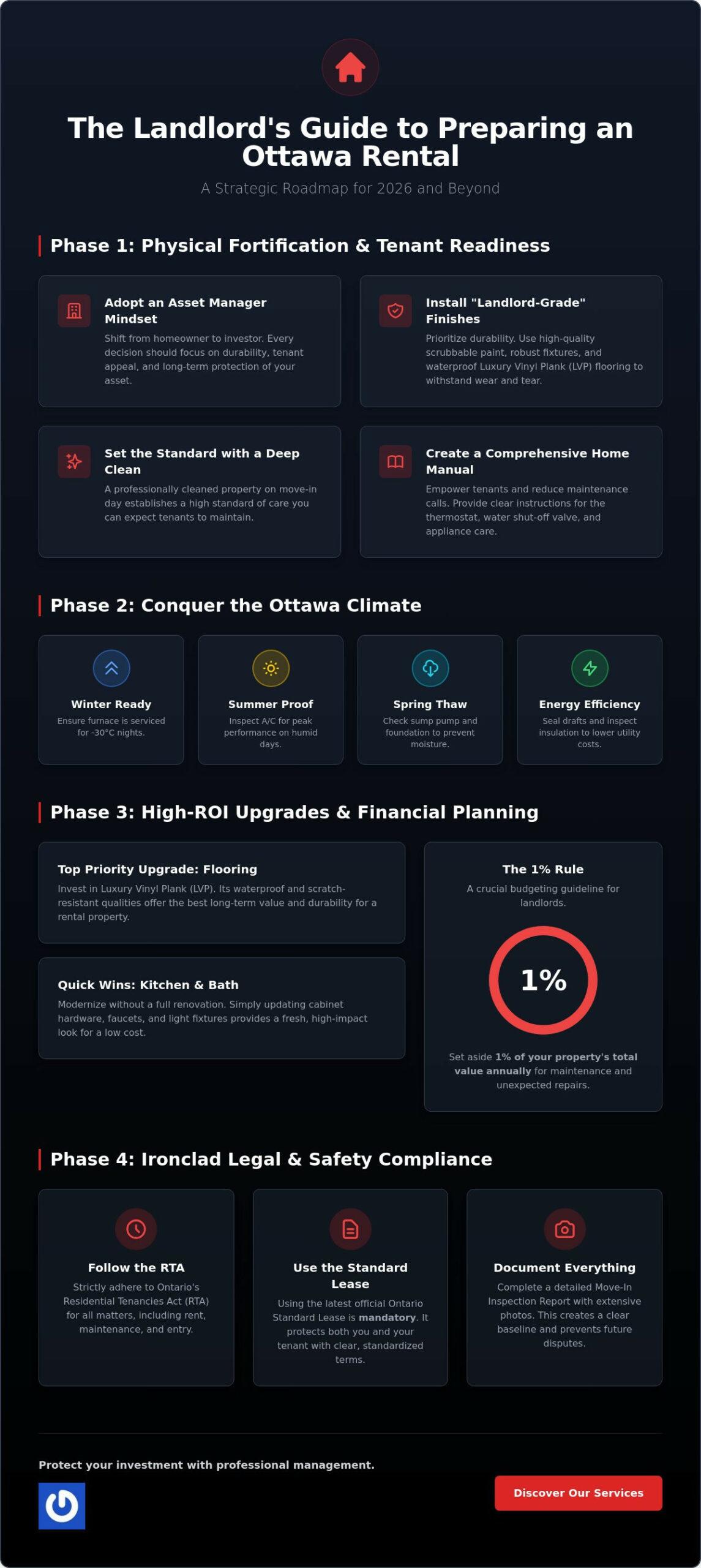
Transforming a cherished family residence into a high performing investment starts with a shift in perspective. You’re no longer just a homeowner; you’re an asset manager. When preparing your Ottawa home for tenants, your goal is to create a space that feels welcoming while remaining incredibly resilient. We often suggest focusing on “landlord grade” finishes. These materials strike a perfect balance between modern aesthetics and extreme durability, ensuring that the property looks fresh even after several years of tenancy. Choosing high quality, scrubbable paint and robust fixtures acts as a protective layer for your investment.
A professional deep clean is your non-negotiable baseline. This isn’t just about appearances; it’s about setting a standard. When a tenant moves into a spotless home, they’re much more likely to maintain that level of care throughout their stay. While you prepare the space, take time to neutralize it. Removing personal photos and unique decor helps prospective renters envision their own lives within the walls. To bridge the gap between a new environment and a comfortable home, develop a comprehensive “Home Manual.” This document should explain how to operate the thermostat, where the water shut-off valve is located, and how to care for specific appliances. Providing this clarity reduces “how-to” maintenance calls and empowers your tenants to be good stewards of the property.
Ensuring your property is in a good state of repair isn’t just a best practice; it’s a requirement under Ontario’s Residential Tenancies Act, 2006. Meeting these standards early prevents future disputes and establishes a professional relationship from the start. It’s about creating a safe, functional environment where a tenant can thrive while your asset remains protected.
Ottawa-Specific Maintenance: Winterization and Humidity Control
Our local climate is demanding. With temperature swings that can reach sixty degrees between seasons, your HVAC system must be in peak condition. We recommend a professional inspection to ensure the furnace is ready for a -30°C night and the AC can handle a humid July afternoon. In the spring, the thaw can be aggressive. Check your sump pump and foundation for any signs of moisture to prevent flooding. Finally, sealing drafts and inspecting attic insulation keeps utility costs manageable, which is a significant selling point for high quality tenants who value energy efficiency.
The High-ROI Refresh: Where to Spend Your Prep Budget
If you’re deciding where to allocate funds while preparing your Ottawa home for tenants, look at the floors. Luxury vinyl plank (LVP) has become the industry standard because it’s waterproof, scratch-resistant, and looks remarkably like hardwood. In kitchens and bathrooms, you don’t always need a full renovation; simply updating cabinet hardware and faucets can modernize the entire room for a fraction of the cost. The 1% Rule suggests that you should set aside one percent of your property’s total value every year to cover ongoing maintenance and unexpected repairs.
Legal Compliance and Safety Standards in Ontario
Navigating the legal landscape of Ontario’s rental market can feel like a daunting task. While the physical work makes the house look ready, the legal framework ensures your investment is actually protected. When you’re preparing your Ottawa home for tenants, you must adhere to the Residential Tenancies Act (RTA) from the very first day. This legislation governs everything from rent increases to maintenance obligations. Consulting a practical guide to landlord responsibilities helps clarify these duties, ensuring you don’t miss a critical step that could lead to future disputes.
One of the most important tools in your arsenal is the Ontario Standard Lease. As of 2026, using the most current, updated version of this document is mandatory for all private residential tenancies. It’s designed to be easily understood and protects both parties by clearly outlining the rules of the home. Alongside the lease, you should always complete a comprehensive Move-In Inspection Report. Documenting the exact condition of every room with photos and notes creates a baseline of accountability. This simple act of diligence often prevents disagreements about property damage when a tenant eventually moves out.
Transparency is the foundation of a good landlord-tenant relationship. You’re legally required to provide clear utility disclosures if the tenant is responsible for costs like heat, water, or hydro. If the thought of keeping up with these evolving regulations feels overwhelming, a partner for Full-Service Property Management can act as your legal shield, managing the paperwork so you can focus on your life elsewhere.
Mandatory Safety Requirements for Ottawa Landlords
Safety is a non-negotiable priority. You must meet the Ontario Fire Code standards, which require functional smoke alarms on every level of the home and carbon monoxide alarms outside all sleeping areas. If you’re renting out a basement apartment or a secondary suite, ensure it meets all egress requirements; every bedroom needs a window large enough for an adult to escape in an emergency. Finally, check that all “wet” areas like kitchens and bathrooms have functional GFCI outlets to prevent electrical accidents. These steps aren’t just about compliance. They’re about the active protection of the people living in your home.
Liability Protection: Insurance and Documentation
Your existing homeowners insurance is likely insufficient once you move out. You must switch to a dedicated Landlord Policy that covers the specific risks of a rental property, such as loss of rental income or tenant-related liabilities. We also strongly recommend requiring Tenant Liability Insurance as a condition of the lease. This ensures that if a tenant accidentally causes a fire or a flood, their insurance handles the damages rather than yours. Always maintain a digital paper trail for every safety inspection and repair. Having these records organized and accessible provides immense relief if you ever need to prove your diligence as a landlord.
Financial and Administrative Setup for the Modern Landlord
Treating your property as a business from the first day is the most effective way to ensure long-term success. When you’re preparing your Ottawa home for tenants, it’s vital to establish clear boundaries between your personal life and your investment. We always recommend opening a dedicated bank account specifically for your rental operations. This simple step provides a clean audit trail and makes it much easier to monitor your cash flow. It also simplifies the process of setting up a reliable rent collection system. While Interac e-Transfer is a common choice, many modern landlords prefer using dedicated portals that automate receipts and provide a more professional experience for the tenant.
Setting the right price requires a careful look at current 2026 market data. As of May 2026, the average rent in Ottawa has stabilized at $2,140. Specifically, 1-bedroom apartments are averaging $1,949, while 2-bedroom units are seeing rates around $2,453. Because the market has shifted toward a more balanced state with 3.0 months of inventory, pricing your home accurately is essential to avoid long vacancies. Understanding your financial rights and the rules around rent deposits is also covered in the official Ontario Residential Tenancies Act guide, which serves as a foundational resource for your administrative setup.
CRA Compliance for Non-Resident Landlords
Many Ottawa homeowners find themselves being posted abroad for military or diplomatic service, which triggers “non-resident” status for tax purposes. If this applies to you, the CRA typically requires a 25% withholding tax on the gross rent. However, you can find significant relief by filing an NR6 form. This allows you to withhold tax based on your net income after expenses instead of the gross amount. You’ll need to appoint a Canadian agent to help with these filings, issue annual NR4 slips, and ensure your Section 216 tax returns are filed correctly. Managing these technicalities is a core part of preparing your Ottawa home for tenants when you’re living in a different time zone.
Record Keeping and Expense Tracking
Meticulous record keeping is the hallmark of a seasoned landlord. You should categorize all deductible expenses, including property taxes, which increased by 3.75% in Ottawa for 2026, as well as insurance and routine maintenance costs. Digital portals are incredibly helpful here, offering real-time financial reporting that you can access from anywhere in the world. While repairs are immediate deductions for restoring something to its original state, capital improvements provide a lasting benefit and must be depreciated over time. Having these records organized transforms tax season from a period of high stress into a routine administrative task.
Strategic Marketing: Attracting the Right Tenant Profile
Once the physical and legal foundations are set, the focus shifts to the most critical variable: the people who will live in your home. Marketing isn’t just about visibility; it’s about resonance. When preparing your Ottawa home for tenants, your listing should speak directly to the city’s unique professional demographics. Whether you’re targeting Foreign Service Officers (FSOs) near Rockcliffe Park, tech professionals in Kanata, or DND members near Carling, your copy must highlight the specific lifestyle benefits they value. High-resolution photography and immersive virtual tours are no longer optional extras; they are the 2026 industry standard. These tools allow high-quality applicants to vet your property before they even step through the door, saving you time and ensuring that only the most serious candidates request a showing.
During the showing itself, shift your focus from aesthetics to functional reliability. While a beautiful kitchen is a draw, a tenant who values stability will be more impressed by the well-maintained HVAC system and the energy-efficient insulation you’ve recently checked. Set clear, legal rental criteria before the first showing to maintain a professional and transparent process. If the prospect of managing multiple showings and inquiries feels like a second full-time job, our Tenant Placement Service can handle the entire process, ensuring your property is seen by the right audience without the personal time commitment.
The Tenant Screening Process
Finding a tenant is easy; finding the right tenant requires a methodical approach. In 2026, a comprehensive credit check and employment verification are essential to confirm financial stability. When checking references, look beyond simple confirmation of dates. Ask previous landlords about communication styles and how the tenant handled minor maintenance issues. It’s also vital to remain compliant with the Ontario Human Rights Code throughout this process. Avoiding discriminatory language in your ads and using a consistent set of questions for every applicant protects you from liability while ensuring you select a tenant based on merit and reliability.
Setting a Competitive Rent in a Shifting Market
Ottawa’s real estate market has reached a balanced state, currently sitting at 3.0 months of inventory. This means tenants have more choices than they did in previous years. To remain competitive in neighbourhoods like Westboro or Orléans, you must analyze recent “comps” for similar properties. While it’s tempting to push for the maximum possible rent, remember that a single month of vacancy often costs more than a small monthly price adjustment. Using professional Tenant Placement Services allows you to tap into real-time data and a pool of vetted applicants, helping you find a reliable match quickly and efficiently.
The Professional Advantage: Why Management Matters
Transitioning from being a resident to an asset manager requires a fundamental psychological shift. You’re no longer viewing the property through the lens of personal comfort; you’re looking at its durability, compliance, and long-term yield. Professional oversight acts as a stabilizing force that preserves the value of your investment through every season. By delegating the daily burdens to a seasoned hand, you gain the freedom to focus on your next chapter without the constant weight of property-related stress. One of the greatest benefits of this partnership is our deep local network. We provide access to vetted contractors who understand the nuances of Ottawa homes, ensuring repairs are handled with meticulous care. When preparing your Ottawa home for tenants, E&S Property Management offers the disciplined, thorough approach needed to turn a complex set of tasks into a clear, orderly path forward.
The transition from stress to relief happens when you realize you don’t have to be the one answering the midnight call about a furnace or a leaking pipe. We act as a protective guardian for your asset, ensuring that the physical, legal, and financial structures we’ve discussed remain intact. This professional distance also helps maintain a healthy, transactional relationship with your tenants, which is essential for long-term stability. Choosing professional management isn’t just about outsourcing tasks; it’s about investing in the expertise of a partner who has navigated every possible challenge and uses that wisdom to shield you from similar pitfalls.
Serving Ottawa’s Foreign Service and Expat Community
For members of the military, the diplomatic corps, or the expat community, the distance between you and your property can be a significant source of anxiety. We have over 40 years of experience acting as a steady hand for those posted abroad. Our team understands the specific burdens of international relocation, from the initial move-out to the ongoing complexities of non-resident tax compliance. We handle the seamless administration of NR6 and NR4 filings, ensuring you remain in good standing with the CRA while you are thousands of miles away. This specialized support provides the peace of mind you need to focus on your mission, knowing your home is in capable, empathetic hands.
Conclusion: Your Next Steps to Rental Success
Success in the Ottawa rental market is built on a trifecta of physical durability, legal insulation, and financial structural integrity. By addressing these three pillars early, you create an environment where high-quality tenants thrive and your investment remains protected. We recommend starting the process of preparing your Ottawa home for tenants at least 6 to 8 weeks before you plan to list. This timeline allows for the deep cleaning, maintenance refreshes, and strategic marketing required to attract the right profile. If you’re ready to move from uncertainty to clarity, we invite you to take the next step toward a stress-free rental experience. Contact E&S Property Management for a Professional Rental Assessment and let us help you secure the future of your Ottawa home.
Securing the Future of Your Ottawa Investment
Mastering the balance of physical durability, legal compliance, and financial organization ensures your property thrives in the 2026 market. You now have the roadmap to navigate the latest RTA updates and the city’s shifting rental landscape with total confidence. While the list of responsibilities is extensive, you don’t have to carry the burden alone. Successfully preparing your Ottawa home for tenants is a process that benefits from a steady, experienced hand to ensure every detail is handled with meticulous precision.
Since 1981, E&S Property Management has provided over 40 years of local expertise to homeowners across the capital. We specialize in the administrative duties that provide true relief, including specialized NR6 and NR4 tax administration for non-residents and access to a reliable network of licensed Ottawa contractors. Our team acts as a protective guardian for your asset, allowing you to step away from the daily stress of management. When you’re ready to transition your home into a high-performing investment, Get a Professional Rental Assessment from E&S Property Management. Your property is a significant part of your financial legacy; let’s work together to protect it.
Frequently Asked Questions
Do I have to use the Ontario Standard Lease for my Ottawa rental?
Yes, the Ontario Standard Lease is mandatory for almost all private residential tenancies in the province. Using the 2026 updated version is essential to ensure your agreement complies with current laws and remains enforceable. This standardized document helps prevent misunderstandings by clearly outlining the rights and responsibilities of both parties from the start of the tenancy.
How much should I budget for preparing my home for tenants?
A reliable guideline is the “1% Rule,” which suggests allocating one percent of your property’s total value every year for maintenance and preparation. This budget should cover essential “landlord-grade” updates like durable flooring or professional detailing. Investing in these high-ROI areas while preparing your Ottawa home for tenants helps attract a higher caliber of applicant and preserves the long-term value of your asset.
What is the most important safety feature I need to install?
Functional smoke and carbon monoxide alarms on every level of the home are the most critical safety features required by the Ontario Fire Code. If you have a basement apartment, ensuring proper egress windows are installed is also a non-negotiable safety requirement. These installations act as a protective shield for your residents and are the first things checked during regular property inspections.
Can I refuse a tenant who has a pet in Ontario?
No, you cannot legally include a “no pets” clause in an Ontario lease, as such provisions are generally void under the Residential Tenancies Act. While you can choose an applicant based on other legal criteria during the screening process, once a tenant moves in, they have the right to keep a pet. The only exceptions involve municipal bylaws or situations where the pet causes significant damage or allergic reactions for other residents.
What happens to my taxes if I move out of Canada but keep my Ottawa home?
If you move abroad, you become a non-resident for tax purposes, and the CRA typically requires a 25% withholding tax on your gross rental income. This transition is a significant part of preparing your Ottawa home for tenants for those in the Foreign Service or expat community. To manage this efficiently, you’ll need to appoint a Canadian agent and file specific documentation to ensure you’re only paying tax on your net rental income.
Is professional property management worth the cost for a single home?
Yes, professional management provides a stabilizing force that often pays for itself through reduced vacancy rates and lower maintenance costs. For a single home, the value lies in the transition from being a stressed homeowner to a confident asset manager. Having a seasoned hand to manage legal compliance, tenant placement, and emergency repairs provides immense relief, especially if you live elsewhere in the city or abroad.
How long does it typically take to find a tenant in Ottawa in 2026?
In the current balanced market, which features 3.0 months of inventory, it typically takes between four and six weeks to find a high-quality, vetted tenant. This timeframe allows for strategic marketing, immersive virtual tours, and a methodical screening process. Rushing this timeline can lead to selecting the wrong tenant, so we recommend starting your preparation at least two months before your desired move-in date.
What is an NR6 form and do I need one?
The NR6 form is a CRA document that allows non-resident landlords to pay withholding tax on their net rental income rather than the 25% gross amount. You need this form if you want to improve your monthly cash flow while living outside of Canada. It must be filed at the beginning of each tax year and requires a Canadian agent to guarantee the tax payments on your behalf.


