Paying 25% of your gross rental income to the CRA isn’t a mandatory cost of doing business; it’s often the result of an outdated tax strategy. Managing a non-resident landlord tax Canada profile requires more than just passive compliance; it demands a proactive approach to asset protection. You’ve likely felt the pressure of high carrying costs for your Ottawa property, especially as the national vacancy rate climbed to 5.1% in early 2026. It’s frustrating to watch a quarter of your revenue disappear before you’ve even accounted for maintenance or mortgage interest.
We understand that navigating gross versus net income reporting feels like a legal minefield. This 2026 guide provides the administrative resolution you need to master CRA requirements and maximize your rental ROI through strategic, 100% deductible oversight. You’ll learn how to utilize the NR6 undertaking to lower monthly withholdings, navigate the compliance shifts introduced by Bill C-15, and leverage localized expertise to ensure your Canadian investment remains a stable, profitable component of your portfolio.
Key Takeaways
- Distinguish between gross and net income reporting to effectively manage your non-resident landlord tax Canada obligations and preserve your rental ROI.
- Categorize your property expenditures accurately by understanding the CRA’s critical distinction between recurring current expenses and long-term capital improvements.
- Identify primary operating deductions, such as mortgage interest and Ottawa municipal taxes, to significantly reduce your taxable rental income.
- Ensure full compliance with 2026 CRA regulations by mastering the strict documentation requirements for specialized travel and home office claims.
- Streamline your administrative burden through professional financial reporting and NR6 tax filing support to secure a predictable tax position.
Understanding Rental Property Tax Deductions in Canada: The Basics
Effective management of your Canadian assets starts with a clear understanding of what the CRA considers a deductible expense. According to Form T776, a deductible expense is any reasonable cost you incur to earn rental income. For the 2026 tax year, the CRA remains vigilant regarding the “reasonable expectation of profit” requirement. If your expenses consistently exceed your revenue without a clear path to profitability, the CRA may deny your rental losses. This is particularly relevant in the current 2026 environment, where average asking rents have decreased by 4.7% year-over-year. Proving your intent to generate profit is essential for maintaining your non-resident landlord tax Canada strategy.
You must also be precise when splitting expenses for multi-unit dwellings or part-year rentals. If you lived in your Ottawa home for four months before moving abroad, you can only deduct expenses for the eight months it was available for rent. Similarly, if you own a duplex and occupy one unit, only the portion of utilities and taxes attributed to the rental unit is deductible. Precision in these calculations prevents red flags during the assessment of your Taxation in Canada obligations.
Who Can Claim Rental Deductions?
Individual expats and corporate non-resident owners both qualify for deductions, though the administrative frameworks differ. In the Ottawa market, co-owners or partnerships must report income and expenses based on their specific ownership percentage. A meticulous paper trail serves as your primary defense. Digital receipts, bank statements, and property management reports are essential for surviving a 2026 CRA audit. Without documentation, even legitimate expenses like emergency repairs will be disallowed.
The Role of Form T776
Form T776 serves as the blueprint for your annual filing. It breaks down major expense categories such as insurance, professional fees, and property taxes. If you transitioned to non-resident status mid-year, you’ll report income earned during your residency separately from your non-resident period. We also emphasize tracking your Adjusted Cost Base (ACB). This figure represents the total cost of your property, including acquisition fees and capital improvements. Maintaining an accurate ACB is vital for long-term capital gains planning and ensures you don’t overpay when you eventually sell the asset.
Current vs. Capital Expenses: Navigating the CRA’s Critical Distinction
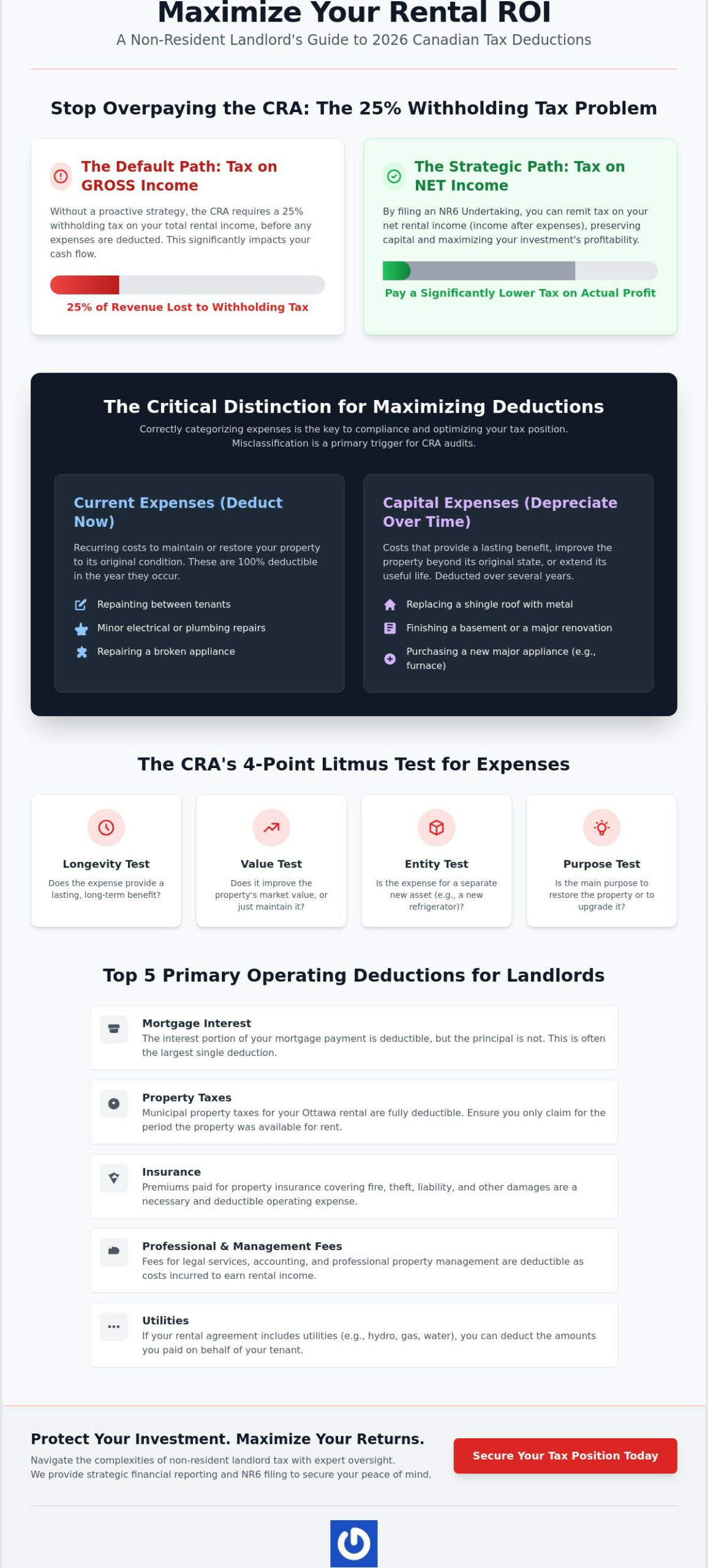
Distinguishing between current and capital expenses is a fundamental requirement for non-resident landlord tax Canada compliance. Current expenses are recurring costs that restore a property to its original condition, such as minor electrical repairs or repainting a unit after a tenant moves out. These are fully deductible in the year they occur. Conversely, capital expenses are costs that improve the property beyond its original state or significantly extend its useful life. For example, replacing a shingle roof with a metal one provides a lasting benefit that alters the asset’s value. The CRA applies the “Benefit Test” to determine if a fix is temporary or provides a structural upgrade. Misclassifying an improvement as a current repair remains the primary trigger for non-resident landlord audits, as it incorrectly front-loads tax deductions.
Properly categorizing these outlays ensures your financial records remain defensible during a review. Our team provides comprehensive financial reporting to help you track these distinctions throughout the fiscal year. By referencing the CRA Guide for Electing Under Section 216, you can see how these classifications directly impact your ability to pay tax on net income rather than gross revenue.
The 4-Point Litmus Test for Repairs
- Longevity Test: Does the expense provide a lasting benefit? For instance, in 2026, replacing a standard water heater with a high-efficiency tankless system creates a long-term capital improvement rather than a simple maintenance fix.
- Value Test: Determine if the work improves the property’s market value or simply maintains its current operating state.
- Entity Test: Assess if the expense is for a separate new asset, such as a new refrigerator, or an integral part of the existing structure.
- Acquisition Test: If you repair a defect that existed when you purchased the property to make it suitable for rent, the CRA typically views this as a capital cost.
Understanding Capital Cost Allowance (CCA)
While you cannot deduct the full price of a capital expense in one year, you can use Capital Cost Allowance (CCA) to depreciate the building over time. Land is never depreciable; you must separate the value of the structure from the land it sits on. Most residential rental buildings fall under Class 1, which allows for a 4% annual depreciation rate. Appliances and furniture are usually Class 8 assets with a 20% rate. Under the “Half-Year Rule,” you can only claim CCA on 50% of your net acquisitions in the year you buy them. Be cautious with CCA claims; if you sell the property for more than its depreciated value, you’ll face “recapture” tax, which adds that previously deducted amount back to your 2026 taxable income.
Top 5 Operating Deductions for Canadian Landlords
Optimizing your cash flow requires identifying every eligible operating expense. These recurring costs are subtracted from your gross revenue to determine your net taxable income. For those managing a non-resident landlord tax Canada profile, these deductions are the primary tools for lowering the 25% withholding obligation. Unlike capital improvements, which are depreciated over years, operating expenses provide an immediate reduction in your 2026 tax liability.
- Mortgage Interest: Interest paid on your Ottawa rental property loan is fully deductible. You cannot claim the principal portion of your monthly C$ payments. Ensure your annual statement clearly separates these figures.
- Property Taxes: Municipal and school taxes levied by the City of Ottawa are standard operating costs. These are deductible in the year they’re paid.
- Insurance Premiums: Non-resident landlord policies often carry higher premiums. These costs are necessary to protect a rental asset and are 100% deductible.
- Professional Fees: Costs for legal advice, accounting, or NR6 and NR4 tax filing support are eligible. These services ensure compliance while reducing your taxable base.
- Maintenance and Repairs: Routine upkeep, such as HVAC servicing or minor plumbing fixes, falls under current expenses. Sourcing licensed Ottawa contractors provides the documentation needed to satisfy CRA auditors.
Professional Management Fees: The ‘Net-Zero’ Strategy
Expats often view property management as an added cost. However, these fees are 100% deductible against your gross rental income. Hiring E&S Property Management effectively creates a “tax shield.” Our fees reduce your taxable burden while you live abroad, converting a portion of your revenue into professional stewardship. We position maintenance coordination as a deductible administrative oversight cost. This ensures your asset remains protected without increasing your personal tax liability. It’s a strategic way to offset the costs of expert local oversight.
Financing and Mortgage Interest Nuances
Beyond simple interest, you can deduct loan origination fees, appraisal costs, and mortgage processing fees. These are typically amortized over a five-year period. If you use a Home Equity Line of Credit (HELOC) for property repairs, that interest is also deductible. You must maintain a strict distinction between personal debt and rental property debt. Using a rental-backed loan to pay for personal expenses will disqualify the interest deduction. Clear separation is vital for a smooth 2026 tax filing.
Specialized Deductions: Travel, Home Office, and Non-Resident Requirements
Beyond standard maintenance, several specialized deductions can further protect your rental yield. Vehicle and travel expenses are often misunderstood by those managing a non-resident landlord tax Canada profile. The CRA maintains strict rules here. You can generally only deduct travel costs if you’re performing repairs or supervising major renovations yourself. Simply flying to Ottawa to “check in” on a property is rarely deductible. If you manage multiple Canadian properties, you may have more flexibility in claiming vehicle expenses, provided you maintain a detailed logbook of every kilometer driven for business purposes.
Home office expenses are another area for potential recovery. If you use a dedicated space in your international residence to manage your Ottawa assets, you can deduct a pro-rated portion of your home’s operating costs. This calculation is based on the square footage of the office relative to the total home size. Additionally, any utilities you pay on behalf of the tenant, such as heat, hydro, or water, are fully deductible. In the Ottawa climate, landscaping and snow removal are essential operational costs. Budgeting for these ensures the property remains accessible and compliant with municipal bylaws while providing a 100% tax offset.
Marketing your asset is also a recoverable cost. Advertising fees, professional photography for listings, and the full cost of tenant placement services are deductible. These expenses are vital for attracting high-quality tenants in a market where the national vacancy rate reached 5.1% in early 2026. Investing in professional representation ensures your property doesn’t sit vacant while allowing you to write off the associated costs.
The Non-Resident Landlord Tax Strategy
Success as an international investor relies on the Section 216 election. This allows you to pay tax on your net rental income rather than a flat 25% of gross revenue. To avoid the cash flow strain of monthly 25% withholdings, you and your Canadian agent must file an NR6 form. This document asks the CRA to allow withholdings based on estimated net profit. We act as the Canadian agent for many clients, providing the administrative resolution required for Non-Resident Landlord Tax Services in Ottawa Explained. We also handle the issuance of NR4 slips, which are mandatory annual statements of the rent paid and taxes withheld.
Ottawa-Specific Considerations for 2026
Foreign Service members and expats must account for Ottawa’s Vacant Unit Tax (VUT). While principal residences are often exempt, rental properties must be occupied for at least 184 days per year to avoid this levy. If you do incur the VUT, it’s generally considered a deductible property tax for federal purposes. Regional maintenance, such as annual furnace inspections and roof clearing, is non-negotiable in the capital. Our localized expertise prevents the costly tax errors often made during the transition from resident to non-resident status. To ensure your filings are accurate and your withholdings are minimized, contact our team for NR6 and NR4 tax filing support.
Strategic Asset Oversight: How E&S Property Management Maximizes Your Tax Position
Transitioning from a passive landlord to a strategic investor requires more than just filing the right forms. It involves a shift toward professional stewardship that prioritizes asset longevity and tax efficiency. While we’ve discussed the technicalities of the non-resident landlord tax Canada framework, the execution of these strategies relies on consistent, high-level oversight. Our role is to remove the operational burdens that often lead to costly compliance errors. By maintaining a disciplined approach to property care, we ensure your investment remains a stable source of net income rather than a source of administrative chaos.
Preventative maintenance is a key component of this strategic oversight. By addressing minor issues before they escalate into major structural failures, we keep your expenses in the “Current” category. As established in previous sections, these recurring costs are 100% deductible in the year they occur, providing an immediate offset to your rental revenue. We also provide a 24/7 emergency maintenance response, which serves as a shield against the “stress tax” non-resident owners often pay when managing a crisis from another time zone. Knowing a seasoned professional is on-site to handle a midnight pipe burst provides the security you need while living abroad. This proactive stance protects your capital and ensures your cash flow remains predictable.
Methodical Financial Reporting and Accounting
Our digital systems are designed to track every deductible dollar with precision. We provide monthly financial reporting that categorizes every expenditure, ensuring your accountant has a clear, audit-ready trail for your 2026 year-end filing. Organized receipts and annual summaries are not just conveniences; they are your best defense against CRA scrutiny. This transparency extends to our maintenance coordination, where we only utilize licensed professionals to protect your asset’s value and ensure all work meets municipal standards. By consolidating your tax records in real-time, we eliminate the year-end scramble that often leads to missed deductions and overpayment of taxes. Our goal is to provide a tailored resolution to the complex accounting needs of international property owners.
A Reassuring Partnership for Foreign Service Members
We specialize in supporting DND and Global Affairs clients posted abroad. Leveraging 40+ years of Ottawa residential expertise, we understand the specific needs of Foreign Service members who require a steady hand to manage their Canadian assets. Our localized knowledge ensures your rental ROI is optimized while you focus on your mission. We provide the predictability and competence essential for those navigating the complexities of international relocation and the unique tax obligations that follow. Whether you’re an institutional investor or an individual owner, our disciplined approach to property management ensures your Canadian assets are protected and your tax position is maximized.
Protect your investment and simplify your taxes with E&S Property Management.
Secure Your Canadian Investment Strategy for 2026
Managing a non-resident landlord tax Canada profile doesn’t need to be an operational burden. You now understand that distinguishing between current and capital expenses is vital for maximizing immediate deductions. Utilizing the NR6 election allows you to shift from paying tax on gross revenue to a more favorable net-income calculation. These strategies ensure your Ottawa asset remains a profitable component of your global portfolio rather than a source of administrative stress.
We provide the steady hand needed to navigate these complexities. With over 40 years of local Ottawa expertise, we offer specialized NR6 and NR4 tax filing support alongside comprehensive monthly financial reporting. This disciplined oversight removes the uncertainty from international property ownership and protects your asset’s longevity. Maximize Your Rental ROI with Professional Ottawa Property Management and enjoy the security of a well-managed investment. Your path to simplified compliance and enhanced asset performance starts with a reliable local partner. We’re ready to help you achieve the results your portfolio deserves.
Frequently Asked Questions
Can I deduct the cost of my own labour if I do repairs myself?
No, you cannot deduct the value of your own labour under CRA regulations. Only the actual cost of materials and payments made to third-party contractors are eligible for deduction. If you perform the work yourself, you’re essentially providing a service to your own investment, which doesn’t result in a deductible out-of-pocket expense.
What happens if my rental property expenses are higher than my rental income?
This situation results in a rental loss. If you’ve elected to file under Section 216, you can generally use this loss to offset other Canadian rental income. It’s important to remember that the CRA requires a reasonable expectation of profit. Consistent losses without a clear path to profitability may lead to the denial of your claims during an audit.
Are property management fees tax-deductible for non-resident landlords?
Professional property management fees are 100% deductible against your gross rental income. This is a core strategy for those managing a non-resident landlord tax Canada profile. By hiring professional oversight, you reduce your net taxable income while ensuring your Ottawa asset remains compliant and well-maintained while you live abroad.
How do I distinguish between a repair and an improvement for my 2026 tax return?
The distinction relies on the “Benefit Test” applied by the CRA. A repair is a current expense that restores the property to its original condition, like fixing a leaky faucet. An improvement is a capital expense that provides a lasting benefit or increases the property’s value, such as installing a new high-efficiency HVAC system in 2026.
Can I claim travel expenses if I only own one rental property in Ottawa?
CRA rules are very restrictive regarding travel for owners of a single rental property. Generally, you cannot deduct travel expenses to visit a single rental property for the purpose of general inspections or maintenance. Deductions are typically only considered if you own multiple properties and are travelling between them for business purposes.
Is the interest on a HELOC deductible if I used the money for a new roof?
Yes, the interest portion of a Home Equity Line of Credit is deductible if you can prove the funds were used specifically for your rental property. Since a new roof is often a capital expense, the interest remains deductible as a financing cost. You must maintain a strict paper trail to separate this business debt from personal borrowing.
What forms do I need to file if I am a Foreign Service officer renting out my Ottawa home?
Most Foreign Service officers utilize Form NR6 to lower their monthly tax withholdings based on estimated net income. You’ll also need to file a Section 216 return (Form T1159) annually. Your Canadian agent will provide an NR4 slip, which summarizes the gross income and the total non-resident landlord tax Canada remitted throughout the year.
How long should I keep receipts and records for my rental property deductions?
You’re required to maintain all supporting documentation for at least six years after the end of the tax year to which they relate. This includes digital receipts, bank statements, and monthly financial reports. Keeping organized records is your primary defense if the CRA requests a review of your 2026 deductions or prior filings.