Imagine you’re settling into a new posting in London or Canberra, only to receive an urgent notification that your Ontario rental agreement contains illegal clauses that could cost you thousands in fines. With the maximum penalty for individual landlords now reaching $100,000 as of July 2026, the stakes for your investment have never been higher. It’s completely natural to feel overwhelmed by the rigid requirements of the Residential Tenancies Act and the nuances of the mandatory Form 2229E. We understand that managing a home from across the globe feels like a constant balancing act between administrative duty and personal peace of mind.
This ontario standard lease agreement guide is designed to transform that uncertainty into confidence. You’ll learn how to navigate the 2026 rent increase guideline of 2.1 percent, identify which “Additional Terms” actually hold up in court, and ensure your lease acts as a protective shield for your property. We’ll walk through the latest legislative changes, including shortened eviction notice periods and the mandatory new forms for rent arrears. By the end of this guide, you’ll have the clarity needed to ensure your lease is legally binding and your asset is protected while you’re away.
Key Takeaways
- Confirm that the Standard Form of Lease is the mandatory legal template for your rental, ensuring your agreement starts on solid legal ground.
- Discover how to use Section 15 to draft custom, RTA-compliant “Additional Terms” that transform a standard form into a smart, protective lease.
- Use this ontario standard lease agreement guide to navigate the trap of illegal deposits and ensure your financial requirements are fully compliant.
- Gain clarity on accurately documenting rental unit descriptions and parking allocations to prevent future disputes with your tenants.
- Understand how professional oversight can simplify the complex paperwork of lease execution, especially for landlords managing assets from abroad.
Understanding the Ontario Standard Lease: Is it Mandatory for You?
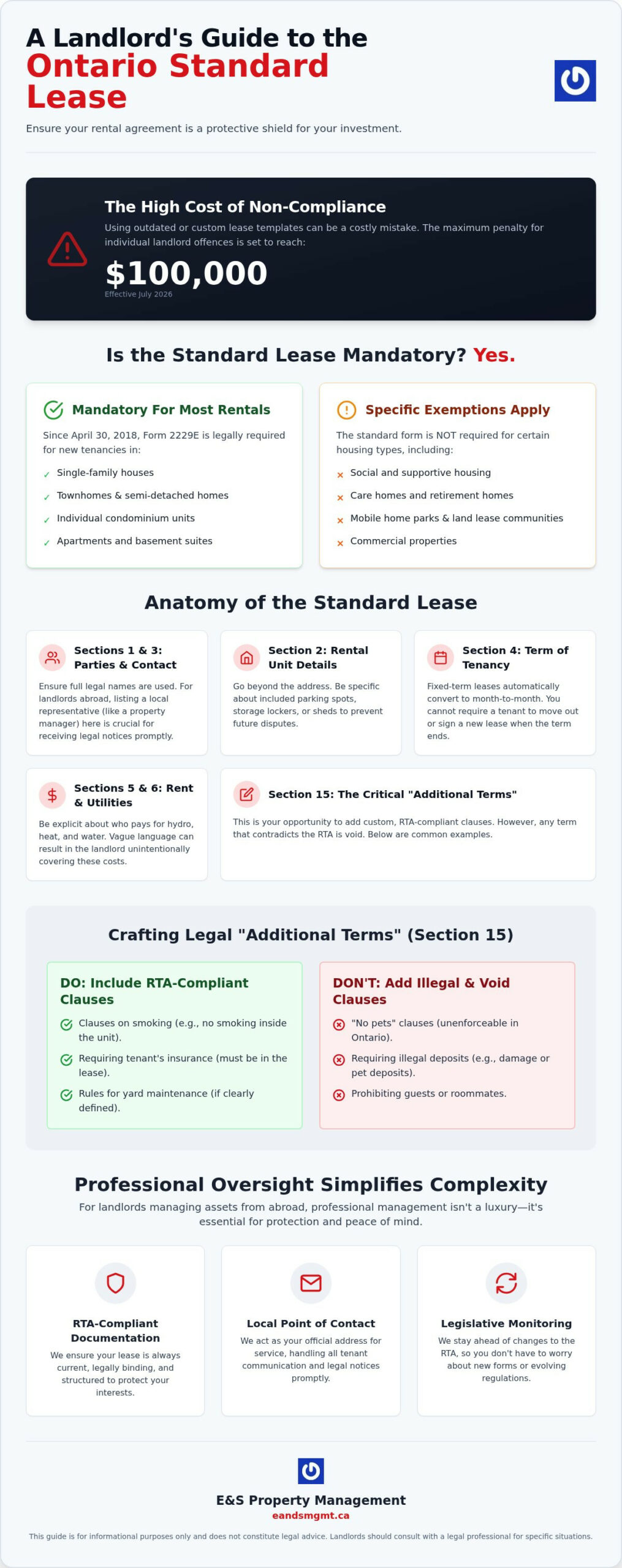
Since April 30, 2018, the Residential Tenancy Agreement (Standard Form of Lease) has been the mandatory template for most private residential tenancies in Ontario. This requirement applies to the vast majority of rental situations, including single-family houses, townhomes, and individual condominium units. If you’re a landlord in Ottawa or elsewhere in the province, this form isn’t a suggestion; it’s a legal necessity. Using this ontario standard lease agreement guide helps you recognize that even if you have a long-standing relationship with a tenant, a new written agreement must use this specific document to remain valid.
While the mandate is broad, there are a few specific exemptions. The standard lease isn’t required for care homes, social housing, mobile home parks, or land lease communities. However, for the typical residential investor, the Residential Tenancies Act, 2006 dictates that any new tenancy must be documented through Form 2229E. Failure to do so gives the tenant significant leverage, including the right to demand the form at any time and potentially withhold one month’s rent if it isn’t provided within 21 days of that request.
Why the Government Created the Standard Lease
The primary goal behind standardizing the lease was to create a level playing field across the province. In the past, custom-made agreements were often filled with illegal clauses regarding pets, guests, or maintenance responsibilities that directly contradicted provincial law. By providing a uniform template, the government simplified the process for both parties. This clarity reduces the administrative burden on the Landlord and Tenant Board (LTB) because the basic rights and responsibilities are clearly defined in plain language, leaving less room for the “paperwork headaches” that often plague self-managed properties.
The Risk of Using “Old” or Custom Templates
Holding onto a legacy lease template from the 1990s or early 2000s is a recipe for a legal nightmare in 2026. The Residential Tenancies Act has evolved, and outdated clauses aren’t just unenforceable; they’re risky. With maximum fines for individual landlord offences now at $100,000, the margin for error has disappeared. If your current paperwork doesn’t align with the ontario standard lease agreement guide, you risk losing rental income or facing LTB orders to repay illegal deposits. E&S Property Management specializes in helping landlords, particularly those posted abroad, transition their assets to current legal standards. We ensure your documentation is robust, RTA-compliant, and designed to protect your interests without the stress of constant legislative monitoring.
Essential Sections of the Ontario Standard Lease Explained
While the form looks straightforward, small errors in the initial sections can create large hurdles later. This ontario standard lease agreement guide helps you navigate the first few pages where you define the foundation of your rental relationship. Section 1 identifies the legal names of both parties, while Section 2 requires a precise description of the rental unit. In Section 2, don’t just list the address. Include specific storage lockers or shed access. It’s also vital to specify parking allocations here; ambiguity regarding which spot belongs to whom is a frequent source of friction in multi-unit properties.
Section 4 covers the “Term of Tenancy.” In Ontario, a fixed-term lease doesn’t simply end. It automatically converts to a month-to-month arrangement under the same conditions. You can’t force a tenant to sign a new lease or move out just because the initial year has ended. Sections 5 and 6 deal with rent and utilities. You must be explicit about who pays for hydro, heat, and water. Vague language here can lead to a landlord inadvertently absorbing utility costs that should’ve been the tenant’s responsibility.
Contact Information and Service of Documents
Section 3 is often overlooked but remains vital. It requires an address where the tenant can send legal notices. For our clients posted abroad, this is where a professional partner becomes indispensable. By listing E&S Property Management as your representative, you ensure all legal correspondence is handled promptly by a local expert. This removes the stress of managing time-sensitive paperwork from a different time zone. If you change management or ownership, you’re legally required to notify the tenant in writing to ensure the “address for service” remains accurate. You can learn more about how our tenant placement service manages these logistical details for you.
Rent Deposits and Key Deposits: What is Legal?
Navigating the rules for deposits requires precision to avoid LTB penalties. According to the Official Guide to Ontario’s Standard Lease, the only legal security deposit is for the last month’s rent. This deposit can’t exceed one month’s rent and must be applied only to that final period. You must also pay annual interest on this deposit at the rate of the provincial rent increase guideline, which is 2.1 percent for 2026.
- Security or damage deposits are strictly prohibited under the RTA.
- Pet deposits cannot be requested, even if you’re worried about wear and tear.
- Key deposits are legal but must be refundable and limited to the actual replacement cost of the keys.
Section 15: Why “Additional Terms” are the Most Critical Part
While the first 14 sections of the document are largely fixed, Section 15 is where your ontario standard lease agreement guide becomes truly actionable. This is the “Additional Terms” area where a standard template evolves into a sophisticated tool for asset protection. For Foreign Service members or local landlords seeking long-term security, this section allows you to address the unique characteristics of your specific Ottawa property. However, you must remember the golden rule: any term that contradicts the RTA is automatically void and unenforceable. Understanding this boundary is the difference between a lease that protects you and one that fails during an LTB hearing.
Legal vs. Illegal Additional Terms
Many landlords inadvertently include clauses that jeopardize their standing at the LTB. Common mistakes include trying to ban guests or demanding that tenants pay a “deductible” for every repair. These are direct violations of tenant rights in Ontario and can lead to costly disputes. On the other hand, you can and should include terms regarding tenant insurance requirements and specific smoking restrictions. A “no pets” clause is only valid if the rental is in a condominium with a registered “no pets” bylaw or if the pet causes a documented allergic reaction for another resident. We find that clearly outlining these rules from the start fosters a relationship of mutual respect and clarity.
Maintenance and Yard Care in the Standard Lease
Maintenance expectations often cause the most stress for landlords posted abroad. Section 15 is the place to define the line between your duty to maintain a “good state of repair” and the tenant’s responsibility for “ordinary cleanliness.” If your home features high-end finishes like quartz counters or reclaimed hardwood, you can include specific care instructions to ensure they’re treated with respect. Yard care and snow removal are also critical points of focus. Since the RTA generally places the burden of snow removal on the landlord, many savvy owners use Section 15 to reference a separate service agreement or a professional contract. This proactive approach is a hallmark of our leasing process; we include the expert drafting of Section 15 terms in our professional fees to ensure your property remains safe and compliant without you needing to manage the logistics from another continent.
Avoiding Common Legal Pitfalls and RTA Violations
Even with a comprehensive ontario standard lease agreement guide, small procedural errors can expose you to significant liability. As of July 1, 2026, the maximum fine for individual landlords who violate the Residential Tenancies Act has doubled to $100,000. This increase reflects a provincial shift toward stricter enforcement and greater accountability. One of the most frequent “traps” involves illegal deposits. Aside from the last month’s rent, any other charge, whether labeled as a “damage deposit,” “cleaning fee,” or “pet deposit,” is strictly prohibited. If you collect these, the Landlord and Tenant Board (LTB) will order an immediate repayment and may impose additional administrative penalties.
Payment methods are another area where landlords often overstep. While it’s convenient to have post-dated cheques or automatic withdrawals, you cannot legally require these as a condition of the lease. Tenants must agree to these methods voluntarily. Similarly, your right to enter the property is strictly regulated. Except in emergencies or cases where the tenant agrees to entry, you must provide a written 24-hour notice that specifies the time and reason for the visit. Understanding these boundaries ensures you remain a respected, law-abiding steward of your property.
Insurance and Liability Requirements
Protecting your physical asset is only half the battle. We believe requiring Tenant Liability Insurance within the lease is a non-negotiable step for every landlord. This coverage protects you if a tenant’s negligence leads to significant damage, such as a flood or fire. At E&S, we verify this insurance coverage annually to ensure there are no gaps in protection. When tenant insurance and landlord insurance intersect during a claim, having the right clauses in your agreement makes the recovery process far smoother and less emotionally taxing.
The Consequences of RTA Non-Compliance
The LTB hearing process is often a lengthy, stressful experience that can lead to months of lost rental income while a case is pending. A single error in how you’ve handled a deposit or a notice period can derail an otherwise valid claim. Our “Protective Guardian” approach focuses on preventing these disputes before they ever reach a boardroom. We act as a stabilizing force, ensuring every interaction with your tenant is documented and compliant. If you want to delegate these complex legal duties to a seasoned hand, consider our full-service property management to secure your investment’s future.
Professional Leasing: How E&S Property Management Protects You
Managing an Ontario rental property, especially from a distance, shouldn’t feel like an exhausting second job. This ontario standard lease agreement guide has highlighted the many legal traps that can catch even the most diligent landlord. At E&S Property Management, we believe your primary role should be that of an investor, not a legal clerk. Since 1981, we’ve acted as a stabilizing force for Ottawa landlords, using our 40+ years of experience to shield them from market volatility and legislative shifts. We understand the specific anxieties of Foreign Service members and local owners alike, and we’re here to turn that burden into a sense of order and relief.
Our approach to tenant placement goes far beyond simply filling out a form. We treat every vacancy as a search for a reliable partner for your home. This process includes professional photography to attract the right candidates and a rigorous screening process that looks much deeper than a simple credit score. Once a tenant is selected, we handle the entire lease execution process. This includes the expert drafting of custom Section 15 terms, which we include in our professional leasing fees to ensure your specific property requirements are legally enforceable from day one. By tailoring these additional terms to your property’s unique features, we provide a level of protection that a generic template simply cannot match.
End-to-End Lease Management for Peace of Mind
Our involvement doesn’t end when the ink dries on the contract. We provide a comprehensive service cycle that includes move-in inspections and regular property inspections to verify that your asset is being cared for as intended. The transition from a fixed-term lease to a periodic, month-to-month tenancy is often a source of confusion for owners. We manage this shift seamlessly, ensuring all original terms remain in force while keeping you compliant with LTB regulations. You won’t have to worry about the nuances of automatic tenancy conversion because we handle the administrative flow for you.
For our clients posted abroad, we offer specialized NR6 and NR4 tax filing support. This ensures you remain in good standing with the CRA without having to navigate complex non-resident tax laws on your own. Having a local Ottawa expert manage your tenant relations 24/7 means that emergency maintenance or administrative questions are resolved before they ever become your problem. We act as your dedicated steward, providing the meticulous care your investment deserves.
Ready to Lease Your Ottawa Property?
Delegating the responsibilities of a landlord to a seasoned hand allows you to focus on your career or your posting abroad with complete confidence. Our modern digital systems make the onboarding process effortless for new clients, providing you with real-time access to financial reporting and property updates. We invite you to experience the relief of professional oversight and the security of a well-managed asset. Contact E&S Property Management for a Professional Rental Assessment today and let us handle the complexities of your Ottawa investment.
Secure Your Investment with Confidence
Mastering the complexities of the Residential Tenancies Act is the vital foundation of a successful rental investment. This ontario standard lease agreement guide has detailed how the mandatory Form 2229E provides a framework, but your true protection lies in the meticulous drafting of Section 15. By avoiding illegal deposits and ensuring your additional terms are legally sound, you shield yourself from the risk of significant LTB fines and administrative delays that can derail your financial goals.
You don’t have to navigate these legal waters alone. With over 40 years of Ottawa property management expertise, E&S acts as a stabilizing force for your investment. We provide specialized NR6 tax support for expat landlords and maintain 24/7 emergency maintenance coordination to ensure your home is always in a good state of repair. It’s time to trade the stress of legal paperwork for the relief that comes with professional stewardship. Download our Landlord Checklist and see how E&S manages your Ottawa rental to start your journey toward a worry-free tenancy today.
Frequently Asked Questions
Is the Ontario Standard Lease mandatory for condos in Ottawa?
Yes, the standard lease is mandatory for almost all private residential tenancies in Ottawa, including individual condominium units. While some exemptions exist for care homes or social housing, the typical condo owner must use the official Form 2229E. Using this ontario standard lease agreement guide ensures you remain compliant with the Residential Tenancies Act, protecting your investment from potential disputes at the Landlord and Tenant Board. This consistency provides peace of mind for both you and your tenant.
Can I still use my own custom lease agreement alongside the standard form?
You cannot replace the standard form with a custom agreement, but you can attach additional terms in Section 15. Many Ottawa landlords use this section to specify maintenance expectations or insurance requirements. However, any custom clause that contradicts the Residential Tenancies Act is legally void. Our team at E&S specializes in drafting these terms to ensure they provide maximum protection for your property while remaining fully enforceable under provincial law during an LTB hearing.
What happens if I didn’t use the standard lease for a tenant who moved in after 2018?
If you didn’t provide the standard lease, your tenant has the legal right to demand one in writing at any time. You then have 21 days to provide the signed document to them. If you fail to meet this deadline, the tenant can legally withhold one month’s rent. If you still don’t provide the lease within 30 days after they start withholding rent, the tenant is not required to pay that specific month’s rent back.
Can I legally ban pets in an Ontario Standard Lease?
Generally, you cannot ban pets in a residential lease in Ontario, as no pet clauses are considered void under the RTA. There are very specific exceptions, such as if the rental unit is in a condominium where the corporation’s registered bylaws specifically prohibit pets. Additionally, a pet can be removed if it causes documented allergic reactions for other residents or significant property damage. We help our clients navigate these nuances to maintain a harmonious rental environment.
Is a verbal rental agreement binding in Ontario?
Yes, a verbal rental agreement is technically binding in Ontario, but it’s highly discouraged due to the lack of clear evidence during a dispute. Regardless of whether the agreement is written or verbal, the Residential Tenancies Act still governs the relationship and provides protections to both parties. Without a written document, proving specific terms regarding utilities or parking becomes nearly impossible at the LTB. This is why following an ontario standard lease agreement guide is essential for modern property management.
How do I add a roommate to an existing Ontario Standard Lease?
Adding a roommate usually requires a written amendment to the existing lease, signed by the landlord and all tenants. Alternatively, you can choose to sign an entirely new lease agreement that includes the new occupant. It’s important to screen any new roommate with the same rigor as the original tenant. We manage this transition for our Ottawa clients to ensure that all occupants are legally accountable and that the security of the property is maintained.
Does the standard lease cover utilities like water and heat?
The standard lease includes specific sections where you must clearly define which party is responsible for utilities like water, heat, and hydro. If these sections are left blank or are ambiguous, you may inadvertently become responsible for these costs. For Ottawa properties, where heating costs can fluctuate significantly in winter, we ensure these responsibilities are precisely documented in the initial agreement to prevent unexpected financial burdens for the property owner while you’re away.
Can I change the terms of the lease after it has been signed?
You can only change the terms of a signed lease if both the landlord and the tenant agree to the changes in writing. This is typically done through a formal amendment or an Agreement to Terminate a Tenancy followed by a new lease. You cannot unilaterally change terms, such as removing a parking spot or changing utility responsibilities, once the agreement is active. Professional oversight ensures any necessary adjustments are handled correctly and legally.