
What should you do first when a rental furnace starts failing in an Ottawa winter: approve another repair or plan for a replacement? Knowing how to handle a furnace replacement in a rental unit means looking beyond the equipment. The decision also affects tenant comfort, contractor access, scheduling, and the maintenance record you’ll rely on later.
It’s understandable to feel unsure when a repair may only buy time, while replacement requires more coordination. A calm, documented process helps you assess the problem, respond to tenants clearly, and keep the work moving without losing track of important details.
This guide walks you through the key steps, from comparing repair and replacement to coordinating contractor visits, preparing tenants, and recording what was completed. For Ottawa owners who can’t always attend the property themselves, local property management can organize maintenance and communication.
Key Takeaways
- Record the tenant’s report, dates, and warning signs to support a clear, timely assessment.
- Use a qualified HVAC assessment to weigh the furnace’s condition, recurring faults, safety, and expected reliability before choosing repair or replacement.
- Learn how to handle a furnace replacement in a rental unit by keeping tenant updates, access arrangements, and work records organized at each stage.
- Check current official Ontario guidance so your response reflects applicable heating and maintenance requirements.
- Local property management can coordinate contractor visits and communication, especially when you can’t be at the Ottawa property yourself.
When a Rental Unit Furnace Needs Attention: Start With Comfort and Safety
When a tenant reports a furnace problem, first establish whether the home is still being heated and whether anyone may be at risk. A complete loss of heat calls for prompt attention, especially during cold weather. Uneven temperatures, unfamiliar sounds, or heating that switches on and off also deserve timely assessment, but they don’t identify the cause on their own. Don’t try to diagnose the equipment remotely. Gather clear information and arrange an appropriate assessment.
A written record makes it easier to track the problem and communicate consistently. Note when the tenant first reported it, what they experienced, whether anything has changed, and what steps you’ve taken. Landlord and tenant responsibilities are shaped by local law and the tenancy agreement. Landlord-tenant law offers a general overview, but it isn’t a substitute for checking current Ontario guidance.
What to ask when a tenant reports a furnace problem
Keep questions practical and focused on what the tenant has observed. Ask when the issue began and whether the heat stopped completely or became inconsistent. Invite them to share the thermostat reading, any displayed error message, unusual sounds, and recent changes they noticed, such as the problem starting after a power interruption. Record their answers in their own words where useful. Ask whether anyone noticed an alarm or unusual smell, but don’t ask tenants to inspect, open, or troubleshoot the furnace.
When a furnace concern needs urgent attention
Suspected gas leaks and carbon monoxide alarms are safety concerns, not routine maintenance requests. Ask tenants to follow the alarm’s or emergency authority’s instructions, move to safety, and contact the appropriate emergency services or gas utility when needed. Don’t delay a safety response while trying to determine the cause or arrange a routine service visit.
Once immediate safety concerns are addressed, arrange a qualified assessment promptly. Confirm how the contractor will access the unit, share relevant observations, and keep a timeline of reports, calls, messages, and next steps. This record helps prevent details from being lost between the tenant, owner, manager, and contractor. In practice, how to handle a furnace replacement in a rental unit begins with a careful response to the report, not an assumption about what the furnace needs.
Repair or Replace a Rental Furnace? Compare the Evidence Before Deciding
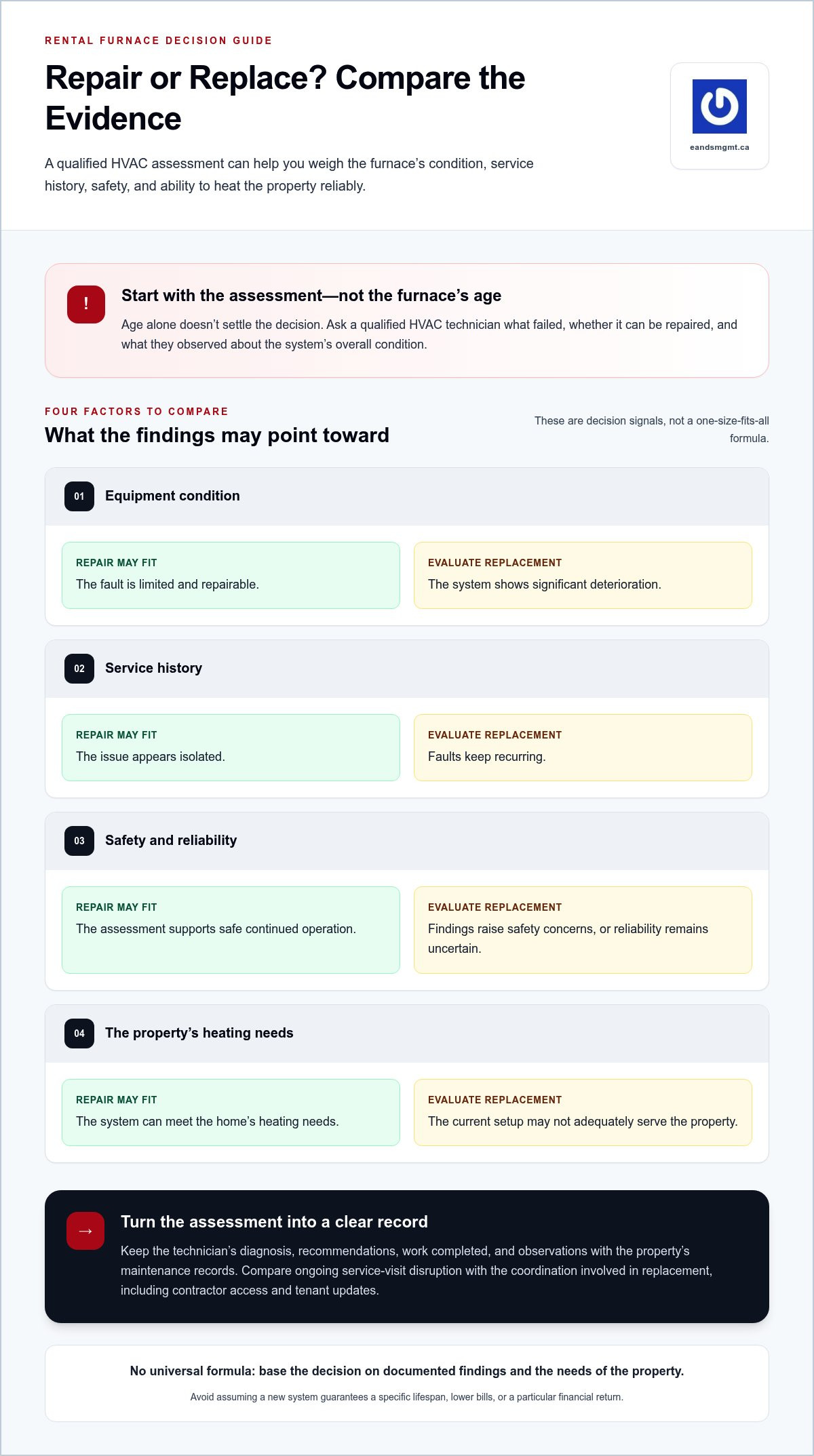
A furnace’s age alone doesn’t settle whether it should be repaired or replaced. Start with a qualified HVAC assessment, then weigh the equipment’s condition, repair history, safety findings, and ability to heat the rental reliably. The decision should reflect the evidence and the needs of the property, not a one-size-fits-all rule.
Ask for findings that explain what failed, whether it can be repaired, and what the technician observed about the system’s overall condition. Consider whether the furnace can meet the home’s heating needs, including any concerns about uneven heating. Keep the assessment and recommendations with the property’s maintenance records. For broader context on landlord and tenant responsibilities, consult the Government of Ontario’s guide to Ontario’s Residential Tenancies Act.
When repairing the existing furnace may be reasonable
A repair may make sense when the assessment identifies a limited, repairable fault and indicates that the furnace can continue operating safely. Consider that finding alongside the unit’s service history: one isolated issue presents a different picture from recurring faults. Record the technician’s diagnosis, work completed, and observations about the system so future decisions are based on evidence rather than memory.
When replacement may be the more practical option
Repeated breakdowns, significant deterioration, or safety concerns may call for a closer look at replacement. Compare the disruption of ongoing service visits with the coordination involved in replacing the furnace, including contractor access and tenant updates. A technician’s findings can clarify the options, but avoid assuming a new system will guarantee a specific lifespan, lower bills, or a particular financial return.
Use the comparison below to organize the evidence before deciding:
| Consideration | Repair may fit when… | Replacement may merit evaluation when… |
|---|---|---|
| Equipment condition | The fault is limited and repairable. | The system shows significant deterioration. |
| Service history | The issue appears isolated. | Faults keep recurring. |
| Safety and reliability | The assessment supports safe continued operation. | Findings raise safety concerns or reliability remains uncertain. |
| Property heating needs | The system can meet the home’s needs. | The current setup may not adequately serve the property. |
There isn’t a universal formula. For owners learning how to handle a furnace replacement in a rental unit, a documented assessment creates a sound basis for the decision and next steps. Ottawa property management support can help organize contractor coordination and property records.
Ontario Rental Furnace Replacement: Protect Tenant Comfort and Check Your Duties
A furnace replacement affects more than the building’s equipment. In an Ottawa winter, a heating interruption can quickly become a tenant comfort concern, so plan the work around clear communication, coordinated access, and timely updates. Before deciding what steps to take, confirm the current rules that apply to the tenancy rather than relying on assumptions or outdated summaries.
Which Ontario rules should landlords verify?
Review current Ontario government information on the Residential Tenancies Act and official Landlord and Tenant Board (LTB) guidance related to maintenance and repairs. Check the lease and the circumstances of the tenancy as well, since they may affect how you arrange access and communicate about the work. Avoid relying on an old checklist or a rule quoted without a current, authoritative source.
General maintenance guidance can help you organize a response, but it isn’t legal advice; an owner’s obligations may depend on current Ontario law, official LTB guidance, the tenancy agreement, and the specific facts of the situation. If you’re unsure how a requirement applies, consult an appropriate legal professional or official resource before acting.
How to keep tenants informed during furnace work
Communication helps tenants know what to expect and gives everyone a shared record of the plan. Explain that an assessment is being arranged, outline the proposed access arrangements, and tell the tenant who will coordinate the visit. Don’t give a completion time until the contractor has provided one. If the schedule changes, share the update promptly and explain the next known step.
For Ottawa properties, winter conditions make it especially important to take heating disruption seriously and keep occupants informed while work is underway. If the system must be shut down during assessment or replacement, record the interruption and any interim arrangements made to address tenant comfort. Be clear about what is known, what remains uncertain, and when you expect to provide another update.
- Keep copies of messages, access arrangements, and schedule changes.
- Record when the tenant was informed and any concerns they raised.
- Document interim arrangements and the contractor’s updates about the work.
A steady communication trail can reduce confusion if the work takes longer than expected or plans change. Treat tenant updates and legal checks as part of the maintenance process, not as paperwork to complete afterward.
How to Manage a Furnace Replacement in a Rental Unit, Step by Step
A clear workflow keeps the equipment decision, tenant communication, and contractor coordination moving together. Leave a record at each step so the owner, tenant, and property manager can stay aligned, even when they aren’t all on site.
In brief: record the tenant’s report, arrange a qualified assessment, review the findings and approve the scope, coordinate access and updates, then confirm completion and file the records.
- Log the report. Record when the tenant raised the concern, what they observed, and any relevant follow-up. Keep the notes factual and add new information as it comes in.
- Arrange an assessment. Coordinate access for a qualified HVAC contractor and share the tenant’s observations and relevant maintenance history. Confirm the appointment arrangements with the tenant.
- Review findings and scope. Read the contractor’s assessment and clarify the recommended work, including whether the evidence supports repair or replacement. Confirm who must approve the work and obtain that approval before authorizing it.
- Coordinate the work. Arrange contractor access, share practical instructions for entering the unit, and tell the tenant what to expect. Provide updates if the schedule or scope changes, without promising a completion time that hasn’t been established.
- Close the loop. Confirm the work has been completed, retain the relevant documentation, and tell the tenant whom to notify if a related concern returns.
Coordinate the assessment, approval, and work schedule
Access and communication take planning, especially in an occupied home. Confirm the visit arrangements with the tenant, pass access details to the contractor, and keep the owner informed about the assessment and proposed scope. If further work is recommended, make sure the decision-maker understands the findings before approving it. Clear updates help tenants prepare for visits and reduce avoidable confusion or disruption.
Confirm completion and keep a clear maintenance record
Ask for the contractor’s findings and a description of the completed work, along with relevant equipment information and follow-up recommendations. Add these to the property file with the dates, communications, invoices, and access arrangements. A complete record supports future maintenance decisions and makes the property’s service history easier to understand.
Before closing the matter, tell the tenant how to report a recurring or related issue. Owners who aren’t nearby may benefit from local support coordinating maintenance and communication. Ottawa property management support can help organize these moving parts. A documented process is the practical foundation of how to handle a furnace replacement in a rental unit.
How Ottawa Property Management Can Simplify a Rental Furnace Replacement
A furnace replacement involves several connected tasks: organizing an assessment, deciding how to proceed, coordinating contractor access, keeping tenants informed, and preserving the work history. Managing each handoff takes time, particularly if you can’t be at the property. Ottawa property management can bring those moving parts into an organized process while keeping tenant communication and documentation in view.
What coordinated maintenance support can take off an owner’s plate
E&S Property Management coordinates maintenance and repairs through a network of reliable contractors. For a furnace concern, the team can help organize the assessment and work schedule, communicate with the tenant about access and updates, and keep the owner informed as findings and next steps are documented. The contractor assesses and carries out the HVAC work; property management coordinates the process around it.
Consistent records matter after the immediate issue is resolved. Keeping the assessment, work details, relevant equipment information, invoices, and follow-up recommendations together makes it easier to understand the property’s maintenance history and respond if a related concern arises. It also gives owners a clear record to refer to when planning future upkeep.
Local oversight can be especially useful when an owner lives elsewhere or can’t attend the unit. E&S is based in Ottawa and manages residential properties, including homes for Canadian Foreign Service members serving abroad. Its emergency 24/7 maintenance response supports urgent maintenance concerns, while qualified contractors assess and complete furnace work.
A clear next step for Ottawa rental property owners
A well-managed replacement starts with a reliable assessment, continues with organized access and tenant updates, and ends with a clear record of completed work. Full-service property management brings these responsibilities together, giving owners local support with the coordination and administration involved, whether they live nearby or manage a property from a distance.
If you’re considering how to handle a furnace replacement in a rental unit, E&S Property Management can coordinate the maintenance process while qualified contractors handle the HVAC work. Explore full-service property management in Ottawa.
Make the Next Furnace Decision with a Clear Plan
A failing furnace can feel like a large problem, but a calm process makes the next steps easier to manage. Record the tenant’s observations, arrange a qualified assessment, and use the findings to weigh repair against replacement. Keep tenants updated about access and schedule changes, then save the work details and related communication in the property file.
That’s the practical core of how to handle a furnace replacement in a rental unit: protect tenant comfort, make an evidence-based decision, and keep the maintenance record complete. For Ottawa owners, local coordination is useful when you’re away from the property. E&S Property Management coordinates maintenance through a network of reliable contractors and provides emergency 24/7 maintenance response.
Let E&S Property Management help coordinate your rental property’s maintenance. Explore full-service property management in Ottawa.
Frequently Asked Questions
Who is responsible for replacing a furnace in an Ontario rental unit?
In general, the landlord is responsible for maintaining heating equipment provided with the rental and arranging replacement when a qualified assessment indicates it’s needed. The tenant should report problems promptly, but shouldn’t be expected to decide whether the furnace needs replacing. Specific obligations can depend on current Ontario requirements, the tenancy agreement, and the circumstances, so consult official provincial and Landlord and Tenant Board guidance before making decisions.
How do I know whether a rental furnace should be repaired or replaced?
Use a qualified HVAC contractor’s assessment rather than relying on the furnace’s age alone. Consider the identified fault, overall equipment condition, safety findings, repair history, and whether the system can meet the property’s heating needs. A limited, repairable issue may support repair, while recurring breakdowns or significant deterioration may justify evaluating replacement. Keep the assessment and recommendations in the property file to inform future maintenance decisions.
Can a tenant arrange a furnace replacement without the landlord’s approval?
A tenant should report the problem to the landlord or property manager and avoid authorizing a replacement without approval, unless applicable requirements or the circumstances provide otherwise. Furnace replacement involves decisions about the property’s equipment, contractor access, scope, and records. If there’s a suspected gas leak or carbon monoxide alarm, safety comes first: follow emergency instructions and contact appropriate emergency services when needed. Document the concern and communications, then coordinate assessment and work through the responsible decision-maker.
What should a landlord do if the furnace stops working in winter?
Respond promptly: confirm whether heat has stopped completely, record the tenant’s report, and arrange a qualified assessment. Keep the tenant informed about access and next steps, and document updates or interim arrangements during the interruption. Treat a carbon monoxide alarm or suspected gas leak as an urgent safety concern, not routine maintenance. Ask the tenant to follow emergency guidance and contact the appropriate emergency services when needed.
How long does it take to replace a furnace in a rental unit?
There isn’t one dependable timeline for every replacement. The schedule can depend on the assessment, the work required, access to the unit, and contractor scheduling. Ask for updates as the scope and arrangements become clearer, then share confirmed information with the tenant without promising an unverified completion time. In an Ottawa winter, plan communication carefully if heating is interrupted, and record schedule changes and the steps taken.
What should landlords document during a furnace replacement?
Keep a clear timeline from the first report through completion. Save the tenant’s description of the problem, dates and messages, assessment findings, recommendations, approval details, access arrangements, and updates about schedule or scope changes. After the work, file the contractor’s description of completed work, relevant equipment information, invoices, and follow-up recommendations. These records preserve the property’s maintenance history and provide context if a related concern returns.
How can an out-of-town landlord manage a furnace replacement in Ottawa?
An out-of-town landlord can use local property-management support to coordinate the assessment, contractor access, tenant updates, and maintenance records. E&S Property Management manages homes for local landlords and Canadian Foreign Service members serving abroad. Its team coordinates maintenance through reliable contractors and provides emergency 24/7 maintenance response. The contractor assesses and completes the HVAC work; management organizes the process around it.


