
Imagine waking up in Vancouver to a frantic voicemail about a failing furnace in your Ottawa townhouse, knowing you’re four time zones and a five-hour flight away from solving the crisis. Managing a rental property from another province often feels less like a steady investment and more like a high-stakes balancing act where you’re always one step behind. It’s exhausting to worry about property damage going unnoticed or to feel overwhelmed by Ontario’s specific rental regulations from thousands of kilometres away.
You’ve worked hard to build your equity, and we understand the deep-seated need to protect that legacy. With the 2026 rent increase guideline set at 2.1% and Landlord and Tenant Board wait times often stretching between six and ten months, the margin for administrative error is incredibly thin. This guide is designed to help you bridge that distance. You’ll discover how to protect your investment, ensure strict legal compliance, and maintain your peace of mind while your property thrives. We will outline a reliable system for maintenance, rent collection, and LTB protection that provides a local presence without the logistical nightmare of constant travel.
Key Takeaways
- Establish a pre-vetted network of licensed contractors to ensure maintenance issues are resolved quickly without requiring your physical presence.
- Avoid costly legal setbacks by mastering the specific LTB notice requirements and timelines unique to Ontario’s rental market.
- Secure your investment’s cash flow by implementing automated digital rent collection and detailed monthly financial reporting.
- Learn why managing a rental property from another province requires a “boots on the ground” approach to tenant placement that goes beyond simple video tours.
- Transition from a state of constant anxiety to professional relief by choosing a dedicated local steward to act as your surrogate in Ottawa.
The Distance Gap: Why Managing from Another Province Requires a New Strategy
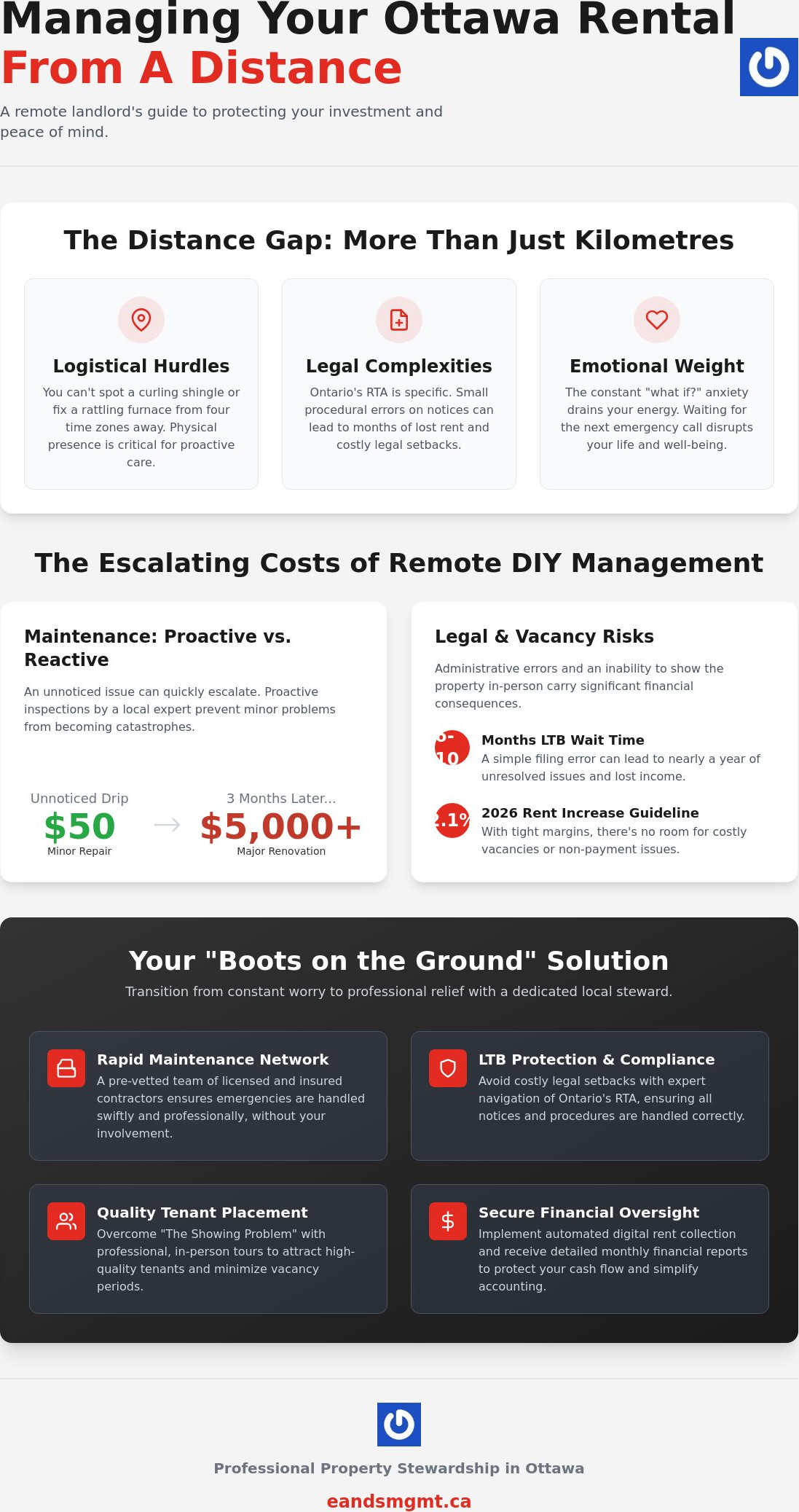
Moving away from your investment property is a significant transition that shifts your role from a hands-on homeowner to a remote investor. It’s a change that often brings a mix of excitement for your new chapter and a lingering sense of vulnerability regarding the asset you’ve left behind. When managing a rental property from another province, you quickly realize that distance magnifies every challenge. This “Distance Gap” isn’t just about kilometres; it’s built on three distinct pillars: logistics, legal complexities, and emotional weight.
Logistically, you’re no longer there to spot the curling shingle or hear the rattling furnace. Legally, you must stay perfectly aligned with Navigating Ontario’s Residential Tenancies Act, where even a small procedural error can lead to months of lost rent. Emotionally, the constant background hum of “what if” can drain your energy. Many owners try to bridge this gap by asking a neighbour to keep an eye on things. While well-intentioned, this model usually fails during a real crisis. A neighbour isn’t a licensed plumber or a legal expert; they’re a friend who has their own job and family. Professional stewardship offers a stabilizing force, replacing casual favours with meticulous, expert care.
The Myth of the Low-Maintenance Rental
Many landlords believe their property is “quiet” until it suddenly isn’t. A slow, unnoticed drip under a kitchen sink can quietly rot subflooring over three months, turning a fifty-dollar repair into a five-thousand-dollar renovation. The Stewardship Gap is the critical difference between reactive care, where you fix things after they break, and proactive care, where an expert eye prevents the break entirely. Living far away creates a psychological toll; you find yourself constantly waiting for the “bad news” call that disrupts your evening.
Calculating the Real Cost of DIY Remote Management
The true expense of managing a rental property from another province often hides beneath the surface. You might save on management fees, but a single emergency flight to Ottawa or a missed work day for a Landlord and Tenant Board hearing can cost thousands. Vacancies also last longer when you can’t host immediate, in-person showings for high-quality applicants. Your mental well-being and time are your most valuable assets; spending them on logistical fires is a cost that rarely shows up on a balance sheet but impacts your life daily.
Solving the “Boots on the Ground” Logistics: Maintenance and Tenant Placement
The most significant hurdle when managing a rental property from another province is the physical disconnect between your home and your investment. You cannot afford to wait for a burst pipe to start searching for a plumber. A successful remote strategy relies on a pre-vetted network of licensed contractors who are ready to respond at a moment’s notice. We recommend moving away from the “handyman” model for critical systems; instead, focus on professionals who provide warranties for their work and carry proper insurance. This proactive preparation ensures that a midnight emergency remains a minor scheduled repair rather than a catastrophic event that requires an emergency flight to Ottawa.
The logistics of finding new residents presents another challenge often called “The Showing Problem.” While video tours offer a convenient glimpse into the home, high-quality tenants typically hesitate to sign a lease without an in-person walkthrough. Relying solely on digital tours can lead to longer vacancies or, worse, attracting tenants who aren’t fully committed to the property. Entrusting these details to a Full-Service Property Management team allows you to maintain a local presence that ensures your property is shown professionally and frequently until the right fit is found.
Detailed move-in and move-out inspections are your primary defense against property damage. These inspections must include high-resolution photographic evidence of every room, appliance, and fixture. Without this clear documentation from the day the keys were handed over, proving your case at the Landlord and Tenant Board becomes nearly impossible. Accurate record-keeping for every repair and inspection is also essential for long-term Financial Oversight and the ‘Silent’ Risks, especially for owners who need to navigate specific reporting requirements for the CRA.
The 5-Step Remote Repair Protocol
To maintain order from afar, follow a consistent response cycle for every maintenance request. Start with immediate tenant communication to triage the issue. Next, dispatch a vetted, licensed professional to ensure the job is done right the first time. Once the repair is complete, verify the work through digital reporting or photos before processing the payment. Finally, audit the invoice for accuracy and follow up with the tenant to confirm their satisfaction. This methodical approach creates a sense of reliability and care for your residents.
Professional Tenant Placement from a Distance
High-quality marketing is non-negotiable for remote owners. Professional photography and clear, honest descriptions attract a better pool of applicants. Your screening process must be rigorous, including comprehensive credit checks, employment verification, and direct conversations with previous landlords. Once a candidate is selected, ensure the Ontario Standard Lease is executed correctly to avoid legal vulnerabilities. This thoroughness at the start of a tenancy is what protects your peace of mind for the years to follow.
Navigating Ontario’s Residential Tenancies Act from Afar
Ontario’s rental landscape is a legal minefield where a single misplaced date on a form can cost you half a year of income. When managing a rental property from another province, you quickly find that the Landlord and Tenant Board (LTB) operates with zero margin for error. Current wait times for a hearing often stretch between six and ten months. If you serve an incorrect notice, such as an N1 for a rent increase or an N4 for non-payment, you don’t just get a correction; you get a dismissal. This means you must start the entire months-long process from the beginning, all while your property remains occupied and your expenses continue to mount.
Distance makes serving these legal documents even more complicated. You cannot simply mail a notice and hope for the best; the LTA has specific requirements for how and when a tenant is deemed to have received a document. Having a local representative is essential not just for physical service, but for appearing at digital-first hearings where local knowledge of the property’s condition is vital. Beyond the paperwork, success as a remote landlord depends on turning potential disputes into collaborative solutions. A local steward acts as a buffer, de-escalating tensions before they reach the LTB and maintaining a professional relationship that protects your investment.
Staying compliant also involves understanding your broader obligations as a property owner. For example, Navigating Ontario’s Residential Tenancies Act from Afar requires a holistic view of both provincial rules and federal tax elections. Proper legal standing at the LTB often rests on your ability to prove you’ve met every administrative requirement, from local property tax installments to specific non-resident withholding rules if you’ve moved outside of Canada.
Common LTB Pitfalls for Out-of-Province Landlords
The most frequent error we see is the failure to use the mandatory Ontario Standard Lease. If you used a generic template from another province, your tenant can legally withhold one month’s rent. You must also be precise with rent increases. For 2026, the guideline is capped at 2.1% for most units, unless the property was first occupied after November 15, 2018. Finally, never fall into the “Self-Help” eviction trap. Changing the locks or cutting off utilities from afar will result in massive fines and a guaranteed loss at the LTB.
Compliance as a Risk Mitigation Strategy
Regular Property Inspections are your best defense against both physical damage and legal liability. These visits fulfill insurance requirements and ensure you aren’t surprised by an “own-use” eviction (N12) dispute later on. Maintain a meticulous digital paper trail of every text, email, and repair receipt. LTB compliance is the best insurance against financial loss. By treating every interaction as a potential piece of evidence, you create a shield that protects your equity from the risks of managing a rental property from another province.
Financial Oversight and the “Silent” Risks of Remote Landlording
The “engine room” of your investment is its financial health, and managing a rental property from another province requires a shift from casual oversight to professional accounting. Many landlords begin by accepting Interac e-transfers, but this manual process becomes a burden when you’re juggling different time zones or busy schedules. Transitioning to automated, secure digital systems ensures that rent is collected on time without you needing to send reminders. Clear financial boundaries are essential; you need a system that separates your personal life from the property’s operational costs.
Transparency is the antidote to the anxiety of distance. Monthly owner statements that detail every cent of income and expenditure provide the clarity you need to make informed decisions. These reports should account for everything from the 3.75% property tax increase approved by the City of Ottawa for 2026 to minor repair costs. Managing these recurring payments, alongside insurance renewals and utility bills, is a logistical hurdle that feels much heavier when you aren’t there to open the mail. Entrusting your Financial Reporting and Accounting to a local partner ensures that no deadline is missed and no bill goes unpaid.
Bridge to Non-Resident Tax Compliance
One of the most significant “silent” risks involves the Canada Revenue Agency (CRA). Even if you’re currently elsewhere in Canada, your tax obligations change if your move becomes permanent or if you eventually relocate outside the country. For those who move abroad, the CRA typically requires a 25% withholding tax on gross rental income. However, by filing an NR6 form, you can often reduce this to a percentage of your net income instead. Understanding these Non-Resident Landlord Tax Services in Ottawa Explained is vital for protecting your cash flow and staying on the right side of federal regulations.
Insurance Considerations for Remote Owners
Your insurance policy is a contract based on specific risks, and moving to another province changes that risk profile. You must notify your insurer that the property has transitioned from a primary residence to a rental managed from afar. Most policies include a “vacancy” clause that can void your coverage if the home sits empty for more than 30 days during a tenant turnover. Professional oversight through Regular Property Inspections satisfies the “duty of care” requirements most insurers demand, ensuring that your coverage remains intact even when you’re thousands of kilometres away.
From Stress to Relief: Choosing a Local Steward for Your Ottawa Property
The journey of managing a rental property from another province often begins with a sense of optimistic control, but it can quickly transform into a source of persistent background anxiety. We have explored the logistical hurdles of maintenance, the rigid legal requirements of the Landlord and Tenant Board, and the complex financial obligations to the CRA. Each of these elements adds weight to your daily life, creating a “distance gap” that is difficult to bridge alone. The transition from an anxious DIY landlord to a protected, confident investor happens the moment you decide to stop reacting to crises and start relying on a professional system of stewardship.
At E&S Property Management, we have spent over 40 years acting as the protective guardian for Ottawa homeowners. As a boutique, family-run firm, we provide a level of neighborly care and personal accountability that large corporations simply cannot replicate. We don’t view your property as just another unit in a database; we see it as a significant personal asset that requires meticulous care and active protection. Our role is to be your steady hand on the ground, ensuring that your investment thrives while you focus on your life in another province. This seasoned approach turns the chaotic cycle of property management into a predictable, orderly experience.
Why E&S Property Management is the Right Fit
Our team holds deep expertise in supporting those who serve our country or work abroad, including members of the Foreign Service and DND. We understand the unique pressures of being relocated and the absolute necessity of having a reliable surrogate back home. By leveraging our established network of trusted Ottawa contractors, we ensure that every repair is handled by a professional who values quality as much as we do. Our commitment goes beyond simple maintenance; we focus on maximizing your property value through regular inspections and detailed financial reporting, ensuring your equity is preserved for the long term.
Take the First Step Toward Relief
You don’t have to carry the burden of 3:00 AM emergency calls or the fear of LTB disputes on your own. We invite you to a no-obligation consultation to discuss your specific needs and how we can tailor our services to your property. Our goal is to provide the order, clarity, and professional oversight you need to reclaim your peace of mind. Let us handle the complexities of managing a rental property from another province so you can enjoy the benefits of your investment without the stress.
Delegate the stress; contact E&S Property Management today to learn how we can protect your Ottawa home.
Securing Your Ottawa Investment for the Long Term
Transitioning from a hands-on landlord to a remote investor doesn’t have to be a source of constant stress. By implementing a proactive maintenance protocol and ensuring strict adherence to Ontario’s evolving rental laws, you protect both your equity and your sanity. We have seen how managing a rental property from another province requires more than just a digital connection; it demands a dedicated local surrogate who understands the unique rhythms of the Ottawa market and the specific needs of its residents.
Whether you need specialized NR6 and NR4 tax filing support for non-resident status or access to an A-rated network of local Ottawa contractors, our team is here to act as your protective guardian. With over 40 years of property management experience in the capital, we specialize in turning complex logistical burdens into a streamlined, hands-off experience. You’ve worked hard to build your investment, and you deserve to enjoy the rewards without the weight of 3:00 AM phone calls.
Let us be your boots on the ground in Ottawa—Contact E&S Property Management today to discuss how we can bring stability and clarity to your remote landlording journey. Your peace of mind is our priority.
Frequently Asked Questions
Do I need a property manager if I live in another province?
You aren’t legally mandated to hire a manager, but managing a rental property from another province without one often leads to significant logistical and legal stress. A local surrogate ensures that someone is physically available to address urgent repairs or serve legal notices that require in person delivery. This local presence acts as a stabilizing force, protecting your equity when you cannot be there to oversee the property yourself.
How much does it cost to have a property managed in Ottawa?
Typical property management fees in Ottawa for 2026 range from 6% to 12% of the monthly rent collected. You should also budget for separate tenant placement fees, which often equal 50% to 100% of one month’s rent. These costs cover the professional oversight, administrative duties, and logistical coordination required to maintain your investment from a distance.
Can I use the Ontario Landlord and Tenant Board (LTB) portal if I live outside Ontario?
Yes, the Landlord and Tenant Board operates with a digital first approach through the Tribunals Ontario Portal. You can file applications and participate in video hearings from anywhere in the world. However, you must still ensure that all legal notices are served correctly to the tenant at the local property address according to the strict timelines required by provincial law.
What happens if my tenant has an emergency and I can’t be reached?
If a critical emergency occurs and you are unreachable, the tenant might pursue “self help” repairs, which can lead to unvetted contractors and unapproved expenses. Having a professional emergency 24/7 maintenance response system in place ensures a licensed professional is dispatched immediately. This proactive approach protects the property from further damage and maintains your tenant’s safety without requiring your constant availability.
Is it legal to manage an Ontario rental property without a local representative?
It’s legal to manage your property yourself as long as you follow all provincial regulations and federal tax requirements. The challenge arises when physical presence is required for maintenance emergencies or legal document service. Many remote owners find that the distance makes it nearly impossible to meet the “duty of care” expectations of insurance providers and the Landlord and Tenant Board.
How do I handle property inspections if I live across the country?
You can coordinate regular property inspections through a local management partner who provides detailed photographic reports and digital verification. These visits are essential for identifying preventative maintenance needs and ensuring the tenant is complying with the lease terms. Consistent documentation from these inspections is your best defense if a dispute regarding property condition ever reaches a legal hearing.
What are the tax implications of renting out my Ottawa home while living in another province?
Your rental income must be reported on your Canadian tax return, and you can typically deduct eligible expenses like property taxes and maintenance costs. If your move eventually takes you outside of Canada, you will face non resident withholding requirements under the CRA. Filing an NR6 form is a common strategy in these cases to pay tax on your net income rather than the gross amount.
How do I find a reliable property manager in Ottawa?
Look for a firm with deep roots in the local community and a proven track record of supporting owners who are managing a rental property from another province. A reliable partner should offer comprehensive services, including financial reporting and a vetted network of contractors. Seek out a boutique firm that prioritizes stewardship and clear, empathetic communication over high volume corporate scaling.


