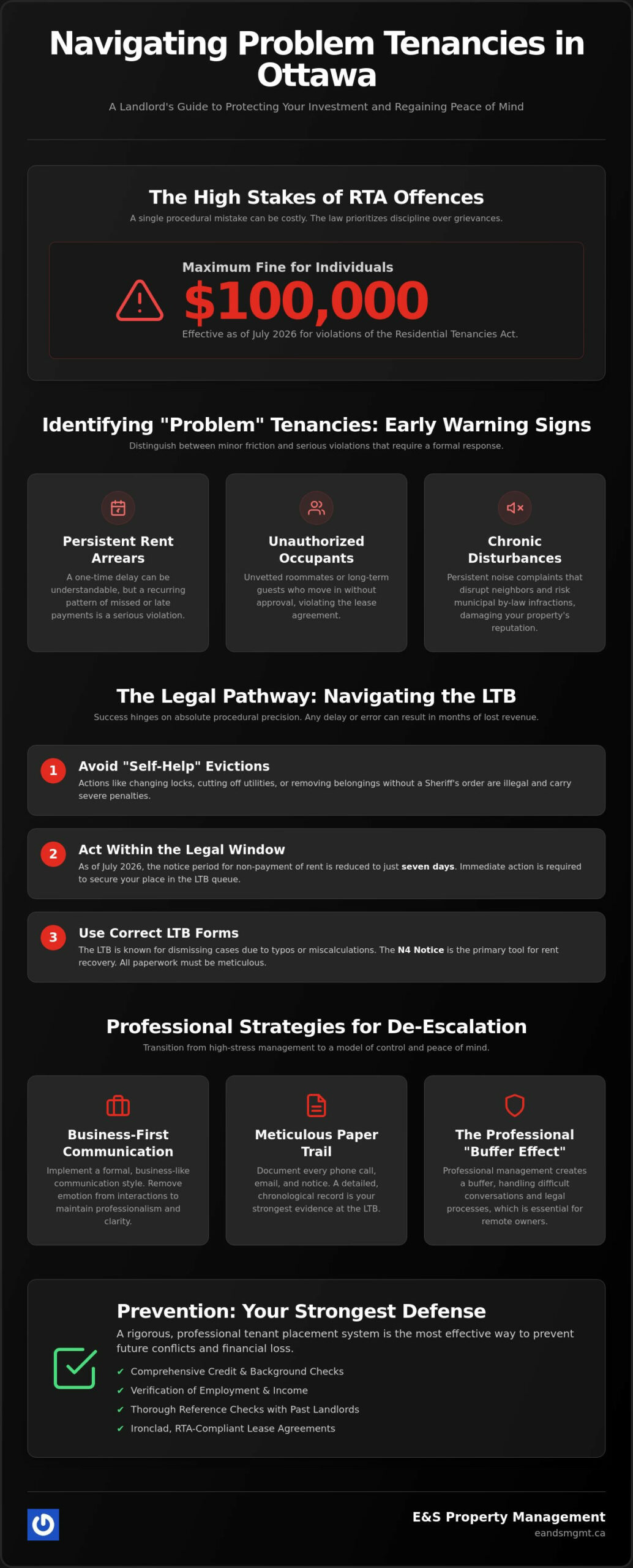
You’ve checked your bank account for the third time today, but the rent transfer still hasn’t arrived. Instead of the steady income you expected, you’re facing unreturned texts and the heavy weight of a looming confrontation. We understand that managing problem tenants Ottawa isn’t just about the money; it’s about the sleepless nights and the fear that a single procedural mistake could lead to a grueling wait at the Landlord and Tenant Board. It’s exhausting to feel like a stranger in your own investment, especially with fines for RTA offences doubling to $100,000 for individuals as of July 2026.
You deserve a rental experience that provides security rather than constant anxiety. This guide will help you regain control by navigating the latest legal shifts, including the new seven-day notice period for non-payment of rent. We’ll show you exactly which LTB forms are now mandatory for arrears agreements and how to build a meticulous, documented path toward resolution. We’ll explore how to handle these complexities with professional discipline, helping you transition from a state of high-stress management to a model of total peace of mind.
Key Takeaways
- Understand the legal boundaries of the Residential Tenancies Act and why avoiding “self-help” measures is critical for protecting your investment.
- Learn to implement a “business-first” communication style and maintain a meticulous paper trail to remove emotion from difficult interactions.
- Discover how professional oversight creates a “buffer effect,” simplifying the process of managing problem tenants Ottawa while providing essential support for remote owners.
- Identify the key differences between minor lease friction and serious violations to determine the most effective legal path forward.
- Explore how a rigorous, professional tenant placement system acts as your strongest defense against future conflicts and financial loss.
Identifying “Problem” Tenancies in the Ottawa Rental Market
Owning a rental property in the nation’s capital should feel like a stable step toward your future, but when communication breaks down, that sense of security quickly evaporates. Often, the challenge of managing problem tenants Ottawa begins with a subtle shift in the relationship. It might start with a missed rent payment or a polite request for an extension that slowly turns into a recurring pattern of arrears. While minor friction is a natural part of any business relationship, serious lease violations require a more disciplined, administrative response to protect your investment and your sanity.
In our local market, we frequently see three primary stressors that indicate a tenancy has moved beyond simple misunderstanding into problematic territory:
- Persistent rent arrears: This is often exacerbated by recent shifts in the federal public service workforce, which remains a key driver of rental demand in Ottawa.
- Unauthorized occupants: Guests who never leave or unvetted roommates moving in without proper screening or lease updates.
- Noise complaints: Chronic disturbances that threaten your reputation with neighbors and risk municipal by-law infractions.
For landlords posted abroad or working in the Foreign Service, these issues are magnified by time zones and physical distance. You can’t simply knock on a door to assess a situation or verify a noise complaint. Relying on “handshake agreements” or informal texts often backfires with difficult personality types who view flexibility as an opportunity to test boundaries. Without a professional buffer, the emotional toll of these confrontations can become overwhelming, turning a valuable asset into a source of constant dread.
When a Tenant Becomes a “Problem”
The early warning signs are often behavioral. You might notice a sudden lack of transparency or defensive responses to routine maintenance requests. It’s vital to distinguish between a tenant facing a genuine, temporary hurdle and a serial non-payer who understands how to navigate the system’s delays. Regardless of the conflict, you must remain compliant with the Residential Tenancies Act (RTA). Even when a tenant stops paying, you cannot cut off utilities or change locks without facing significant legal repercussions, including fines that have recently doubled for individuals.
The Local Ottawa Context: LTB Realities in 2026
The current administrative landscape requires landlords to be both patient and proactive. The Ontario Landlord and Tenant Board (LTB) continues to manage a significant volume of cases, meaning any delay in filing your paperwork can result in months of lost revenue. As of July 2026, the notice period for non-payment of rent has been reduced to seven days. You must act within this window to secure your place in the queue. Additionally, staying informed about specific ward bylaws regarding property standards is essential, as the City of Ottawa has increased its focus on landlord compliance through new licensing measures.
Navigating the Ontario Landlord and Tenant Board (LTB)
The Residential Tenancies Act (RTA) serves as the definitive rulebook for every rental interaction in Ontario. When you’re managing problem tenants Ottawa, it’s vital to remember that the law prioritizes procedural discipline over personal grievances. Even if a tenant’s behavior feels like a personal affront, you must never attempt “self-help” evictions. Changing the locks, cutting off water, or removing a tenant’s belongings without a Sheriff’s order is illegal. With fines for RTA offences now reaching $100,000 for individuals as of July 2026, the cost of a mistake far outweighs the frustration of a slow legal process.
Success at the LTB hinges on absolute precision. The board is known for dismissing cases based on a single typo or a miscalculated date. You can find the necessary resources and current guidelines on the Official Landlord and Tenant Board website. Every step, from serving the initial notice to the final hearing, requires a steady hand and an eye for detail. The timeline from serving a notice to an enforced eviction can span several months, making it essential to act immediately when a violation occurs.
Essential LTB Notices for Ottawa Landlords
Selecting the correct form is the first step toward resolution. The N4 notice serves as the primary tool for rent recovery when payments are missed. If the issue involves persistent noise, property damage, or overcrowding, the N5 notice is the appropriate choice. For landlords who need to regain possession of the unit for their own use or for a close family member, the N12 notice is required. Each of these documents carries specific notice periods that must be strictly observed. For instance, as of July 1, 2026, the notice period for non-payment of rent is now seven days.
The Step-by-Step Filing Process
The journey toward a resolution follows a methodical path. First, serve the correct notice with 100% accuracy in spelling and dates. Even a minor error in the tenant’s name can reset your timeline. Once the notice period expires, you can file an application, such as an L1 for rent arrears or an L2 for other conduct issues. The current LTB application fee is approximately $53. This filing officially places your case in the queue for a hearing.
Preparation is your best defense. Create a comprehensive evidence binder that includes payment logs, dated communication records, and clear photographs of any damage. Most hearings are now conducted virtually, allowing you to participate even if you’re currently posted abroad. If the administrative burden of these filings feels overwhelming, seeking professional property management can ensure every form is filed correctly the first time, protecting your investment from costly delays.
Professional Strategies for De-escalation and Documentation
When managing problem tenants Ottawa, your most powerful asset isn’t a stern warning or a heated confrontation. It’s a silent, meticulous paper trail. Emotional responses often escalate friction, turning a simple misunderstanding into a lasting conflict. By adopting a “business-first” communication style, you remove the personal element from the equation. This shift doesn’t mean being cold; it means being consistent, predictable, and fair. It allows you to treat every interaction as an administrative task rather than a personal battle, which is essential for protecting your long-term sanity.
Setting firm boundaries is particularly important when dealing with the “constant negotiator.” These individuals often test limits with repeated requests for rent delays or exceptions to lease terms. A professional approach involves acknowledging their situation while firmly reiterating the terms of the agreement. By sticking to established protocols, you signal that the lease is a binding contract, not a starting point for negotiation. This clarity helps prevent the cycle of “handshake agreements” that often lead to further arrears and frustration.
Communication Protocols that Protect Landlords
Formal communication should always move away from informal text messages. While texts are convenient, they’re often disorganized and difficult to present as evidence. Instead, rely on email or registered mail for all official notices. This ensures you have a verifiable record of when information was sent and received. When you need to enter the property, you must provide a written “Notice of Entry” at least 24 hours in advance. This notice should clearly state the reason for entry and the time window, ensuring you remain fully compliant with the rules found on the Landlord and Tenant Board (LTB) website.
The Evidence Binder: Your Best Defence
If a dispute eventually reaches a hearing, your success depends on the quality of your documentation. An organized evidence binder serves as a comprehensive history of the tenancy. It should include every maintenance request and your subsequent professional response, demonstrating that you’ve fulfilled your obligations as a landlord. Tracking payment history is equally vital. While manual ledgers are a start, modern property management software provides a more reliable, tamper-proof record of financial transactions.
Photographic evidence is another critical component. When conducting regular property inspections, take clear photos to document the unit’s condition. As of July 1, 2026, landlords must use official forms for any rent arrears payment agreements, making it even more important to keep these records organized. By documenting property damage without violating the tenant’s right to privacy, you build a case based on facts rather than hearsay. This methodical approach transforms a chaotic situation into a manageable, professional process.
When to Delegate: How Professional Management Solves the Problem
Managing your own property can feel like a full-time job, especially when you’re dealing with conflict. At some point, the emotional weight of managing problem tenants Ottawa outweighs the satisfaction of owning the investment. This is where the “Buffer Effect” becomes invaluable. By introducing a third-party manager, you immediately de-escalate personal animosity. Tenants who might be combative with a landlord often adopt a more professional tone when communicating with a management firm. It shifts the relationship from a personal dispute to a standard business transaction.
For members of the Foreign Service or expats living outside of Canada, the challenges are even more acute. Trying to coordinate an emergency repair or respond to a noise complaint from a different time zone is a recipe for burnout. You can’t be there to verify if a repair was done correctly or to serve a notice in person. Professional management acts as your local eyes and ears, ensuring your property is protected while you’re thousands of miles away. It bridges the gap between your location and your tenant’s needs, providing a stabilizing presence that prevents minor issues from spiraling into crises.
Many landlords hesitate to delegate because of the cost, but a true cost-benefit analysis often reveals that professional oversight pays for itself. Consider the financial impact of a single month of lost rent or the legal fees associated with a poorly filed LTB application. Managing problem tenants Ottawa requires a level of emotional detachment that’s hard to maintain when it’s your own home on the line. When you factor in the value of your own time and mental health, the decision to outsource becomes a strategic investment in your portfolio’s stability.
The E&S Approach to Conflict Resolution
Our team steps in as the “seasoned hand” to take the administrative burden off your shoulders. We don’t just handle the paperwork; we manage the people. This includes leveraging our network of reliable Ottawa contractors to quickly address any damage or repairs that might be fueling tenant frustration. For our non-resident clients, we ensure full CRA compliance, handling complex tax requirements like NR6 and NR4 filings while simultaneously resolving local tenant issues. We transition your “problem” tenant to professional oversight smoothly, setting new expectations without triggering unnecessary friction.
Restoring Your Peace of Mind
The most significant benefit of delegation is the transition from “crisis mode” to “passive income mode.” There is profound psychological relief in knowing that a dedicated professional is handling the LTB and the tenant. You no longer have to dread opening your email or answering a late-night call. Instead, you can return to the role of an investor, watching your asset grow while we handle the day-to-day complexities. If you’re ready to reclaim your time, exploring Full-Service Property Management in Ottawa is the first step toward a stress-free ownership experience. To learn more about how we can protect your investment, consider partnering with a team that provides comprehensive property oversight.
Prevention: Building a Bulletproof Tenant Placement System
The most effective strategy for managing problem tenants Ottawa isn’t found in a courtroom or a legal filing; it’s found in your initial vetting process. While the legal tools we’ve discussed are essential for resolution, the ultimate goal is to ensure those tools are never needed. Signing a lease is a significant long-term commitment that shouldn’t be rushed. By shifting your focus toward proactive protection, you can transform your rental experience from a source of constant worry into a stable, predictable investment. It starts with a philosophy that prioritizes the “right fit” over the first available applicant.
A professional approach to placement involves more than just a cursory glance at a credit report. Credit scores can be misleading, especially if they don’t reflect a tenant’s specific history with previous landlords. We look for patterns of stability and reliability that suggest a respectful future relationship. This meticulousness creates a foundation of trust from day one, allowing you to breathe easier knowing your property is in responsible hands.
Our Meticulous Screening Process
Verifying employment and income requires a skeptical, professional eye to ensure the data matches the reality of the applicant’s situation. We don’t just accept a pay stub; we confirm the longevity and stability of the source. Reference checks are equally vital, but they are an art form rather than a checklist. We ask previous landlords specific, open-ended questions designed to reveal the truth about payment habits and property care. To see exactly how we filter out potential risks, you can review Our Ottawa Tenant Screening Process Checklist for a deeper look at our standards.
While the Ontario Standard Lease is the mandatory starting point for all tenancies, it’s often the customized, legal schedules that provide the most protection. These schedules clarify specific expectations regarding maintenance, utility payments, and conduct without infringing on RTA rights. By being clear about these details before the keys are handed over, you eliminate the ambiguity that often leads to future friction.
The Move-In Foundation
The move-in inspection is your first opportunity to establish professional expectations. We conduct a detailed walkthrough accompanied by high-resolution professional photography to document the unit’s exact condition. This process isn’t just about accountability; it’s about education. We take the time to show the tenant how to care for the home, where the shut-off valves are located, and how to report maintenance issues through our 24/7 emergency response system. This level of care signals that you are a dedicated steward of the property, which encourages the tenant to treat the home with similar respect.
Establishing clear channels for communication and rent payment from day one removes the guesswork for the tenant. When people know exactly how and when to pay, and who to call when a pipe leaks, they are far less likely to become “problem” cases. This organized start transitions the relationship into a smooth, administrative flow. If you’re ready to move away from the stress of managing problem tenants Ottawa, delegating these foundational steps to a seasoned hand ensures your investment remains a source of peace of mind rather than a burden.
Reclaiming Your Investment and Your Sanity
Navigating the complexities of the Ontario rental market doesn’t have to be a solitary or stressful journey. By prioritizing meticulous documentation and understanding the latest LTB shifts, you protect your property from the risks of administrative errors and lost revenue. Success lies in maintaining a professional distance that removes emotion from the equation. The right support changes everything.
Managing problem tenants Ottawa becomes significantly easier when you have a seasoned partner acting as your local guardian. With over 40 years of experience in the Ottawa market, we specialize in the unique needs of Foreign Service members and non-resident landlords. Our proven track record of professional tenant placement ensures that your investment is handled with meticulous care from day one.
Let E&S Property Management take the stress out of your rental, contact us today.
You’ve worked hard to build your portfolio. It’s time to step back from the daily friction and enjoy the reliable, passive income you originally envisioned for your home.
Frequently Asked Questions
Can I evict a tenant in Ottawa for not paying rent?
Yes, you can initiate the eviction process for non-payment, but it must be done through the formal legal channels of the Landlord and Tenant Board. As of July 1, 2026, the notice period for non-payment of rent has been shortened to seven days. You’ll start by serving an N4 notice, and if the tenant doesn’t pay or move out within that week, you can file an L1 application to seek a termination of the tenancy.
How long does the LTB eviction process take in Ontario right now?
Current wait times for a hearing at the LTB typically span several months due to the ongoing volume of cases. While recent legislative changes aim to reduce these delays, the process still requires patience and absolute procedural accuracy. Acting the moment a violation occurs is the best way to protect your investment, as any delay in filing your paperwork only extends the time you’re left without rental income.
What should I do if my tenant is damaging my property?
If you discover damage beyond normal wear and tear, you should immediately document the condition with dated photographs and serve an N5 notice. This notice gives the tenant a specific window to either repair the damage or pay the associated costs. Regular property inspections are essential here, as they allow you to identify issues early and maintain a professional standard of care for your asset.
Is it legal to record conversations with my tenant in Ontario?
Ontario follows a “one-party consent” rule, which means it’s legal to record a conversation as long as you are one of the people participating in it. While these recordings can be helpful, the LTB generally places a higher value on a clear, professional paper trail of emails and registered mail. Maintaining a disciplined record of all written interactions remains the most effective strategy for managing problem tenants Ottawa.
How do I handle a tenant who constantly pays rent late?
For tenants who have a recurring habit of late payments, you can serve an N8 notice for persistent late payment of rent. Unlike the N4 notice, which is for specific arrears, the N8 focuses on the pattern of behavior over several months. You’ll need to provide a meticulous payment ledger as evidence to prove that the late payments are a chronic issue rather than a one-time occurrence.
Can a property manager represent me at the Landlord and Tenant Board?
Yes, a professional property manager can act as your agent and represent your interests throughout the LTB process. They can handle the technical requirements of serving notices, filing applications, and participating in virtual hearings. This service is a significant relief for landlords who find the legal environment intimidating or for those who are currently living outside of the country.
What are the rules for entering a rental unit in Ottawa?
You must provide the tenant with at least 24 hours of written notice before entering the unit, and the entry must take place between 8:00 AM and 8:00 PM. The notice must clearly state the date, the time window for entry, and a valid reason, such as a routine inspection or a repair. The only exception to this rule is a genuine emergency, like a fire or a major water leak, where immediate entry is required.
Can I evict a tenant to move into my own house if I am returning from a Foreign Service posting?
Yes, you can serve an N12 notice to regain possession of your home if you or a close family member genuinely intend to move back into the unit. You must provide at least 60 days’ notice and intend to live in the property for at least one full year. It’s vital that this notice is served in good faith, as the penalties for “bad faith” evictions are severe and can include significant fines.