
Imagine you’re managing your rental property from abroad or balancing a demanding career when you discover that a simple “no pets” clause in your contract is actually void and unenforceable. With maximum fines for Residential Tenancies Act offences jumping to $100,000 for individuals as of July 2026, the stakes for administrative errors have never been higher. You want to provide a great home for your tenants, but the fear of including illegal clauses or mishandling utility responsibilities can make the process feel overwhelming.
It’s completely natural to feel a sense of weight when navigating these legal requirements. This Ontario standard lease agreement guide is designed to replace that stress with the relief of professional certainty. You’ll gain expert insights into the mandatory December 2020 form and learn how to craft a legally bulletproof agreement that protects your investment while ensuring full RTA compliance. We will walk through the 2026 rent increase guideline of 2.1% and the latest rules regarding air conditioning units to ensure your next tenancy starts with total clarity and peace of mind.
Key Takeaways
- Recognize why the mandatory Standard Form of Lease is your essential foundation for reducing disputes and navigating the current LTB backlog.
- Learn to use this Ontario standard lease agreement guide to identify which “Additional Terms” in Section 15 are legally enforceable and which are automatically void.
- Gain clarity on the financial core of your agreement, including the specific rules for legal deposits and utility responsibilities that protect your cash flow.
- Understand how to adapt your lease management to the Ottawa market, specifically addressing the timing and requirements of the local Foreign Service cycle.
- Discover how professional lease administration can provide a stabilizing force for your investment, replacing the burden of paperwork with expert-backed confidence.
The Essentials of the Ontario Standard Lease Agreement
The Standard Form of Lease is the mandatory template for compliance under the Residential Tenancies Act, 2006. It serves as the only legally recognized residential tenancy agreement in Ontario. Since its introduction, the primary goal has been to create a level playing field by standardizing rental rules across the province. This consistency helps reduce confusion and, ideally, eases the heavy backlogs at the Landlord and Tenant Board (LTB). As we move through 2026, understanding this Ontario standard lease agreement guide is vital for protecting your property and your peace of mind.
The scope of this requirement is broad. It covers most private residential rentals, including houses, apartments, and basement suites. In the current 2026 landscape, the importance of using the correct version, updated in December 2020, cannot be overstated. With the 2026 rent increase guideline set at 2.1% and LTB wait times still averaging between 3 and 8 months for most applications, starting your tenancy with a compliant document is the best way to avoid unnecessary delays or legal setbacks later on.
Mandatory vs. Exempt Tenancies
Most landlords find that their properties fall squarely within the mandatory category. If you own a single-family home, a duplex, or a condo that you’re renting out, you must use the standard form. It doesn’t matter if you’re a seasoned investor or a first-time landlord; the law applies equally. There are a few specific exemptions, such as commercial properties, co-operative housing, and temporary shelters. Some specialized care homes or transitional housing may also be exempt. If you choose to use a custom or “handwritten” lease for a standard tenancy, the law will likely treat it as if the standard lease were in place anyway, often rendering your custom clauses void if they conflict with provincial regulations.
The Risk of Using Non-Standard Agreements
Using a non-standard agreement creates significant vulnerabilities for your rental investment. One of the most immediate risks is that a tenant has the right to withhold one month’s rent if you don’t provide the standard lease within 21 days of their written request. If you still don’t provide it within 30 days of them withholding rent, they don’t have to pay that month’s rent back at all. This can cause an immediate and preventable blow to your cash flow.
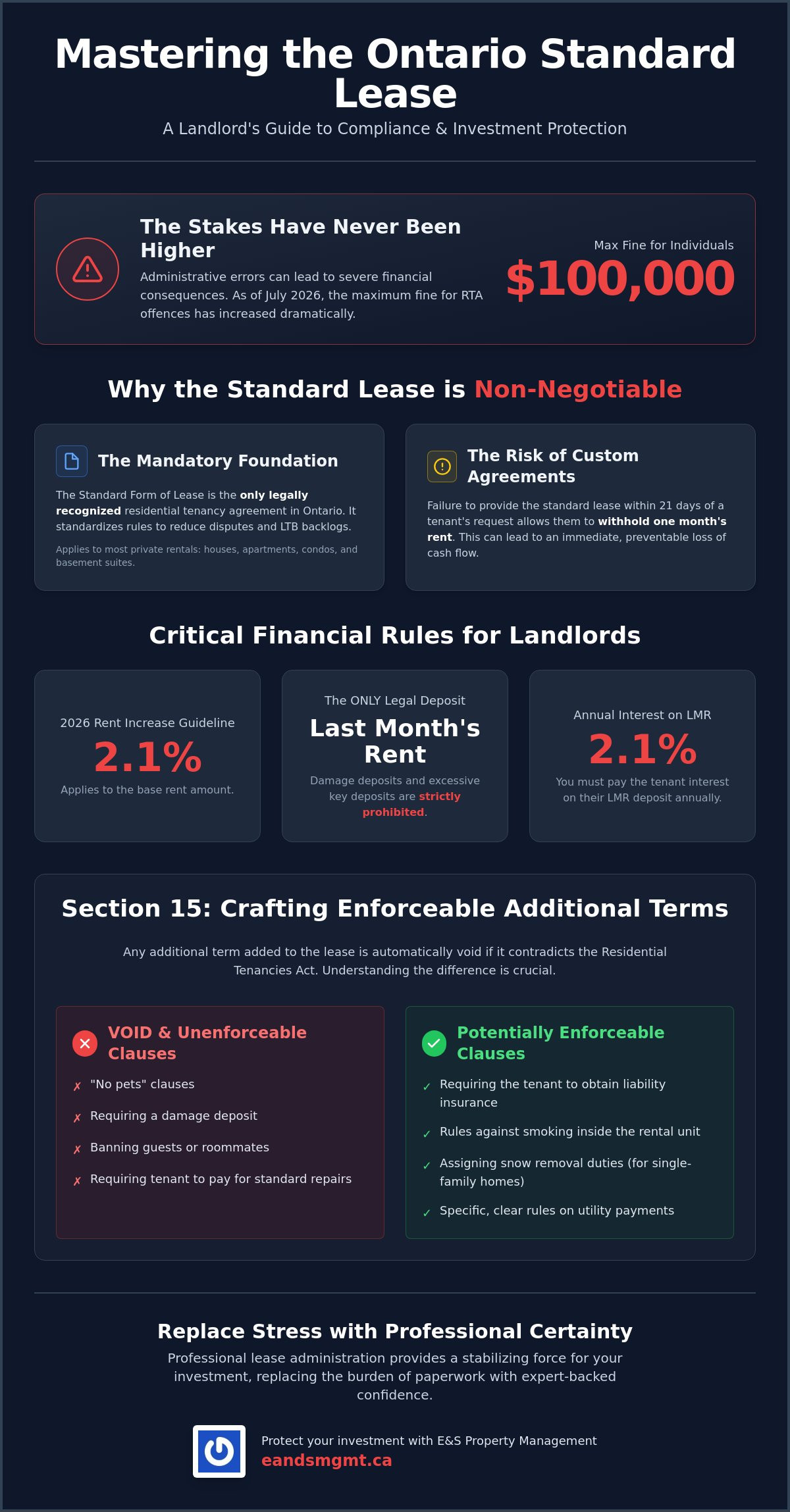
Beyond financial loss, custom contracts frequently lead to void clauses that won’t hold up during an LTB hearing. Many landlords accidentally include terms that are illegal, such as “no pets” or “no guests” policies. When these issues go before the board, the landlord often loses the case and may face penalties. As of July 2026, the maximum fines for offences under the Act have increased to $100,000 for individuals. Using the official Ontario standard lease agreement guide ensures you aren’t accidentally putting yourself at risk of these severe financial consequences.
Navigating the 15 Core Sections: A Landlord’s Breakdown
Filling out a legal document can feel like a high-stakes puzzle where one wrong piece ruins the whole picture. Sections 1 through 4 of the standard form focus on the basics: who is involved, where the property is located, and how parties can be reached. Accuracy here is vital. If you provide an incorrect address for service, you may face significant delays when trying to deliver official notices for unit inspections or rent arrears. This Ontario standard lease agreement guide serves as a reminder that these administrative details are the foundation of your legal protection.
Rent, Deposits, and Utilities (Sections 5-9)
Clarity in the financial sections prevents the most common landlord-tenant disputes. You must distinguish between “Base Rent” and “Total Rent,” especially since the 2.1% rent increase guideline for 2026 applies specifically to the base amount. For a deeper look at the legal requirements for each field, you can consult Ontario’s official lease guide. Remember that the only legal deposit you can collect is the Last Month’s Rent (LMR). Damage deposits or “key deposits” that exceed the actual replacement cost are strictly prohibited. In 2026, you are also required to pay your tenant 2.1% interest on their LMR deposit annually. When outlining utilities, be incredibly specific. Ottawa winters are long and expensive; leaving utility responsibilities vague is a recipe for financial strain.
Smoking, Pets, and Insurance (Sections 10-11)
Many landlords are surprised to learn that “no pets” clauses are generally void under the Act. While you can choose not to rent to a pet owner initially, you cannot evict a tenant simply for bringing a pet into the home later. Smoking rules are different. You have the right to ban smoking to protect your property’s air quality and long-term value. In Section 11, always require tenant insurance as a mandatory condition. This isn’t just a suggestion; it’s a critical layer of protection that ensures your tenant’s belongings and liability are covered, shielding you from unnecessary complications if an accident occurs.
Every blank left on a lease represents a potential loophole. Professional oversight ensures that your calculations are accurate and your terms are enforceable. If the weight of managing these details feels like a burden, leaning on full-service property management can provide the stabilizing force you need to enjoy your investment without the administrative headache. Taking the time to get these 15 sections right today prevents the stress of an LTB hearing tomorrow.
The Power of Section 15: Crafting Enforceable Additional Terms
While the standard form provides the skeleton of your agreement, Section 15 is where you add the muscle. This “Additional Terms” section allows you to tailor the document to the specific needs of your property, but it requires a steady, informed hand. Any term you include that contradicts the Residential Tenancies Act is automatically void, regardless of whether the tenant signs it. Relying on this Ontario standard lease agreement guide helps you navigate the fine line between protecting your investment and inadvertently creating unenforceable rules. For a detailed breakdown of what the province allows, the Official Guide to Ontario’s Standard Lease provides an excellent baseline for compliance.
Vague or overreaching language in Section 15 is a leading reason landlords lose cases at the Landlord and Tenant Board. When terms are unclear, the Board typically rules in favor of the tenant. This is why having a seasoned property manager vet your clauses is so valuable. They act as a protective guardian, ensuring your custom terms are both precise and legally sound. By using professional oversight, you don’t just fill space; you create a stabilizing framework for your entire tenancy.
Illegal Clauses to Avoid
Many well-meaning landlords include clauses that simply won’t hold up in court. For example, you cannot legally require a tenant to provide post-dated checks only, nor can you ban guests from the unit. Another common pitfall is the “fixed-term move-out” clause. In Ontario, tenancies automatically transition to a month-to-month arrangement once the initial term ends, and you cannot force a tenant to waive this right in Section 15. An illegal clause in Section 15 does not void the entire lease, only that specific term.
Essential Terms for Ottawa Landlords
In the Ottawa market, specific environmental and legal factors demand clear additional terms. Snow removal and lawn maintenance are frequent points of contention during our long winters. If you want the tenant to be responsible for these tasks, it’s often best to structure this as a separate service agreement rather than a simple lease clause to ensure it remains enforceable. If your investment is a condo, you must include a term requiring the tenant to comply with all condo corporation bylaws. Finally, setting clear maintenance reporting requirements helps you stay ahead of repairs. You can specify that all non-emergency repair requests must be submitted in writing, which creates a reliable paper trail for your records and ensures your property receives the meticulous care it deserves.
Practical Lease Management for Ottawa Property Owners
Ottawa’s rental market moves to a distinct rhythm, largely influenced by the seasonal rotations of the diplomatic and military communities. If you are part of the Foreign Service, you know that your posting schedule dictates your life, including when your property becomes vacant. Managing the lease cycle from marketing to move-out requires a proactive approach that respects these local timelines. This Ontario standard lease agreement guide helps you stay organized, but the real work begins after the ink is dry. You must ensure that every communication is documented and that your transitions to month-to-month status are handled with the same care as the initial signing.
Managing Leases from Abroad
Being posted abroad shouldn’t mean losing sleep over your Ottawa investment. For non-resident landlords, the distance can turn a minor repair into a major source of anxiety. One critical requirement is having a local “Agent for Service.” This is a person or entity within Ontario authorized to receive legal documents on your behalf. Without one, you might miss essential LTB notices or legal filings. Modern property management software now acts as a bridge, giving you real-time access to financial reporting and maintenance updates from anywhere in the world. It provides the visibility you need to feel like you’re right next door, even when you’re across an ocean.
Annual Rent Increases and N1 Forms
Consistency is the key to maintaining your property’s value over time. In Ontario, you have the right to increase rent once every 12 months, provided you follow the strict rules set by the province. For 2026, the rent increase guideline is set at 2.1%. To implement this, you must provide your tenant with at least 90 days’ written notice using the official N1 form.
Missing this window by even a single day means you cannot collect the increased amount until the following year. Over a long-term tenancy, these missed opportunities compound into thousands of dollars in lost revenue. If the administrative burden of tracking these dates feels overwhelming, our Full-Service Property Management takes the guesswork out of the process, ensuring every notice is served accurately and on time.
Professional lease management is about more than just paperwork; it’s about maintaining the health of your investment. By documenting every interaction and staying ahead of regulatory deadlines, you create a stable environment for your tenants and a predictable income stream for yourself. This methodical approach is what transforms a stressful obligation into a reliable asset.
Why Professional Lease Administration Protects Your Investment
Navigating the legal landscape of the Ontario standard lease agreement guide can feel like a full-time job. E&S Property Management brings over 40 years of experience to every contract we handle, acting as a protective guardian for your rental investment. We understand that behind every lease is a significant personal asset and a landlord who wants to do the right thing. Our role is to bridge the gap between complex provincial regulations and your desire for a stable, profitable rental experience. By applying four decades of local wisdom, we transform the burden of administrative compliance into a source of long-term investor peace of mind.
A legally sound lease is essential, but it is only as strong as the tenant who signs it. Meticulous care begins long before the move-in date through rigorous tenant screening. We ensure that the individuals living in your home respect the property and the terms of the agreement. This proactive approach positions your property for sustained value, ensuring that the transition from one tenancy to the next is seamless and professional.
Beyond the Paperwork: Our Full-Service Approach
The execution of a lease is just the first step in our Full-Service Property Management. We conduct thorough move-in inspections to document the property’s condition in detail, creating a clear baseline that upholds the lease’s maintenance obligations. If an emergency arises at 3:00 AM, our 24/7 maintenance response team is ready to act. This level of oversight ensures that your property is always cared for, preventing minor issues from escalating into costly repairs or legal disputes.
The E&S Difference for Expat Landlords
For members of Global Affairs Canada or the DND serving abroad, the anxieties of property ownership are amplified by distance. We specialize in supporting expatriate landlords, providing a stabilizing force while you are posted in a different time zone. Our team handles the complexities of Non-Resident Tax Administration alongside your lease management, ensuring that NR6 and NR4 filings are completed accurately and on time. We invite you to delegate the daily burdens of your Ottawa rental to a seasoned, empathetic partner who treats your home with the same meticulous care you would. Let us handle the details so you can focus on your mission abroad with total confidence.
Securing Your Rental Legacy in 2026 and Beyond
Navigating the complexities of the Ontario standard lease agreement guide is about more than just paperwork; it’s about protecting the long-term value of your investment. You’ve learned how to identify enforceable additional terms and why clear communication is your best defense against LTB backlogs. Whether you’re managing a single condo or a family home while posted abroad, the right administrative foundation ensures your property remains a source of relief rather than stress.
Since 1981, our team has acted as a dedicated steward for Ottawa landlords, specializing in the unique needs of Foreign Service members. We provide comprehensive NR6 and NR4 tax support alongside meticulous property oversight, ensuring you stay compliant even from thousands of miles away. You don’t have to carry the burden of legislative changes and maintenance alone. Protect your investment with professional Ottawa property management. Your journey toward investor peace of mind starts with a single, confident step toward professional partnership.
Frequently Asked Questions
Can I still use my own custom lease instead of the Ontario Standard Lease?
You cannot use a custom lease for most residential tenancies in Ontario. The law requires the Standard Form of Lease for new agreements signed on or after March 1, 2021. If you attempt to use a private contract, your tenant has the legal right to demand the standard version. Any terms in your custom lease that contradict the Residential Tenancies Act are automatically void, leaving you without the protection you intended to create.
What happens if a tenant refuses to sign the Standard Form of Lease?
If a tenant refuses to sign the standard form before moving in, you may choose not to proceed with the tenancy. However, if they are already in the unit, they have the right to request the document in writing. If you don’t provide it within 21 days, they can withhold one month’s rent. Providing the correct form promptly ensures your relationship remains professional and avoids unnecessary financial disputes and LTB complications.
Can I include a “no pets” clause in the additional terms of the Ontario lease?
You can include a “no pets” clause in Section 15, but it’s almost always void. Under the Residential Tenancies Act, provisions that prohibit animals in a residential unit have no legal effect. The only exceptions involve specific condo bylaws, serious allergic reactions, or safety concerns. It’s better to focus on terms that protect your property value through regular inspections rather than relying on unenforceable pet bans that won’t hold up in court.
How much can I charge for a key deposit in Ontario?
You may only charge a key deposit that is refundable and does not exceed the actual replacement cost of the keys or fobs. Charging an inflated amount is illegal and can lead to disputes at the Landlord and Tenant Board. This deposit must be returned in full when the tenant hands back the keys at the end of their stay, serving as a simple, fair way to manage property access and security.
Is a lease still valid if it is not in the standard form?
The tenancy remains valid even if you didn’t use the official form, but the landlord carries all the risk. Your tenant can still enforce their rights under the Act, while your custom clauses may be ignored by the Board. To move from a state of uncertainty to professional clarity, it’s always best to transition any existing verbal or custom arrangements to the mandatory standard form as soon as possible to protect your investment.
What is the most important “additional term” to include in an Ottawa rental?
For Ottawa properties, a separate agreement for snow removal and lawn maintenance is often the most critical addition. Because Ontario law generally places the burden of maintenance on the landlord, simply adding a line in the lease isn’t enough. Structuring this as a clear, separate service contract ensures your property stays safe during winter and prevents the stress of unexpected liability or city fines for unplowed sidewalks during our long winters.
Do I need to provide a copy of the lease to the tenant?
You are legally required to provide a signed copy of the lease to your tenant within 21 days of the date it was signed. This transparency builds trust and ensures both parties understand their obligations from the start. If you miss this deadline, the tenant is permitted to withhold rent until the document is in their hands, which can disrupt your financial planning and create avoidable tension in the landlord-tenant relationship.
Can I require post-dated checks in the Ontario Standard Lease?
You cannot legally require a tenant to provide post-dated checks or set up automatic withdrawals as a condition of the tenancy. While many tenants prefer these methods for their own convenience, the law protects their right to choose how they pay. This Ontario standard lease agreement guide emphasizes that while you can suggest these options to simplify your accounting, you must remain flexible and professional if a tenant prefers other legal payment methods.


