
Managing Canadian rental property from abroad isn’t simply an annual tax return issue; it’s an ongoing, monthly operational workflow. For any overseas landlord, understanding non-resident withholding tax on rent Canada often begins with an unwelcome shock: the Canada Revenue Agency expects 25% of your gross rental income sent to them every single month. Trying to coordinate these mandatory remittances from another time zone while fearing unexpected audits or steep late penalties can easily turn your investment into a source of constant anxiety.
You don’t have to surrender a quarter of your top-line revenue to keep your home in good standing with the tax authorities. By mastering the statutory rules around Section 216 net elections and timely Form NR6 undertakings, you can protect your monthly cash flow and ensure your Canadian property remains a thriving asset. This guide walks you through every critical deadline, Part XIII obligation, and annual NR4 filing requirement so you can manage your holdings abroad with complete confidence and peace of mind.
Key Takeaways
- Gaining a clear understanding of non-resident withholding tax on rent Canada helps you navigate the statutory 25% gross Part XIII requirement and avoid costly CRA audits.
- Filing Form NR6 before the start of the tax year lets you elect under Section 216, significantly reducing monthly withholdings by taxing net rental profit instead of gross revenue.
- Appointing an authorized Canadian withholding agent eliminates the logistical burden of managing monthly remittances and annual NR4 reporting from across different time zones.
- Adhering strictly to the CRA compliance calendar ensures you never forfeit eligible expense deductions or face severe late-remittance penalties.
- Delegating non-resident tax administration and day-to-day tenancy oversight to seasoned local professionals keeps your Canadian real estate secure and profitable while you live abroad.
Understanding Non-Resident Withholding Tax on Canadian Rental Property
Leasing out your residential home while living overseas introduces a rigorous set of administrative duties governed by Part XIII of the Canadian Income Tax Act. For any expat owner, understanding non-resident withholding tax on rent Canada is essential because the Canada Revenue Agency (CRA) handles revenue crossing international borders with intense scrutiny. Under established Canadian international taxation rules, rental proceeds paid to foreign residents are subject to automatic deductions at source. The CRA holds both the payer and the property owner jointly and severally liable for unremitted balances, meaning an oversight can trigger immediate collection actions and hefty arrears.
The 25 Percent Gross Withholding Rule Explained
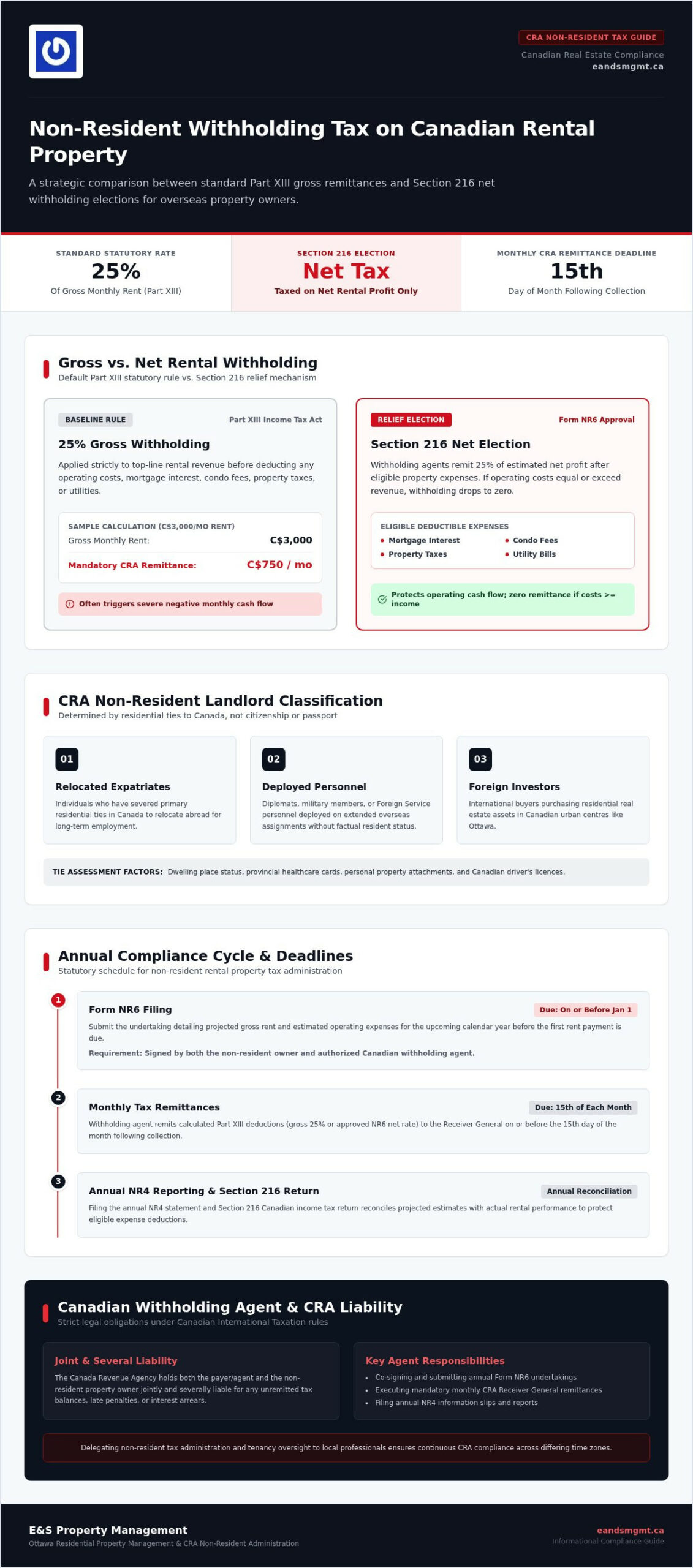
The standard statutory requirement mandates that exactly 25% of gross rent must be withheld and remitted to the Receiver General on or before the 15th day of the month following collection. Proper insight into understanding non-resident withholding tax on rent Canada reveals that this calculation applies strictly to top-line rent before you deduct a single dollar for mortgage interest, condo fees, property taxes, or utility bills. For example, if your Ottawa home rents for C$3,000 per month, the default statutory remittance is C$750 every month, regardless of whether your actual operating costs leave you in a deficit. Operating under this baseline rule often creates substantial negative cash flow, forcing landlords to cover monthly property shortfalls from their personal savings abroad.
Who Qualifies as a Non-Resident Landlord Under CRA Guidelines?
Canadian tax residency is defined by your residential ties to the country, not your citizenship or passport. You can hold Canadian citizenship and still be deemed a non-resident for tax purposes if your central life attachments have shifted overseas. When assessing liability, understanding non-resident withholding tax on rent Canada means evaluating primary ties, including whether you have left a dwelling place behind, along with secondary ties like provincial healthcare cards, personal property, and Canadian driver’s licences. Typical situations that trigger non-resident landlord tax obligations include:
- Individuals who have severed primary residential ties to relocate abroad for long-term employment.
- Diplomats, military members, or Canadian Foreign Service personnel deployed on extended assignments outside Canada who no longer hold factual resident status.
- International owners who purchase residential real estate as investments in stable urban hubs like Ottawa.
Recognizing your tax classification early allows you to put proper withholding mechanisms in place before the first tenant payment arrives, protecting you from sudden audits and unexpected statutory liabilities.
Gross vs. Net Rental Withholding: The Section 216 Election and Form NR6
Default Part XIII rules treat gross rent as taxable income without considering carrying costs. A deeper understanding of non-resident withholding tax on rent Canada reveals an essential relief mechanism: the Section 216 election. By electing under Section 216 of the Income Tax Act, you choose to be taxed on net rental income at graduated Canadian rates rather than surrendering a flat 25% of gross collections. Following the formal CRA non-resident rental income requirements keeps your real estate cash flow positive throughout the year.
How Form NR6 Lowers Monthly Withholding Obligations
Filing Form NR6 (Undertaking to File an Income Tax Return by a Non-Resident Receiving Rent) transitions your remittances from gross to net. This formal document outlines your projected gross rent alongside estimated operating expenses for the upcoming calendar year. Both you and your Canadian withholding agent must sign the form and submit it to the CRA on or before January 1, or before your first rental payment is due. Once approved, your agent remits 25% of estimated net profit each month. If your operating costs equal or exceed your revenue, your monthly remittance amount drops to zero.
Filing the Section 216 Return to Reconcile Actuals
Securing an approved NR6 creates a binding legal pledge to submit a separate Section 216 income tax return (Form T1159) on or before June 30 of the following year. This return reconciles your estimated numbers with exact financial figures. Missing this deadline carries severe consequences: the CRA revokes your net status, retroactively assesses 25% on gross revenue, and levies compounding interest alongside penalties. Partnering with a dedicated team for NR6 and NR4 tax filing support ensures every operational deadline is met cleanly, shielding you from sudden retroactive liabilities.
Eligible Rental Expenses Deductible Under Net Reporting
Electing net taxation allows you to deduct legitimate operational costs directly related to running and preserving the home:
- Full property management fees and tenant placement commissions.
- Municipal property taxes, school taxes, and building insurance policies.
- Routine maintenance, emergency plumbing, electrical repairs, and seasonal servicing.
- Mortgage interest paid on funds borrowed to acquire the rental property.
Most expat homeowners should generally avoid claiming Capital Cost Allowance (CCA) on the building. Claiming depreciation can trigger complex tax recaptures upon sale and jeopardizes your ability to claim the principal residence exemption later.
The Role of the Canadian Withholding Agent and Strict CRA Liabilities
Managing the mechanics of Part XIII tax from abroad requires an on-the-ground representative. A foundational part of understanding non-resident withholding tax on rent Canada is recognizing the legal responsibilities placed upon your designated Canadian withholding agent. Under statutory law, an agent must be a Canadian resident individual or a Canadian corporation. This representative opens a formal non-resident tax account with the CRA, calculates deductions, and remits payments directly to the Receiver General. Crucially, the CRA holds withholding agents personally, jointly, and severally liable for any tax that is under-withheld or remitted late, meaning the government can pursue the agent directly for balances due.
Why Relying on Tenants as Withholding Agents Fails
Historically, Canadian law technically placed the burden of withholding 25% Part XIII tax directly on residential tenants if no agent existed. Recent legislative updates through Bill C-15 relieved individual residential tenants from this statutory withholding duty as of August 2024, shifting remittance obligations squarely back onto non-resident landlords who lack representation. Even prior to this change, expecting tenants to handle government remittances created severe friction. Tenants rarely understand CRA payroll and non-resident accounting portals, leading to missed deadlines, miscalculated remittances, and strained relationships. Appointing a professional Canadian agent insulates your renters completely, allowing them to pay their full rent normally while ensuring all government deductions remain compliant.
Mandatory Annual Filings: Form NR4 and Remittance Deadlines
Operating as a withholding agent involves precise, year-round administrative oversight governed by the Non-Resident Tax Withholding Guide (T4061). The agent must handle two core operational obligations without delay:
- Monthly Remittances: Any tax withheld, whether gross or net, must arrive at the CRA on or before the 15th day of the month following collection. Late remittances face escalating penalties ranging from 3% to 10% of the overdue balance.
- Form NR4 Compliance: On or before March 31 of each year, the agent must file an annual NR4 Return (Statement of Amounts Paid or Credited to Non-Residents of Canada) reporting gross rental amounts and total withholdings, while issuing two copies directly to you for filing your Section 216 return.
Asking well-meaning friends or family members to shoulder this legal liability often leads to missed deadlines and personal strain. Engaging an experienced management partner relieves loved ones of financial liability, giving you full confidence that every remittance and NR4 filing satisfies strict CRA standards.
Key Deadlines and Step-by-Step Annual Tax Calendar for Expat Landlords
Living abroad across disparate time zones makes staying ahead of bureaucratic schedules a genuine challenge. A thorough understanding of non-resident withholding tax on rent Canada requires viewing compliance not as an isolated yearly chore, but as a structured twelve-month calendar. The CRA does not offer grace periods for expat oversights; missing a statutory filing deadline triggers an automatic forfeiture of your net expense deductions, reverting your account to full gross taxation alongside compounding interest penalties.
Pre-Year Planning: Submitting Form NR6
Preparation begins well before the calendar turns. During the autumn months, you and your Canadian agent should assemble an accurate operating budget detailing anticipated gross revenues and eligible deductible expenses. The CRA must receive this completed Form NR6 on or before January 1, or prior to the first rent payment of the new tax year. Crucially, your agent must continue remitting 25% of gross rent until the CRA issues written approval for your net election. Remitting on a net basis prematurely leaves your agent exposed to statutory assessments.
Spring and Summer Deadlines: NR4 Slips and Section 216 Returns
Once the operational year concludes, the tax reconciliation phase unfolds across a set of mandatory milestones:
- March 31: Your Canadian agent files your annual NR4 return with the CRA and provides you with your copies confirming gross rents and withheld taxes.
- June 30: If you operated under an approved NR6 undertaking, your Section 216 income tax return (Form T1159) must be filed on or before this date. Missing June 30 revokes your net status retroactively.
- Two-Year Elective Window: If you did not file an NR6 and paid 25% gross withholdings all year, you have two years from the end of that tax year to file an elective Section 216 return and recover your eligible deductions.
Maintaining meticulous digital financial records ensures seamless coordination between routine property maintenance and cross-border accounting. To safeguard your investment without administrative stress, partner with E&S Property Management for dedicated non-resident tax administration and full-service residential oversight.
Navigating CRA Non-Resident Compliance with Professional Ottawa Property Management
Living halfway across the world while maintaining a rental home in Canada introduces substantial logistical and emotional strain. Complete understanding of non-resident withholding tax on rent Canada extends beyond learning statutory formulas; it requires disciplined, on-the-ground execution every single month. Appointing a seasoned local property manager as your Canadian withholding agent creates an essential bridge between your physical property, your tenants, and the CRA. This professional oversight unites routine property stewardship with meticulous non-resident tax administration, ensuring your real estate remains protected from both physical neglect and statutory penalties.
Protecting Expat Landlords and Foreign Service Personnel
Since 1981, E&S Property Management has operated as a dedicated steward for non-resident property owners, developing specialized expertise in supporting Canadian Foreign Service personnel and Department of National Defence postings abroad. Relocating your household overseas for a diplomatic mission or military assignment brings enough complexity without fielding midnight tenant repair requests or stressing over rental vacancies. Through professional tenant placement services, regular property inspections, and emergency 24/7 maintenance response, your Ottawa residence receives continuous care from vetted local trades, preserving its long-term market value while you focus on your overseas commitments.
Integrated Tax Administration and Peace of Mind
Physical home maintenance represents only half the responsibility of being an overseas landlord. E&S Property Management acts as your qualified Canadian withholding agent, taking on the direct administrative burden to shield you from CRA compliance liabilities. Our team calculates accurate monthly deductions, remits funds to the Receiver General on time, provides comprehensive NR6 and NR4 tax filing support, and prepares mandatory year-end paperwork without fail.
Organized financial reporting and accounting keep your operating numbers completely transparent, simplifying year-end Section 216 return preparation for your chartered professional accountant. Delegating these duties replaces the stress of cross-border compliance with total operational order. Connect with E&S Property Management to protect your Canadian residential investments and enjoy true peace of mind while living abroad.
Turn Cross-Border Tax Complexities into Long-Term Peace of Mind
Mastering Canadian real estate compliance while living overseas doesn’t have to be overwhelming. A clear understanding of non-resident withholding tax on rent Canada allows you to move beyond default gross withholdings, preserve your monthly rental cash flow with timely Section 216 elections, and keep your CRA accounts completely audit-proof. When you establish the right operational workflows, your Canadian property remains a rewarding financial asset rather than an ongoing administrative burden across time zones.
With over four decades of trusted boutique residential management in Ottawa since 1981, E&S Property Management provides specialized support tailored for Canadian Foreign Service members and expat homeowners worldwide. From regular property inspections and maintenance coordination to complete non-resident tax administration covering NR6 filings, monthly remittances, and annual NR4 reporting, we act as your dedicated local guardian on the ground. Delegate your Ottawa rental management and CRA tax administration to E&S Property Management and rest easy knowing your home and financial interests are in experienced, caring hands.
Frequently Asked Questions
What happens if a non-resident landlord in Canada fails to withhold tax on rent?
The CRA assesses the unpaid 25% tax directly against the property owner and payer, accompanied by severe financial penalties. Initial late withholding penalties start at 10% of the required amount, rising to 20% for repeat occurrences, alongside compounded daily interest charges. Failing to comply can also prompt a formal statutory audit and lead to CRA liens placed against the Canadian property title, jeopardizing your investment equity.
Can a tenant act as the Canadian withholding agent for a non-resident landlord?
While Canadian law historically permitted tenants to withhold tax, legislative updates via Bill C-15 officially removed this statutory requirement for residential tenants as of August 2024. Relying on tenants to manage CRA tax accounts almost always leads to administrative breakdowns, missed payments, and strained relations. Appointing an established Ottawa residential property manager as your agent ensures reliable compliance and relieves your renters of confusing bureaucratic burdens.
How does Form NR6 reduce non-resident withholding tax on Canadian rental income?
Form NR6 allows the CRA to calculate your monthly 25% withholding tax on projected net rental profit rather than total gross revenue. In practical terms for understanding non-resident withholding tax on rent Canada, this elective undertaking accounts for carrying expenses like mortgage interest, property taxes, and management fees. If eligible expenses offset your rental income, your required monthly cash remittance to the CRA can drop to zero once approved.
What is the deadline for filing a Section 216 return with the CRA?
If you operated under an approved Form NR6, your Section 216 return (Form T1159) must be filed on or before June 30 of the following calendar year. Missing this firm deadline automatically voids your net status, prompting the CRA to demand 25% of gross rent plus arrears interest. If you didn’t submit an NR6, you have two full years from the end of the tax year to file electively.
Can non-resident landlords deduct property management and repair expenses in Canada?
Yes, non-resident landlords who file under Section 216 can deduct legitimate carrying costs directly associated with operating their rental property. Deductible items include full-service property management fees, tenant placement commissions, municipal property taxes, routine property repairs, and insurance premiums. When managing your Ottawa home from abroad, maintaining detailed financial reporting and vendor receipts ensures every eligible maintenance expense is recognized cleanly during annual tax reconciliation.
What is Form NR4 and when must it be issued to non-resident owners?
Form NR4 is an official CRA tax slip that reports total gross rental revenue paid to a non-resident alongside all Part XIII taxes withheld during the tax year. A core element of understanding non-resident withholding tax on rent Canada is that your Canadian withholding agent must submit this return to the CRA and provide you with two copies on or before March 31. You then use these slips to complete your final return.


