
Owning rental property in Ontario has evolved from a simple investment into a high-stakes legal marathon where a single paperwork error can cost you months of rental income. You likely started this journey seeking a reliable stream of passive income, but the reality of 2026 regulations can feel like a full-time job. Between the 2.1% rent increase cap and the strict new N13 requirements for professional engineering reports, the margin for error is thinner than ever.
It’s natural to feel overwhelmed by the complexities of the Residential Tenancies Act or the stress of managing repairs from a distance. This guide clarifies exactly what does a property manager do in Ontario to act as your legal and operational shield. We’ll explore how a disciplined steward secures your investment through proactive property inspections, 24/7 emergency maintenance response, and specialized NR6 tax filing support for non-resident landlords. By the end of this article, you’ll understand how professional oversight transforms a chaotic portfolio into a stable, value-driven asset.
Key Takeaways
- Understand the evolving legal landscape and what does a property manager do in Ontario to safeguard your rental income against regulatory risks.
- Learn how to navigate the Landlord and Tenant Board (LTB) through professional representation and the precise delivery of legal notices.
- Discover the systems used to maintain asset longevity, including regular property inspections and rapid emergency maintenance response resolutions.
- Explore the specialized financial reporting and tax filing support required to keep your investment compliant with CRA regulations for non-residents.
- Identify the criteria for selecting a management partner with deep expertise in the Ottawa rental market and foreign service relocation needs.
Defining the Role: What Does a Property Manager Do in Ontario?
A Property manager in this province acts as your primary legal representative for residential real estate assets. To understand what does a property manager do in Ontario, one must look past simple rent collection. The role involves a sophisticated balance between tenant satisfaction and the owner’s financial performance. The primary objective is to maintain a high standard of asset longevity while ensuring the rental unit remains a profitable venture for the long term.
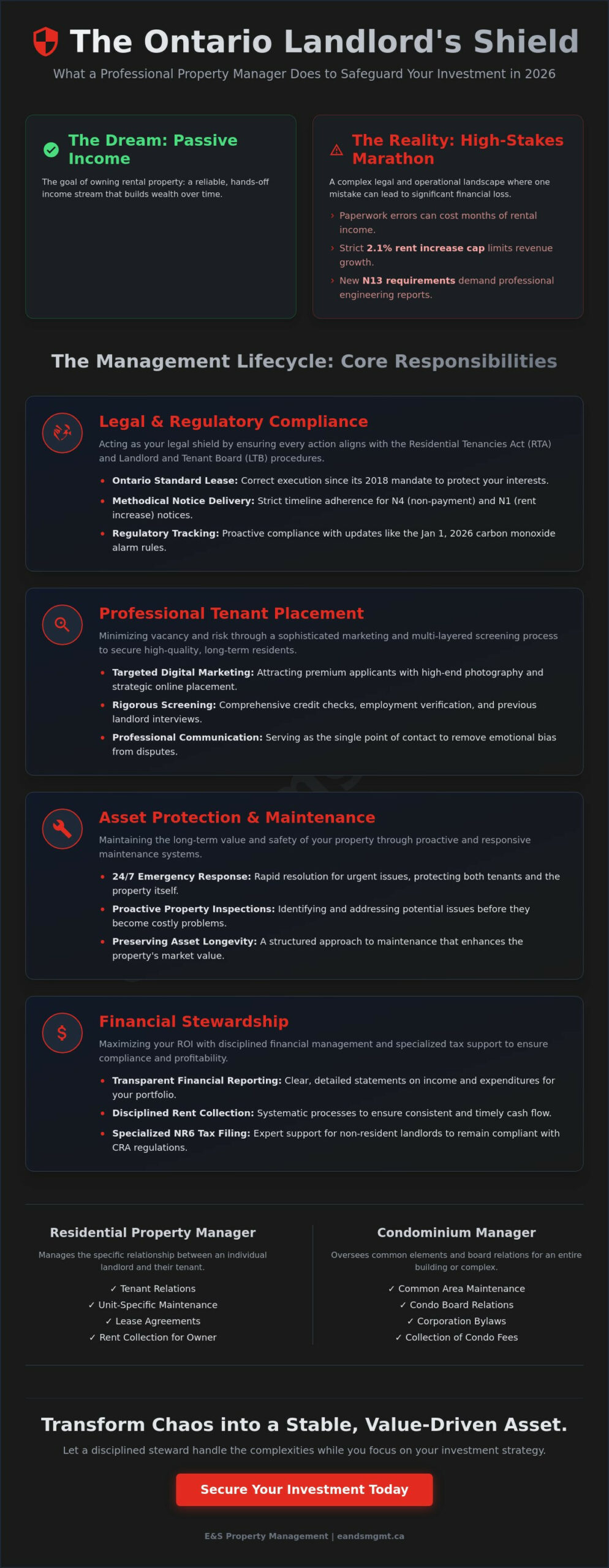
It’s vital to distinguish this role from Ontario condominium management. A condo manager oversees common elements and board relations for an entire building. In contrast, a residential property manager focuses specifically on the relationship between the individual landlord and the tenant. Our “Steady Hand” philosophy centers on removing the operational burdens that often derail private investors. We provide the stability needed to navigate complex oversight without the daily stress of administrative friction.
The Bridge Between Owner and Tenant
A property manager serves as the single point of contact for all tenant communications. This professional distance is vital because it removes the emotional charge from disputes. It ensures every interaction remains grounded in the lease agreement and professional standards. When you don’t have to handle midnight calls or late-rent excuses, you can focus on your broader investment strategy. This distance often leads to a more efficient conflict resolution when issues arise.
Professionalizing the relationship also ensures compliance with the Ontario Human Rights Code and provincial privacy legislation. A disciplined steward manages tenant data with meticulous care. They ensure that every interaction, from the initial viewing to the final move-out inspection, respects the legal rights of all parties involved. This approach protects the landlord from claims of bias or privacy violations.
Navigating the Ontario Legal Landscape
Understanding what does a property manager do in Ontario requires a deep dive into the Residential Tenancies Act (RTA). With frequent legislative updates, such as the 2026 rent increase guideline of 2.1%, staying compliant is a full-time commitment. A manager acts as a legal shield, ensuring that your property operations align with the latest provincial requirements and LTB procedures.
- Standardizing the Ontario Standard Lease: Since 2018, this document has been mandatory for most private residential tenancies. A manager ensures it’s completed correctly to protect your interests while avoiding unenforceable clauses.
- Methodical Documentation: Every notice, whether it’s an N4 for non-payment or an N1 for a rent increase, must follow strict timelines. A manager handles the service of these notices to ensure they’re legally binding.
- Regulatory Updates: Managers track changes like the new carbon monoxide alarm requirements effective January 1, 2026, ensuring your property meets the Ontario Fire Code.
This methodical approach to legal compliance reduces the risk of costly hearings at the Landlord and Tenant Board (LTB). By maintaining order and foresight, a manager protects your reputation and your bottom line. They transform the chaos of legal navigation into a structured administrative resolution.
The Management Lifecycle: Core Responsibilities and Duties
Operational success in real estate depends on a methodical approach to the entire management lifecycle. While the legal framework provides the rules, the daily execution of duties determines the actual return on investment. If you’re asking what does a property manager do in Ontario to maximize these returns, the answer lies in a disciplined cycle of marketing, screening, and maintenance. This structured flow ensures that every stage of the tenancy is handled with foresight and precision.
Professional Tenant Placement and Leasing
In the competitive Ottawa rental market, minimizing vacancy periods requires a sophisticated marketing strategy. We utilize high-end photography and targeted digital marketing to position your asset as a premium choice for high-quality applicants. A generic listing is no longer enough to attract stable, long-term tenants in 2026. This professional presentation creates a sense of value before the first viewing even takes place.
A multi-layered screening process is the cornerstone of our tenant placement service. We conduct rigorous credit checks, employment verifications, and previous landlord interviews to identify reliable residents. Once a tenant is selected, we execute a comprehensive move-in inspection. This document serves as a vital baseline for future damage claims, ensuring that the property’s condition is recorded with technical accuracy before the keys are handed over.
Proactive Maintenance and Emergency Response
Maintenance is where asset longevity is either won or lost. Understanding what does a property manager do in Ontario involves looking at how they handle the unexpected. A dedicated 24/7 emergency maintenance response prevents minor mechanical failures from escalating into structural damage. By addressing a leaking pipe at 2:00 AM, we protect the physical integrity of your investment and maintain tenant satisfaction simultaneously.
Beyond emergencies, we coordinate routine upkeep through a vetted network of licensed contractors. This includes scheduling preventative maintenance for HVAC systems and roofing to preserve the property’s value over time. For landlords owning units in multi-residential buildings, we ensure all work aligns with the guidelines provided by the Condominium Authority of Ontario (CAO). This methodical oversight removes the burden of contractor management from the owner while ensuring high-quality results.
Strategic rent collection and arrears management complete the lifecycle. With the recent legislative change reducing the N4 notice period for non-payment of rent to 7 days, prompt action is essential. We maintain a stable cash flow by following these strict timelines and providing transparent financial reporting. If you seek a partner to manage these operational details, our full-service property management solutions provide the steady hand your portfolio needs.
Regulatory Compliance: Handling the LTB and CRA Requirements
Compliance isn’t just about following rules; it’s about mitigating financial and legal exposure through disciplined oversight. When people ask what does a property manager do in Ontario, they often overlook the technical burden of regulatory adherence. A manager ensures every action taken on your behalf aligns with the Residential Tenancies Act. This includes meeting the January 1, 2026, requirement for carbon monoxide alarms on every storey. It also means applying the 2.1% rent increase guideline for 2026 with the mandatory 90-day notice period using official N1 or N2 forms. Without this precision, a landlord risks costly delays or voided applications.
Ensuring Compliance with the Landlord and Tenant Board (LTB)
Representation at the Landlord and Tenant Board (LTB) requires a methodical approach to evidence. The LTB places a heavy burden of proof on the landlord. If you’re pursuing an N12 notice for “own use,” you must provide professional documentation that satisfies the board’s scrutiny. Recent legislative changes have shortened the timeframe to request an LTB order review to just 15 days. A property manager acts as your steady hand during these proceedings, ensuring no deadlines are missed and every application is filed with technical precision. To issue an N13 notice for renovations, we now secure the required report from a qualified engineer or architect to prove the unit must be vacant, as mandated by the latest provincial requirements.
Specialised Support for Non-Resident (Expat) Landlords
For expat landlords or foreign service members, CRA compliance is a significant hurdle that generic management firms often ignore. This is where specialized NR6 and NR4 tax filing support becomes essential. We manage the monthly tax withholdings required by the federal government. If an NR6 form is approved, we can reduce these withholdings by calculating them based on net rental income instead of gross. Each year, we issue the necessary NR4 slips to ensure your Canadian tax obligations are met with full transparency. Acting as the Canadian agent for service, we provide a local legal presence for owners residing outside the country. This high-level consulting removes the risk of CRA penalties and provides a sense of security for international investors. We handle the administrative efficiency of tax resolution so you don’t have to worry about cross-border complexities.
Maintaining municipal fire and safety codes is another critical area of oversight. Beyond the new carbon monoxide alarm rules, we ensure the property adheres to all local Ottawa bylaws and safety standards. By conducting regular property inspections, we identify potential hazards before they become legal liabilities. This proactive stance protects your tenants and preserves the long-term value of your residential asset.
Financial Stewardship: Maximising ROI and Asset Protection
Financial stewardship is the logical outcome of meticulous property oversight. While previous sections detailed the legal and operational frameworks, this stage focuses on the data-driven decisions that protect your bottom line. To understand what does a property manager do in Ontario regarding financial health, one must look at the transition from simple bill-paying to strategic asset management. A disciplined steward treats your property as a high-performing investment, utilizing technical terminology and administrative efficiency to ensure long-term profitability.
Strategic budgeting is essential for maintaining asset longevity. We don’t just react to repairs; we forecast capital improvements. This foresight allows owners to set aside funds for major expenses like roofing or HVAC replacements before they become emergencies. By analyzing current market trends, such as the national rental vacancy rate increase to 3.1% in 2025, a manager provides the perspective needed to keep your asset competitive. In a cooling market where Toronto rents declined by 3.9% year-over-year by early 2026, having a professional who understands these shifts is the difference between a vacant unit and a stable income stream.
Consistent Rent Collection and Reporting
Maintaining a stable cash flow requires disciplined rent collection protocols. We implement digital payment systems that provide tenants with a seamless transaction experience while ensuring funds reach the owner’s account without delay. If a payment is missed, our team acts immediately within the shortened seven-day N4 notice period to resolve the arrears. This momentum is vital for protecting your monthly revenue.
Transparency is the cornerstone of our financial relationship. Every month, owners receive audit-ready financial statements that detail every dollar in and out. We track every expense against the annual budget to identify cost-saving opportunities and prevent budget overruns. This level of financial reporting and accounting provides the clarity institutional and individual investors require to monitor their portfolio’s performance with confidence.
Long-Term Asset Preservation Strategies
Asset protection extends beyond the balance sheet to the physical structure of the home. We conduct regular property inspections to catch minor wear and tear before it escalates into a major financial burden. These inspections ensure lease compliance and help maintain the property’s value in the eyes of both the tenant and the broader market. When a unit does become vacant, we advise owners on value-add renovations that specifically target higher rental yields, ensuring every dollar spent on upgrades contributes to a better ROI.
Balancing tenant retention with necessary rent adjustments is a delicate strategic task. We apply the 2026 rent increase guideline of 2.1% methodically, ensuring you capture allowable growth while maintaining a positive relationship with reliable residents. This approach reduces turnover costs and protects the asset’s value against inflation. By providing a steady hand in financial oversight, we remove the chaos of uncertainty from your investment journey.
Selecting the Right Property Management Partner in Ottawa
Choosing a property management partner is the final, most critical step in your investment journey. While you now understand what does a property manager do in Ontario, finding a firm that executes these duties with technical precision is a different challenge. You need a partner who prioritizes asset longevity and administrative efficiency over simple volume. Look for a team that utilizes modern management software to provide the transparent, audit-ready reporting discussed in earlier sections. This technology ensures you have real-time access to your portfolio’s performance without the usual operational friction.
A firm’s contractor network is a vital indicator of their reliability. Assess their response times and the caliber of their licensed professionals before signing any agreement. A disciplined steward maintains a vetted roster of experts who can handle everything from routine preventative maintenance to complex structural repairs. This network is what makes an emergency 24/7 maintenance response a tangible reality rather than just a marketing claim. It’s the difference between a minor repair and a major insurance claim.
The Value of Localized Expertise
Ottawa’s rental market has unique dynamics that require specialized regional knowledge. Understanding neighborhood-specific rental trends and municipal bylaws is essential for maximizing your yield and maintaining compliance. A partner with deep roots in the local territory can navigate market shifts with foresight, ensuring your property remains competitive even when vacancy rates fluctuate. Proximity also matters for physical oversight. When an on-site emergency occurs, a local team provides the rapid response needed to mitigate damage and protect your residents.
A 40-year track record in the Ottawa market provides a level of predictability that newer firms cannot match. This experience allows for a methodical approach to management; the team has already successfully navigated decades of economic cycles and legislative updates. This historical perspective is a signature of a seasoned professional who values order and results over quick fixes.
The E&S Property Management Standard
Our solution-oriented approach is designed to remove the chaos of residential oversight. We specialize in managing complex portfolios, providing the steady hand needed to protect and enhance your assets. This commitment to reliability has made us the preferred choice for Canadian Foreign Service members and international investors. We understand the specific needs of expat owners, from CRA tax compliance to the meticulous care required for a family home while the owner is stationed abroad.
If you’re ready to transition from a stressed landlord to a confident investor, our team is prepared to provide the high-level consulting and operational excellence you deserve. Learn more about our full-service management in Ottawa and discover how our disciplined stewardship can protect your investment for years to come.
Protecting Your Rental Portfolio with Professional Oversight
Professional stewardship is the key to transforming a high-risk rental unit into a stable, long-term financial asset. We’ve examined how a disciplined approach to the Landlord and Tenant Board and specialized CRA tax compliance provides the legal protection landlords need in 2026. Understanding what does a property manager do in Ontario allows you to step back from the daily operational friction while maintaining full confidence in your property’s performance.
Success in this market requires more than just rent collection; it demands the steady hand of a seasoned professional. With over 40 years of residential expertise in Ottawa, our team provides the administrative efficiency needed for comprehensive tenant vetting and 24/7 maintenance coordination. We also offer specialized NR6 and NR4 tax filing support to ensure our expat clients remain compliant with federal regulations. You don’t have to navigate these complexities alone.
Get a Professional Rental Assessment for Your Ottawa Property today. Let us provide the resolution-focused management your investment deserves so you can enjoy the results of your hard work without the stress.
Frequently Asked Questions
Is a property manager required to be licensed in Ontario?
In Ontario, there is no specific provincial license required to manage individual residential rental properties. However, anyone managing a condominium corporation must be licensed through the Community Manager Regulatory Authority of Ontario (CMRAO). While a residential property manager doesn’t need a license, they must still comply with the Residential Tenancies Act and local bylaws to protect the owner’s assets effectively.
What is the difference between a property manager and a condo manager?
A residential property manager represents the individual landlord’s interests within a specific rental unit. Their focus is on tenant relations, rent collection, and unit maintenance. A condo manager oversees the entire building’s common elements and works directly for the condominium corporation’s board. If you own a rental unit in a building, you’ll likely interact with both professionals for different operational needs.
How much do property management companies in Ontario typically charge?
Property management fees in Ontario are typically structured as a percentage of the collected monthly rent or a flat monthly fee. Industry averages for percentage-based fees usually range from 6% to 12%. Flat-fee structures for single-family homes often fall between $130 and $280 per unit. Landlords should also check for additional costs such as leasing fees or inspection charges before hiring a firm.
Can a property manager represent me at the Landlord and Tenant Board (LTB)?
A property manager can act as an agent for the landlord at the Landlord and Tenant Board (LTB). This involves preparing applications, serving legal notices, and attending hearings to present evidence. This role is a core part of what does a property manager do in Ontario to resolve disputes efficiently. For complex legal matters, some owners choose to involve a paralegal alongside their manager.
How does a property manager handle non-resident tax for expat landlords?
Managers handle non-resident tax by acting as the Canadian agent for service and managing monthly withholdings for the CRA. This includes filing NR6 forms to base withholdings on net income rather than gross rent. At the end of the year, the manager issues NR4 slips to ensure the owner remains compliant with federal tax laws. This specialized support is essential for expats and international investors.
Does a property manager handle evictions in Ontario?
Property managers handle the administrative and procedural steps of the eviction process in Ontario. They serve the appropriate termination notices, such as the N4 for non-payment, and file the necessary applications with the LTB. If a standard order is issued, the manager coordinates with the Court Enforcement Office to regain possession of the unit legally and safely while maintaining professional distance.
How often should a property manager inspect my rental unit?
A disciplined manager typically conducts property inspections at least twice a year to ensure lease compliance and asset longevity. Some firms opt for quarterly visits to catch minor maintenance issues before they escalate into structural damage. These regular property inspections are vital for documenting the unit’s condition and identifying any unauthorized occupants or safety hazards, such as missing carbon monoxide alarms.
What happens if a tenant has an emergency in the middle of the night?
When a tenant experiences a middle-of-the-night emergency, the property manager’s 24/7 emergency maintenance response team takes immediate action. This service ensures that critical issues like burst pipes or furnace failures are resolved quickly to prevent property damage. By providing a single point of contact for after-hours crises, the manager removes the operational burden from the owner and maintains tenant safety.


