
What if a confident landlord reference isn’t from the landlord at all? When you’re reviewing applications under time pressure, it can be difficult to know whether a contact is genuine, whether an inconsistent answer is a warning sign, or whether there’s an innocent explanation. This checklist makes spotting fake landlord references Ontario landlords encounter more manageable, without turning a rushed decision into an unfair one.
You’ll learn how to confirm a reference’s identity independently, ask focused questions, and compare the answers with the rest of the application. A reference that can’t be verified isn’t automatic proof of dishonesty, but it is a reason to pause, document what you checked, and consider the information consistently alongside other relevant details.
We’ll cover practical warning signs, privacy-conscious verification, and clear next steps when a former landlord can’t be reached or details don’t line up. The goal is a careful, repeatable process that helps you make a fair, well-documented tenant-screening decision, even when the timeline feels tight.
Key Takeaways
- One unusual detail isn’t proof of a fake reference. Look for information that can be independently verified and is consistent with the application.
- Use a repeatable verification process. Start with the applicant’s permission and check contact details through reliable records when reasonably available.
- When a detail doesn’t match, consider innocent explanations and choose a proportionate follow-up before drawing conclusions.
- Keep screening consistent, ask relevant questions, and record factual notes while handling applicant information discreetly.
- Spotting fake landlord references Ontario landlords can rely on means weighing the reference alongside the rest of the application. Professional tenant-placement support may help when screening is complex or time is limited.
Spotting fake landlord references Ontario: what counts as a warning sign?
A reference that raises a question deserves a closer look, not an instant accusation. In residential tenant screening, a fake landlord reference is a contact or account misrepresented as a former landlord. The person may never have rented to the applicant, or may be presented in a misleading way. The challenge is to check the details carefully while staying open to reasonable explanations.
This guide focuses on residential rentals in Ontario. The province’s landlord-tenant framework includes the Residential Tenancies Act, 2006, but a reference check is a practical screening step, not a verdict about someone’s character. A credible reference should be independently verifiable, consistent with information the applicant has authorized you to consider, and specific enough to make sense.
Which landlord-reference details deserve a closer look?
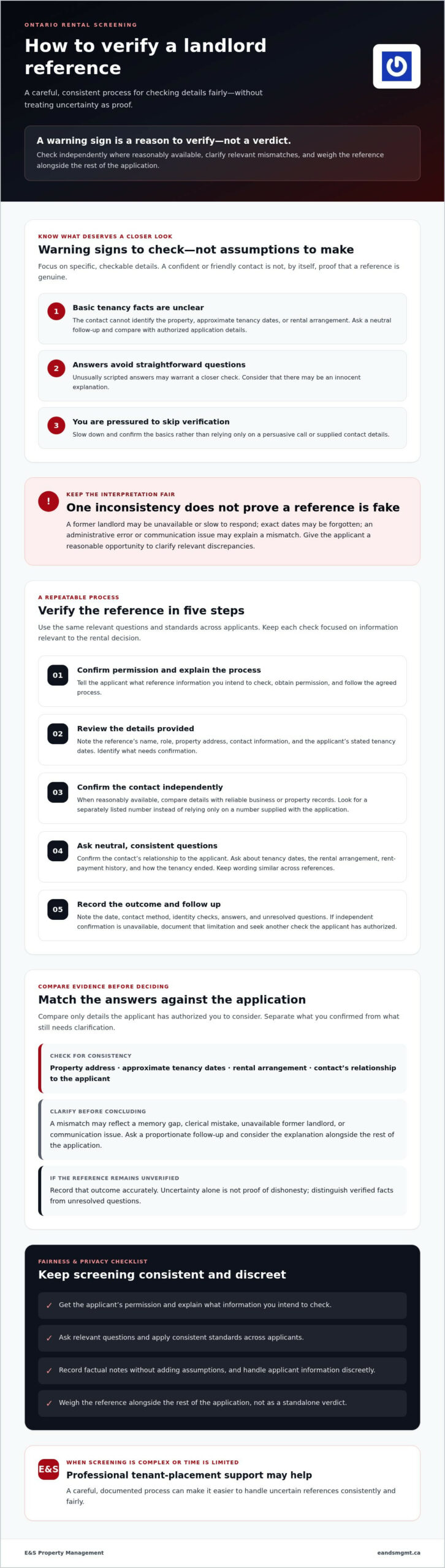
Listen for whether the contact can explain basic facts about the tenancy. If they can’t identify the property, approximate tenancy dates, or rental arrangement, ask a neutral follow-up rather than jumping to conclusions. Compare their answers with authorized application details, such as the address and dates provided, and note any differences to clarify.
Other details to check include unusually scripted answers that avoid straightforward questions or pressure to skip verification. Either could have an innocent explanation, but both are reasons to slow down and confirm the basics. When spotting fake landlord references Ontario applicants provide, focus on specific, checkable details rather than whether a contact simply sounds friendly or confident.
Why one inconsistency does not prove a reference is fake
Former landlords may be unavailable, slow to respond, or unfamiliar with the details you ask about. A reference might remember the tenancy but not exact dates, or an administrative error may explain a mismatch between records and an applicant’s account. Communication issues can also make a genuine contact seem evasive.
Deliberate misrepresentation is different from a memory gap, clerical mistake, or incomplete answer. Give the applicant a reasonable opportunity to clarify relevant discrepancies, then consider the explanation alongside the rest of the application. Keep your questions and standards consistent across applicants, and record what was said without adding assumptions.
A warning sign is a reason to verify, not a verdict. When a detail doesn’t line up, confirm what you can through a reliable source and distinguish verified facts from unresolved questions. If the reference remains unverified, document that outcome accurately rather than treating uncertainty alone as proof of dishonesty.
How to verify a landlord reference in Ontario, step by step
A consistent process helps you check a reference without relying on a persuasive phone call or rushing to a conclusion. For spotting fake landlord references Ontario landlords can use the following sequence, applying the same relevant questions and standards to each applicant.
- Confirm permission and explain the process. Tell the applicant what reference information you intend to check, obtain their permission, and follow the agreed process. Keep questions focused on information relevant to the rental decision.
- Review the details provided. Note the reference’s name, role, property address, contact information, and the applicant’s stated tenancy dates. Identify what needs confirmation before reaching out.
- Find an independent way to confirm the contact. When reasonably available, compare the supplied details with reliable business or property records. Look for a separately listed number and use it to reach the organization or person, rather than relying only on a number supplied with the application.
- Ask neutral, consistent questions. Confirm the contact’s relationship to the applicant and ask about the tenancy dates, rental arrangement, rent-payment history, and how the tenancy ended. Keep the wording similar across references.
- Record the outcome and follow up. Note the date, contact method, identity checks, answers, and any unresolved question. If independent confirmation isn’t available, document that limitation and seek another check the applicant has authorized.
Confirm the reference contact independently
Independent confirmation is especially useful when a reference uses a personal email address or a phone number you can’t otherwise connect to a landlord or property manager. Check reliable records where practical, then call a separately sourced number. If you can’t confirm the contact that way, don’t treat that alone as proof of fraud. Record what you couldn’t verify and ask whether another authorized reference or check is available.
Ask consistent questions and document factual answers
Start by confirming the person’s role, the rental property address, and how they know the applicant. Ask each reference the same relevant, neutral questions, and avoid collecting details unrelated to the tenancy decision. Ontario’s Landlord’s Self-Help Centre provides practical guidance on tenant screening best practices, including what information to consider.
A useful record states who confirmed what, when they confirmed it, and how you made contact. Identify any follow-up clearly. Separate direct answers from your interpretation, and keep notes factual and discreet. For applicant-screening support as part of tenant placement, see E&S Property Management’s tenant placement service.
Fake reference or innocent mismatch? Compare the evidence before deciding
A discrepancy can be unsettling, especially when you’re trying to choose a tenant fairly and on a deadline. But a missed call, a different date, or a reference who remembers few details can have more than one explanation. When spotting fake landlord references Ontario landlords should separate what they’ve confirmed from what still needs clarification, rather than treating a mismatch as proof.
Compare a reference’s account only with application information the applicant has authorized you to use. Keep questions and follow-up focused on rental-relevant details. The Ontario Human Rights Commission policy provides guidance on human rights and rental housing, including tenant-selection considerations.
Common warning signs and reasonable explanations
Use each issue as a prompt for a proportionate next check. An unreachable contact may reflect changed circumstances, not fraud. A credit or background check can provide other screening information, but it doesn’t independently authenticate every landlord reference.
| Observed issue | Possible innocent explanation | Proportionate next check |
|---|---|---|
| The supplied phone number is disconnected. | The former landlord may have changed numbers or left the property-management role. | Look for a current contact route in reliable, independent records. If none is available, document the limitation and ask for another authorized contact. |
| The reference can’t recall much about the tenancy. | Time may have passed, or a different property manager may have handled the tenancy. | Confirm the person’s role and ask whether someone else or a relevant record can verify the specific detail. |
| The tenancy dates differ from the application. | A tenancy extension, move-out notice, or record-keeping error may explain the difference. | Ask the applicant to clarify and compare the answer with another relevant, authorized source if available. |
What to do when information still conflicts
Give the applicant a clear, neutral opportunity to explain a material discrepancy. For example, if the reference recalls a tenancy ending in one month but the application lists another, ask whether there was an extension or a different move-out date. Where appropriate, request an alternative contact with the applicant’s permission.
Then check whether another relevant source supports or contradicts that particular detail. Avoid broad conclusions based on unrelated screening results: a credit check or background check doesn’t establish who provided a reference. Keep a factual record of the discrepancy, the explanation, and what you could or couldn’t confirm.
If uncertainty remains, describe it accurately as unverified or unresolved. Don’t state that fraud occurred unless reliable evidence supports that conclusion. A measured process supports fair decisions based on the available evidence, not suspicion alone.
Ontario landlord-reference checklist: privacy, fairness, and consistent screening
A reliable screening process protects both the decision and the people involved. Keep reference questions focused on rental suitability, collect only information relevant to the decision, and handle what applicants share discreetly. Apply the same standards to each applicant rather than letting one unusual answer trigger extra scrutiny without a clear reason.
Reference checks should not become a way to ask about personal characteristics unrelated to the tenancy. Ontario’s human rights guidance can help landlords understand fair tenant selection and avoid discriminatory questions. Review the Ontario Human Rights Commission’s policy on rental housing and confirm current requirements if you’re unsure whether a question or screening practice is appropriate.
Good notes make your reasoning easier to review later. Separate what you confirmed directly from what the applicant explained and what remains unresolved. When spotting fake landlord references Ontario landlords should focus on relevant evidence and consistent follow-up, not assumptions about an applicant’s circumstances.
Keep reference checks relevant, consistent, and respectful
Use a standard set of neutral questions for each reference, such as confirming the contact’s role, tenancy dates, rental arrangement, and the reference’s account of rent-payment history. Don’t ask about protected personal characteristics or let them influence your assessment. If an answer raises a concern, record the specific detail and give the applicant a fair opportunity to clarify it before reaching a conclusion.
A landlord’s final verification checklist
Use this checklist for each applicant to keep your process orderly and consistent:
- Permission: Confirm the applicant understands the reference check and has authorized the contact and screening steps you’ll take.
- Contact details: Where practical, compare the reference’s details with reliable records and independently confirm a way to reach them.
- Consistent questions: Ask each reference the same relevant, neutral questions about their role and the tenancy.
- Discrepancies: Note any mismatch, the applicant’s explanation, and any proportionate follow-up or alternative authorized check.
- Factual notes: Record who you contacted, when and how, what they said, and which points remain unverified. Keep confirmed facts distinct from assumptions.
- Decision basis: Document how relevant, verified information informed your decision, and apply the same screening criteria across applicants.
This checklist can turn a stressful decision into a process you can explain and repeat. Ottawa landlords looking for applicant-screening support as part of tenant placement can review E&S Property Management’s tenant placement service.
When to get help with tenant screening in Ottawa
Managing several applications while keeping up with property responsibilities can make careful screening difficult. Professional tenant-placement support may be useful when reference details repeatedly conflict, you have limited time to assess applicants consistently, or you want help coordinating screening across multiple applications. A structured process can make it easier to review information calmly, but no screening service can guarantee a particular tenant outcome or eliminate every uncertainty.
When professional tenant placement may simplify screening
For Ottawa landlords, getting help doesn’t mean handing over your judgment. It can mean having support with applicant screening and related checks, then using the findings as part of your overall rental decision. E&S Property Management’s tenant placement service includes applicant screening, background checks, and credit verifications. Confirm the current service scope directly, especially if you need a particular type of reference check. Don’t assume a provider uses a specific reference-authentication method unless they confirm it.
That distinction matters when spotting fake landlord references Ontario landlords may encounter: screening results can inform a decision, but they don’t automatically establish whether a particular contact is a former landlord. Consider the evidence, any explanation, and remaining uncertainties together.
What to ask before choosing screening support
Before engaging a provider, ask clear questions so you understand what support includes and what remains your responsibility:
- Which checks are included? Confirm whether the service covers applicant screening, background checks, credit verifications, and the specific reference-related assistance you’re looking for.
- What does the applicant need to provide? Ask what information and permission are needed before checks begin, and how applicants are informed about the process.
- How are findings shared? Clarify how you’ll receive results, how unresolved discrepancies are identified, and what context accompanies them.
- How are records handled? Ask how screening information and notes are communicated and managed, and what practices apply to protecting applicant details.
- Who makes the final decision? Establish how the screening findings will support your review without being treated as a guarantee or substitute for a fair, evidence-based decision.
These questions can help you decide whether professional tenant placement suits your needs and clarify what to expect before screening begins. Ottawa landlords can discuss tenant placement with E&S Property Management.
Make your next screening decision with confidence
A dependable rental decision doesn’t require certainty from every reference. It requires a steady process: confirm what you can independently, give reasonable mismatches a fair follow-up, and keep a clear record of what’s verified and what remains uncertain. That’s the practical value of spotting fake landlord references Ontario landlords can use without treating a warning sign as a verdict.
If managing applications alongside your other property responsibilities feels like too much to take on alone, professional tenant placement may offer useful support. E&S Property Management is an Ottawa residential property management firm founded in 1981. Its tenant placement service includes applicant screening, background checks, and credit verifications, helping landlords bring relevant information together for their decision. Screening can inform a choice, but no process can guarantee a particular tenant outcome.
With a fair, documented approach, you can move forward thoughtfully and make a decision grounded in the information available.
Frequently Asked Questions
How can you tell if a landlord reference is fake?
No single clue proves a landlord reference is fake. Check whether the contact’s identity and relationship to the applicant can be independently confirmed, and whether their account matches authorized application details such as the property and tenancy dates. Ask neutral follow-up questions if answers seem unusually scripted, vague, or inconsistent. Spotting fake landlord references Ontario landlords encounter calls for checking evidence carefully, not treating suspicion as a conclusion.
Can a landlord contact a tenant’s previous landlord in Ontario?
Yes, a prospective landlord can contact a previous landlord as part of rental screening, but should first explain the check and obtain the applicant’s meaningful consent. Keep the inquiry relevant to the rental decision and handle personal information discreetly. If the applicant hasn’t agreed to the contact, pause and clarify the screening process before reaching out. Consent and privacy requirements can depend on the information and circumstances, so check current guidance when uncertain.
What questions should I ask a previous landlord?
Ask consistent, factual questions about the tenancy rather than broad questions about the applicant’s character. For example, confirm the reference’s role, the rental property, approximate tenancy dates, rental arrangement, rent-payment history, and how the tenancy ended. Give the contact room to explain if they don’t remember a detail. Record their answers accurately, noting what was directly confirmed and what remains unclear, and use a similar approach with other applicants.
What should I do if a landlord reference cannot be reached?
First, check whether the contact details are current using reliable records, then try a reasonable alternative contact method. If the former landlord remains unavailable, document your attempts and ask the applicant for another authorized reference or relevant information. An unanswered call or disconnected number doesn’t establish dishonesty. Consider what you can verify through other relevant parts of the application, and distinguish missing information from evidence that contradicts the applicant’s account.
Can a tenant provide a friend or family member as a landlord reference?
A tenant can offer a friend or family member as a reference, but the relationship should be disclosed clearly. If that person wasn’t actually the landlord, don’t treat their character reference as proof of a rental history. Ask whether the applicant can provide a former landlord, property manager, or another person with direct knowledge of the tenancy. Consider any alternative consistently and explain what information it can and can’t confirm.
What if a former landlord gives information that conflicts with the rental application?
Ask the applicant neutrally to clarify the specific discrepancy, such as different tenancy dates or a rent-payment detail. There may be a reasonable explanation, including an extension, a record error, or a different person managing the property. If appropriate, seek another authorized source to check that detail. Keep notes separating the reference’s account, the applicant’s explanation, and what you verified. Avoid calling it fraud unless reliable evidence supports that conclusion.
Are landlords in Ontario allowed to ask about a tenant’s rental history?
Yes, rental history is among the types of information Ontario landlords may request for tenant screening, subject to applicable privacy and human rights requirements. Ontario Regulation 290/98 addresses information landlords can request, including rental history and credit references. Keep questions relevant to assessing the rental application, apply the same process consistently, and obtain meaningful consent before collecting personal information. For a particular situation, check current authoritative Ontario guidance or seek legal advice.


