
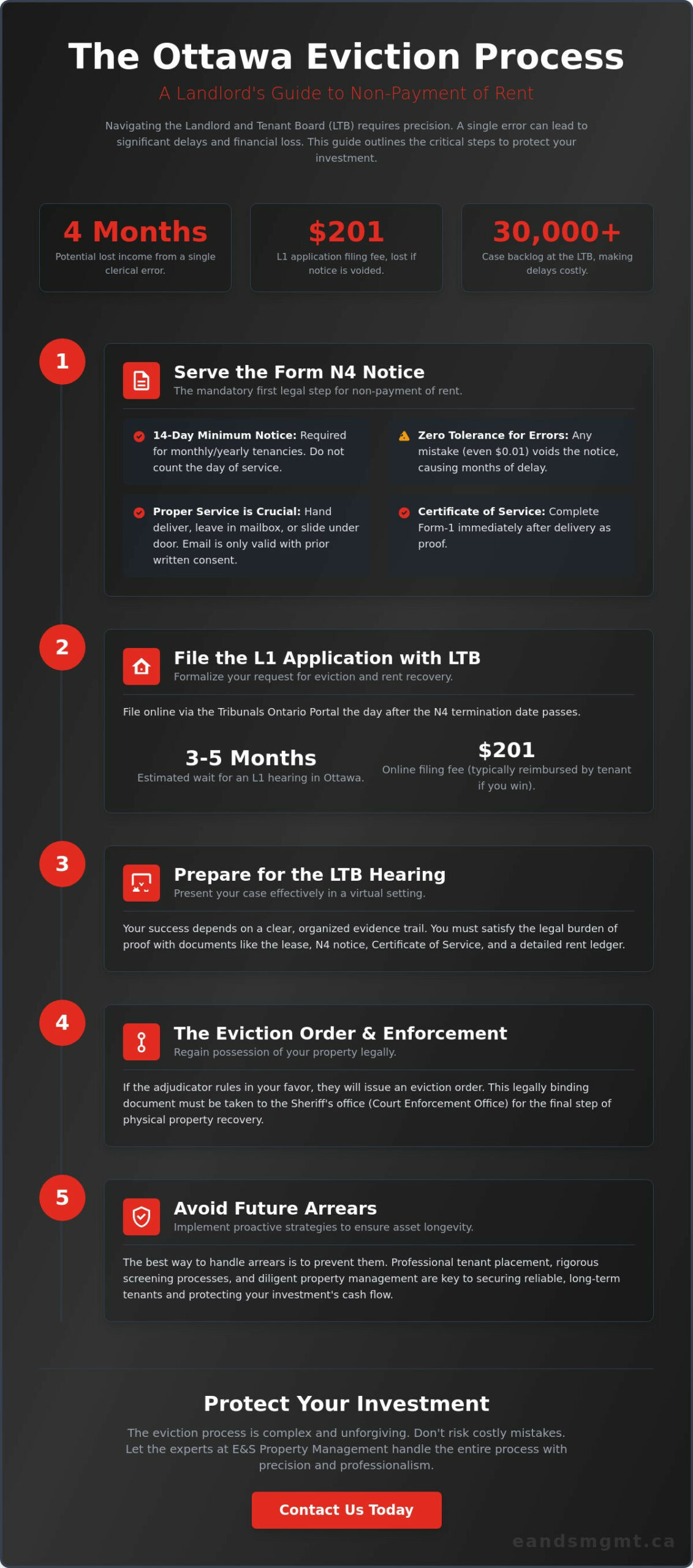
In the Ottawa rental market, a single clerical error on an N4 notice can cost a landlord four months of rental income and $201 in lost filing fees. With the Landlord and Tenant Board still managing a backlog of over 30,000 cases, there’s no room for procedural mistakes. Understanding the eviction process in Ottawa for non-payment of rent is no longer just about knowing the law; it’s about executing a precise administrative sequence to protect your investment.
It’s stressful to watch arrears mount while you wait for a hearing date, especially if you’re managing the property from a different time zone or balancing a busy career. We recognize that the current 3 to 5 month wait time for L1 applications, while an improvement from the 10 month delays of the past, still creates a significant financial burden. This guide provides a methodical breakdown of the legal steps required to regain possession of your property and recover owed rent while remaining fully compliant with the Landlord and Tenant Board. We’ll walk through the specific notice periods, the digital filing process, and the final steps of Sheriff enforcement to ensure your assets are protected.
Key Takeaways
- Identify the mandatory requirements for serving a Form N4, including the critical 14-day notice period required for monthly tenancies.
- Navigate the transition from notice to formal legal action by filing an L1 application to advance the eviction process in Ottawa for non-payment of rent.
- Prepare for virtual Landlord and Tenant Board hearings by establishing a clear evidence trail that satisfies the legal burden of proof.
- Understand the distinction between standard and postponed eviction orders and the final steps for Sheriff-led property recovery.
- Implement proactive strategies, such as professional tenant placement and rigorous screening, to prevent future arrears and ensure asset longevity.
Step 1: Serving the Form N4 – Notice to End your Tenancy for Non-Payment of Rent
The eviction process in Ottawa for non-payment of rent officially begins with the Form N4. This document is the mandatory first legal step required by the Landlord and Tenant Board (LTB) when a tenant fails to pay rent. It serves as a formal notice that the tenancy will end unless the arrears are cleared by a specific date. For monthly or yearly tenancies, the law requires a minimum 14-day notice period. This timeline is non-negotiable; providing even one day less than the statutory requirement will result in the immediate dismissal of your case at a future hearing.
Precision is the cornerstone of a successful resolution. The LTB maintains a zero-tolerance policy for clerical errors on the N4. If you miscalculate the rent amount by a single cent or enter the wrong year in the date field, the notice becomes void. This level of scrutiny often catches self-represented landlords off guard, leading to months of lost time and unrecoverable income. Every N4 also includes a “Right to Void” clause. This means the tenant has the legal right to stay in the property if they pay the full amount of rent owed, plus any new rent that has become due, before the termination date or before an eviction order is issued.
Calculating the Termination Date Correctly
Determining the correct termination date requires a methodical approach. When counting the 14 days, you must not include the day the notice is served. If you are not handing the notice directly to the tenant or an adult in the unit, you must account for delivery delays. For example, if you send the N4 by mail, you are legally required to add five additional days to the notice period to account for transit. The termination date is the final day a tenant has to pay the outstanding balance or vacate the unit before a landlord is legally permitted to file an application for eviction.
Legal Methods for Serving the Notice in Ottawa
How you deliver the N4 is just as important as what is written on it. Valid methods include handing the notice to the tenant personally, leaving it in the mailbox, or sliding it under the door. Email service is a frequent pitfall for many property owners. You can only serve documents via email if the tenant has previously consented to this specific method in writing, usually through the standard Ontario lease agreement. To ensure your efforts are recognized by the LTB, you must complete a Certificate of Service (Form-1) immediately after delivery. This document acts as your primary evidence that the tenant was notified in accordance with the law, protecting your position during the eviction process in Ottawa for non-payment of rent.
Step 2: Filing the L1 Application with the Landlord and Tenant Board
Once the termination date on your N4 notice has passed without full payment, your next move is to file the L1 Application to continue the eviction process in Ottawa for non-payment of rent. You don’t need to wait an extra day; the law allows you to submit this application as early as the day immediately following the deadline. This document serves a dual purpose: it asks the Board to grant an order for the tenant’s eviction and mandates the collection of all outstanding rent including any daily compensation for the tenant’s continued stay.
Precision remains paramount during this stage. The Tribunals Ontario Portal is the primary gateway for these submissions, offering a more streamlined experience than traditional paper filings. As of 2026, the filing fee for an online L1 application is $201. While this is an upfront cost, the Board typically orders the tenant to reimburse this fee if your application is successful. Adhering to the LTB Interpretation Guidelines ensures your application aligns with how adjudicators evaluate non-payment cases, particularly regarding the accuracy of the ledger provided and the validity of the underlying notice.
The Importance of the L1/L2 Processing Timeline
Current data from the Ottawa regional office indicates an estimated wait time of 3 to 5 months for an L1 hearing. While this is a significant improvement from previous years, the Board is still navigating a backlog of over 30,000 cases. Filing the moment the N4 expires is essential for protecting your asset’s value. Every week of delay in filing translates directly into another week of potential rental loss that may never be recovered. Using the portal allows for real-time tracking, providing a level of predictability in an otherwise uncertain schedule.
Managing the Process for Non-Resident Landlords
For Foreign Service officers and expats, the eviction process in Ottawa for non-payment of rent presents unique logistical hurdles. Managing legal filings across different time zones often leads to communication gaps and missed deadlines. Physical document handling and the requirement for a local address for service make it difficult for non-residents to maintain the “procedural perfection” required by the LTB.
Having a professional steward on the ground in Ottawa ensures that all supplementary notices are served correctly and that the L1 application is managed without delay. This is particularly vital when dealing with complex financial oversight. Professional Full-Service Property Management provides the stability needed to navigate these disputes while you focus on your responsibilities abroad. If you require specialized assistance with Non-Resident Landlord Tax Services Canada, ensuring your NR6 and NR4 filings are current is a critical part of maintaining your investment’s legal standing during a dispute.
Step 3: Preparing for and Attending the LTB Hearing
The hearing represents the critical juncture in the eviction process in Ottawa for non-payment of rent. Currently, the Landlord and Tenant Board conducts most proceedings virtually via Zoom. This digital shift requires landlords to be prepared with electronic versions of all evidence and a stable internet connection. During the hearing, the legal burden of proof rests entirely on the landlord. You must demonstrate that the N4 was served correctly and that the tenant has failed to meet their financial obligations. Reviewing the official guide on Renting in Ontario: your rights can help you understand the standard adjudicators expect during these sessions.
A common hurdle in Ottawa hearings is the Section 82 defense. Under the Residential Tenancies Act, tenants are permitted to raise maintenance issues as a defense against a non-payment application, even if they haven’t filed a separate application. This often catches self-represented landlords off guard. If an adjudicator finds merit in these claims, they may reduce the arrears owed or delay the eviction order. However, the Board also offers mediation services on the day of the hearing. A mediator can help both parties reach a voluntary “Payment Plan” agreement. This can be turned into a formal Board order, which often provides a faster resolution than a contested hearing.
Evidence Preparation for Landlords
Success at the LTB depends on the quality of your documentation. You should prepare a comprehensive evidence package well in advance of your Zoom date. This includes the original N4, the Certificate of Service, and all communication logs showing your attempts to resolve the debt before legal action. A clear rent ledger is the most important document in a non-payment hearing. This ledger should be a professional, line-by-line accounting of every charge and payment since the beginning of the tenancy. Disorganized bank statements or handwritten notes are rarely sufficient to satisfy an adjudicator’s requirements for transparency.
Navigating Section 82 Maintenance Claims
Tenants frequently use maintenance complaints to offset rent arrears or buy more time. They might claim a broken appliance or a plumbing issue was the reason for withholding rent, even if they never reported the issue previously. To counter this, you need concrete proof of the property’s condition. Regular Property Inspections are your best defense against surprise claims during the eviction process in Ottawa for non-payment of rent. By documenting the unit’s state through consistent, professional oversight, you can provide the Board with dated reports and photos that refute last-minute allegations. This proactive approach transforms a potential legal pitfall into a manageable administrative task.
Step 4: The Eviction Order and Enforcement by the Sheriff
Receiving a written order from the LTB is the penultimate stage of the eviction process in Ottawa for non-payment of rent. This document is a formal decision that specifies the exact date the tenancy ends and the amount of money the tenant must pay to void the eviction. Adjudicators generally issue one of two types of decisions: standard or postponed. A standard order provides a firm move-out date, whereas a postponed order allows the tenant to remain in the unit as long as they adhere to a strict, Board-mandated payment schedule. If the tenant misses a single payment under a postponed order, the landlord can usually apply for an immediate eviction order without a second hearing.
It’s vital to remember the “No Self-Help” rule. Even with a signed LTB order in hand, you don’t have the legal authority to change the locks, shut off utilities, or physically remove a tenant. Doing so is a serious offense under the Residential Tenancies Act and can result in significant fines and damage awards against you. The Court of Enforcement, commonly known as the Sheriff, is the only entity legally authorized to physically remove a tenant and their belongings from a rental property. Professional Full-Service Property Management ensures this final, often high-tension phase is handled with the necessary legal distance and administrative precision to protect your reputation and your asset.
Booking the Ottawa Sheriff for Eviction
If the tenant remains in the property past the date specified in the LTB order, you must file the order with the Ottawa Sheriff’s Office for enforcement. In Ontario, the cost to have a Sheriff enforce an eviction order is approximately $400, which doesn’t include additional mileage costs. Once the Sheriff schedules the eviction, they’ll provide a notice to the tenant. After the Sheriff has officially restored possession of the property to you, the 72-hour rule begins. You’re legally required to give the tenant access to the unit between 8:00 a.m. and 8:00 p.m. for the following three days to retrieve their property before you can dispose of any remaining items.
The Final Walkthrough and Lock Change
Coordination is essential on the day of enforcement. You should arrange for a locksmith to meet you and the Sheriff at the property to ensure the locks are changed the moment the unit is cleared. Once you regain possession, perform an exhaustive final walkthrough. Document the condition of the unit using high-resolution photography and video to record any new damages or maintenance needs. This evidence is crucial for your internal records and any future efforts to recover costs. Once the unit is secured, the focus shifts to rapid restoration and preparing the property for a new, qualified tenant who will provide a stable return on your investment.
Step 5: Avoiding Future Arrears with Professional Management
The most effective way to navigate the eviction process in Ottawa for non-payment of rent is to prevent it from becoming necessary. While the legal steps outlined in previous sections provide a path to recovery, they also consume time and capital. Professional management shifts the focus from reactive legal battles to proactive asset protection. By establishing a professional distance and clear expectations from the first day of a tenancy, you reduce the likelihood of arrears and ensure your investment remains a source of passive income rather than a source of stress.
A zero-tolerance policy regarding late payments is a hallmark of disciplined property oversight. This doesn’t mean a lack of empathy; it means adhering to a standardized administrative rhythm. Serving an N4 notice promptly when rent is missed signals to the tenant that financial obligations are a priority. This consistency often encourages tenants to prioritize their rent payments over other expenses, preventing small debts from ballooning into the multi-month arrears that lead to the LTB. Our Full-Service Property Management provides the administrative infrastructure to handle these tasks with precision, ensuring every notice is legally sound and served without delay.
The Value of Professional Tenant Placement
The best eviction is the one that never has to happen. Successful tenancies are built on the foundation of rigorous screening that goes far beyond a simple credit score. Professional Tenant Placement Service involves an exhaustive verification of employment history, previous landlord references, and financial stability. We look for patterns of reliability that standard automated checks might miss. This level of scrutiny ensures we match high-quality tenants with high-quality homes, significantly reducing the risk of future non-payment issues. You can review our standards in the Ottawa Tenant Screening Process Checklist to see how we filter for long-term stability.
Comprehensive Oversight for Peace of Mind
Foreign Service officers and expat landlords face the unique challenge of managing a legal dispute from thousands of miles away. Entrusting your property to a seasoned steward provides a level of security that self-management cannot match. E&S has provided this specialized oversight for over four decades, acting as the steady hand for owners who need reliable results in the Ottawa market. Our resolution-focused approach to tenant relations means we often settle disputes through communication and mediation before they ever reach a hearing room.
Managing an investment property shouldn’t feel like a second job. By utilizing professional Financial Reporting and Accounting alongside regular inspections, you maintain total visibility into your asset’s performance without the operational burden. Let E&S Property Management protect your Ottawa investment and handle the complexities of the LTB so you can focus on your life abroad with confidence.
Protecting Your Asset Through Strategic Oversight
Successfully navigating the eviction process in Ottawa for non-payment of rent requires more than just a valid claim; it demands procedural perfection from the first notice to the final lock change. We’ve seen that a clear rent ledger and proactive property inspections are the strongest defenses against delays at the Landlord and Tenant Board. While the legal steps provide a framework for recovery, the most sustainable strategy is a professional management system that prevents arrears before they begin.
Since 1981, E&S has acted as the steady hand for owners navigating these complexities. We specialize in supporting Foreign Service officers and expat landlords who need reliable results while living abroad. Our team provides comprehensive administrative resolution, including specialized NR6 and NR4 tax filing support to ensure your investment remains compliant and profitable. Request a Consultation for Full-Service Property Management and gain the peace of mind that comes with seasoned local expertise. Your property is a significant asset; we have the experience to ensure it’s protected.
Frequently Asked Questions
How long does the eviction process for non-payment take in Ottawa?
The entire process currently takes approximately 4 to 6 months from the initial N4 notice to the physical recovery of the property. This timeline includes the mandatory 14-day notice period, an estimated 3 to 5 month wait for an L1 hearing at the Board, and time for Sheriff enforcement. While wait times have improved from the 10-month delays seen in previous years, the Board’s backlog still influences the total duration.
Can I evict a tenant in Ontario if they pay part of the rent?
Yes, you can proceed with an eviction application if the tenant only pays a portion of the arrears. Any partial payment reduces the total debt but doesn’t automatically cancel the N4 notice unless the full amount is cleared. If the tenant pays every cent owed plus your filing fee before the hearing, the eviction process in Ottawa for non-payment of rent is typically voided by law.
What happens if a tenant refuses to leave after an LTB eviction order?
If a tenant remains in the unit past the move-out date specified in your LTB order, you must file for enforcement with the Ottawa Sheriff’s Office. You cannot personally remove the tenant or their belongings. Only the Sheriff has the legal authority to physically restore possession of the property to you. This step requires a certified copy of the Board’s order and payment of the Sheriff’s enforcement fees.
Can I change the locks if my tenant hasn’t paid rent for two months?
No, you’re strictly prohibited from changing the locks or terminating utility services regardless of how much rent is owed. This is considered an illegal “self-help” eviction under the Residential Tenancies Act and can result in significant fines and legal penalties. Possession must only be regained through the formal LTB process and enforced by the Sheriff’s office to ensure your actions remain within provincial law.
Do I need a lawyer for a Landlord and Tenant Board hearing in Ottawa?
You aren’t legally required to have a lawyer, as landlords can represent themselves or hire a licensed paralegal. However, many owners choose professional representation to navigate the LTB’s complex procedural requirements. Having an expert handle the hearing ensures that your evidence is presented logically and that common tenant defenses don’t result in the dismissal of your application due to technical errors.
What is the cost to file for eviction for non-payment of rent?
The current filing fee for an L1 application through the Tribunals Ontario Portal is $201. This fee is an upfront cost paid by the landlord at the time of submission. During the hearing, you can request that the adjudicator include this cost in the final order, requiring the tenant to reimburse you for the filing fee as part of the total judgment for rent arrears.
Can I serve an N4 notice myself if I live outside of Canada?
You can prepare the document from abroad, but the N4 must be physically served to the tenant in Ottawa using approved delivery methods. The eviction process in Ottawa for non-payment of rent requires a signed Certificate of Service from the person who actually delivered the notice. Most non-resident landlords utilize a local property manager to ensure the notice is served correctly and that the delivery is legally documented for the Board.
What is a “voidable” eviction notice?
A voidable notice is a legal document that becomes invalid if the tenant pays the full amount of rent arrears before the termination date. The N4 notice specifically informs the tenant that they can cancel the eviction by paying what they owe. This right to void the process continues even after you file an L1 application, provided the tenant pays the full arrears plus your $201 filing fee before a final order is issued.


