
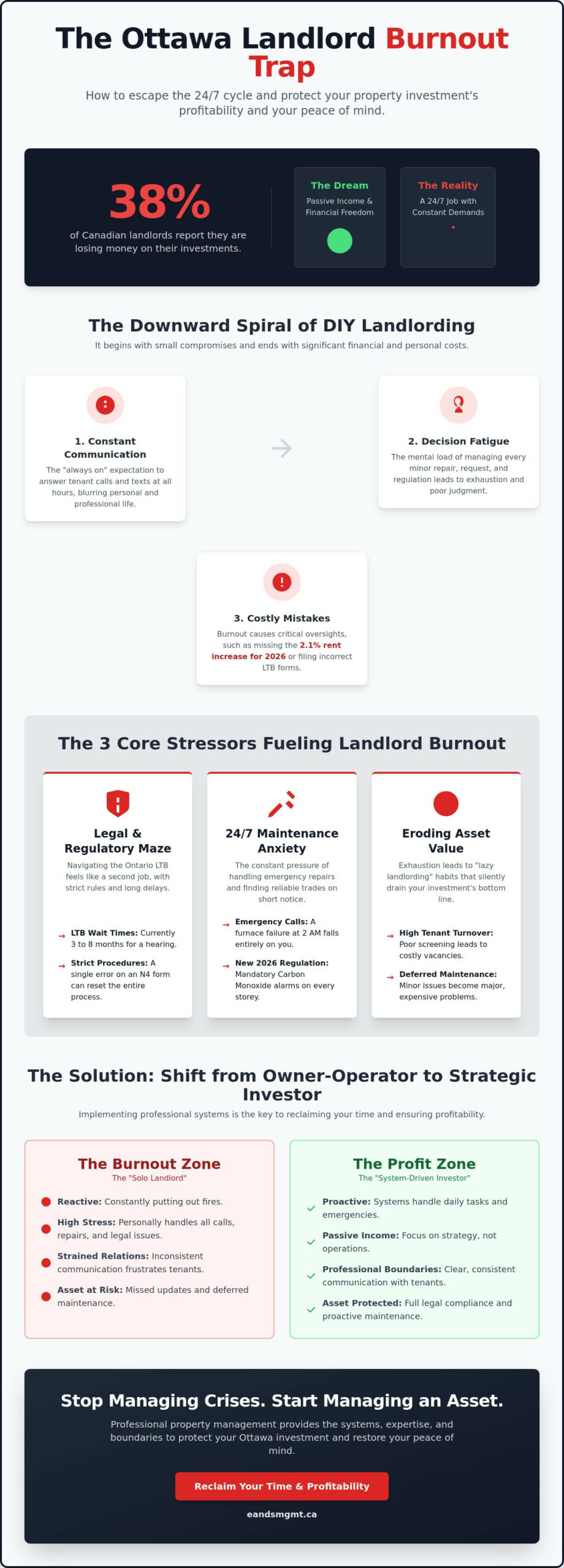
38% of Canadian landlords report they are losing money in 2026, but the true cost often isn’t just financial; it’s the heavy mental toll of a 24/7 job that was supposed to be passive. It’s exhausting to manage midnight repair calls or navigate the shifting timelines of the Ontario Landlord and Tenant Board (LTB) while trying to maintain your own career. You shouldn’t have to choose between your personal peace and the health of your Ottawa property investment. We understand that the constant pressure of maintenance resolution and regulatory changes can feel overwhelming.
This guide focuses on avoiding landlord burnout by identifying early signs of exhaustion and implementing professional systems that return you to the role of a strategic investor. You’ll discover how to automate your emergency response, ensure compliance with the new 2026 Carbon Monoxide regulations, and utilize structured oversight to secure predictable results. We will outline the tangible steps required to move from an owner-operator mindset to a system-driven approach, ensuring your portfolio remains a profitable asset rather than a personal burden.
Key Takeaways
- Identify why the “Always On” communication cycle is unsustainable and how it compromises both your mental health and asset performance.
- Protect your Ottawa property investment by avoiding landlord burnout through the implementation of professional systems and strict communication boundaries.
- Quantify the hidden financial costs of stress-induced landlording, such as high tenant turnover and missed regulatory updates.
- Audit your daily property tasks to identify high-drain activities that can be replaced with disciplined management frameworks.
- Reframe professional property management as a strategic resolution that secures passive income while ensuring full legal and tax compliance.
Identifying the Root Causes of Landlord Burnout in Ontario
Landlord burnout isn’t a temporary frustration; it’s a state of total exhaustion that erodes your investment’s value. Many Ottawa owners operate in a perpetual “Always On” mode, feeling obligated to answer tenant texts at midnight. This relentless pressure mirrors the core dimensions of Occupational burnout. When you act as the sole point of contact, you experience decision fatigue. Small choices about minor repairs eventually lead to major investment mistakes, such as missing the 2.1% rent increase guideline for 2026. Avoiding landlord burnout starts by recognizing the shift from a strategic investor to an “accidental landlord” who merely reacts to the next crisis.
The transition from a passive income stream to a demanding job happens gradually. It begins with one missed inspection and ends with a property owner who feels trapped by their own assets. True investment success requires a steady hand and a disciplined approach to oversight. Without professional systems in place, the mental load of managing every variable personally will eventually compromise your health and your portfolio’s profitability.
The Legal and Regulatory Burden in Ottawa
The Ontario legal framework in 2026 demands meticulous attention to detail. Bill 60 has tightened timelines for non-payment cases, but it also introduced strict procedural requirements. If you make a single error on an N4 form, you face LTB wait times that currently stretch between 3 and 8 months depending on the application type. This regulatory weight makes staying compliant feel like a second job. The stress of navigating these delays while managing rising property taxes often pushes self-managed landlords to the breaking point.
Maintenance Anxiety and the Contractor Gap
Securing licensed trades in the capital region is increasingly difficult on short notice. When a furnace fails at 2 AM or a leak occurs, the burden of immediate resolution falls entirely on you. As of January 1, 2026, the Ontario Fire Code requires Carbon Monoxide alarms on every storey of a home. Coordinating these specific upgrades while managing daily tenant requests creates a cycle of maintenance anxiety. The logistical pressure of supervising repairs becomes unsustainable, making the goal of avoiding landlord burnout nearly impossible without external support.
The Hidden Financial and Personal Costs of Burnout
Burnout is a silent drain on your investment’s bottom line. When an owner reaches a state of chronic exhaustion, they often fall into “lazy landlording” habits. This includes skipping regular property inspections or neglecting to issue the 90 day notice required for the 2.1% rent increase allowed in 2026. These aren’t just minor oversights. They represent a significant loss of potential revenue and a decline in administrative efficiency. Avoiding landlord burnout is essential for maintaining the financial health of your portfolio, especially when 38% of Canadian landlords report they are currently losing money.
The cost of tenant turnover is perhaps the most immediate financial hit. Stress-induced poor screening often leads to placing tenants who don’t align with your property’s requirements. This results in expensive vacancies and potential LTB filings. Beyond the ledger, the mental toll impacts your primary career performance and personal relationships. When you’re distracted by a rental crisis, your focus elsewhere diminishes.
Erosion of Asset Value
Deferred maintenance is the inevitable byproduct of a landlord who’s lost their momentum. Ignoring minor repairs like a dripping faucet or an aging furnace decreases the property’s eventual resale value. Missing annual safety checks for smoke alarms or HVAC systems creates substantial legal and financial risk. Asset longevity is the result of disciplined, proactive oversight. By maintaining a structured schedule, you protect the physical integrity of your investment.
Strained Tenant Relations
Exhaustion frequently leads to slow response times and inconsistent communication. This creates a friction-filled environment where tenants feel ignored. When boundaries aren’t established early, such as defined office hours for non-emergencies, tenants may feel entitled to 24/7 access. Responding to disputes with frustration rather than professional detachment increases the risk of legal complications. If the operational burden has become too great, implementing full-service property management can restore the professional distance needed for successful landlording.
The final stage of this cycle is the “Burnout Sale.” Many Ottawa owners exit the market prematurely because the daily friction outweighs the perceived benefit. By selling during a period of high stress, they sacrifice years of future appreciation and long-term wealth. Reclaiming your time isn’t just about personal peace; it’s about staying in the game long enough to see your strategic vision realized.
Systems vs. Solo: Comparing Management Frameworks
Self-management often appears cost-effective on paper, but it frequently leads to a cycle of reactive crisis management that compromises your long-term goals. The solo model relies on your personal availability, which is a finite and often overextended resource. In contrast, a professional stewardship model replaces individual effort with repeatable, documented processes. This shift is the most effective method for avoiding landlord burnout. It moves the weight of daily operations from your shoulders to a structured system designed for administrative efficiency and asset longevity.
Technology plays a dual role in this transition. While property management apps offer convenient data access, they often add to the noise by delivering 24/7 notifications without providing physical resolution. A notification about a burst pipe at 3 AM is merely a stressor if you lack a boots-on-the-ground team to handle the repair. True systems integrate technology with human oversight, ensuring that data leads to action rather than just more screen time. Professional financial reporting and accounting further stabilize this framework, moving you away from shoebox receipts and toward audit-ready digital records.
The Expat and Foreign Service Challenge
Ottawa hosts a significant population of foreign service officers and expats who face unique logistical hurdles. Managing a rental unit from London, Tokyo, or Dubai makes handling local emergencies an impossibility. Time zone differences mean you’re often waking up to unresolved crises. Beyond the physical distance, tax compliance adds a layer of significant stress. Navigating monthly withholdings and NR6 forms requires precision to avoid CRA penalties. Utilizing professional Non-Resident Landlord Tax Services acts as a critical burnout shield for those living abroad, ensuring legal compliance remains invisible to your daily routine.
Building a Reliable Contractor Network
A major driver of exhaustion is the constant search for reliable, licensed trades. The solo landlord often spends hours “calling a guy” only to find they’re unavailable or uninsured. Professional systems leverage volume-based relationships with a managed vendor list. These contractors prioritize properties under professional oversight because of the consistent work volume and clear communication. This ensures your repairs are completed by qualified professionals, which protects your insurance standing and maintains the physical integrity of your investment. By delegating maintenance resolution to a trusted network, you eliminate the friction of supervising third-party repairs yourself.
Strategic Delegation: Steps to Reclaim Your Time
Reclaiming your schedule requires a transition from operator to strategist. Start by auditing your weekly commitments to identify tasks that drain your energy versus those that add long-term value. Activities like coordinating minor repairs or chasing rent payments are high-friction drains that rarely contribute to your strategic vision. Avoiding landlord burnout is only possible when you stop trading your personal time for manual administrative oversight. By shifting these burdens to professional systems, you ensure your investment remains a source of income rather than a source of stress.
Setting strict communication boundaries is a fundamental first step toward stability. Establish specific “office hours” for non-emergency tenant inquiries to break the 24/7 cycle mentioned earlier. This simple change restores a sense of order to your personal life. Automating predictable systems, such as digital rent collection and financial reporting, further reduces the manual workload. High-friction tasks, like emergency maintenance and tenant placement, should be the first candidates for outsourcing to a professional steward who can provide immediate resolution.
Professional Tenant Placement as a Filter
Successful landlording begins with the right tenant. Professional screening acts as a vital filter, preventing “problem tenants” from ever entering your property. This process involves more than just a credit check; it requires a disciplined review of rental history and employment verification. Detailed move-in and move-out inspections are equally critical. They provide the documented evidence needed to protect your investment and manage property condition without personal conflict. Utilizing Tenant Placement Services ensures this high-stakes process is handled with meticulous detail from the very beginning.
Administrative Efficiency and Tax Compliance
For owners, especially those managing assets from a different time zone, the administrative burden of tax compliance is often the final straw. Offloading the preparation of NR4 slips and the management of monthly CRA withholdings provides immediate relief. Professional tax administration prevents costly CRA penalties by ensuring every filing is accurate and submitted on schedule. This transition results in audit-ready financial reporting that clarifies your portfolio’s performance without the headache of manual bookkeeping. You gain a steady hand to navigate the complexities of Ontario’s regulatory environment.
By delegating these complex oversight tasks, you secure the mental space needed to focus on your primary career and family. If you’re ready to stop the cycle of constant interruptions and LTB anxiety, consider how full-service property management can restore your time and peace of mind.
Professional Property Management as a Long-Term Resolution
Professional management fees are often viewed as a line-item expense, but they are more accurately described as sanity insurance. This investment protects the physical asset while shielding the owner from the daily friction of operations. By transferring responsibility to a disciplined steward, you ensure that administrative efficiency remains high even when your personal schedule is demanding. Choosing a boutique firm like E&S Property Management provides the personalized attention of a local expert combined with institutional-grade systems. This balance is the ultimate resolution for avoiding landlord burnout.
The first 30 days of professional management are transformative. During this period, we conduct a comprehensive audit of existing lease agreements, perform a detailed property inspection, and establish clear communication protocols with tenants. This structured handoff immediately removes the operational burden from your shoulders. We synchronize your portfolio with current 2026 regulations, such as the mandatory Carbon Monoxide alarm updates and the 2.1% rent increase guidelines, ensuring no detail is overlooked during the transition.
The E&S Approach: 40 Years of Ottawa Expertise
Our firm has spent four decades refining the process of property oversight in the capital region. We maintain a specialized focus on supporting Foreign Service and DND members who serve abroad. These clients require a level of reliability that goes beyond simple rent collection. Our Emergency 24/7 Maintenance Response protects your property while you sleep, regardless of your current time zone. We act as your steady hand on the ground, navigating the complexities of the Ottawa market with localized expertise and community connection.
From Burned Out to Strategic Investor
The transition to professional management provides immediate emotional relief. Knowing your asset is in expert hands allows you to shift your focus back to your primary career or your next investment opportunity. You no longer need to monitor LTB wait times or worry about midnight repair calls. Instead, you receive structured financial reporting and the confidence that your property is being managed with foresight and order. Avoiding landlord burnout is about reclaiming your mental space and ensuring your investment serves your life, rather than consuming it. If you are ready to secure your portfolio’s future, Contact E&S Property Management for a consultation to reclaim your time.
Securing Your Investment Future in Ottawa
Reclaiming your time requires a fundamental shift in perspective. True relief comes from implementing professional systems that operate independently of your daily involvement. You’ve seen how identifying exhaustion and delegating high-friction tasks like maintenance and tax filings can stabilize your portfolio. By avoiding landlord burnout, you protect both your mental health and the long-term value of your Ottawa property investment. Professional oversight is the steady hand that turns a demanding job back into a strategic asset.
E&S Property Management provides the disciplined stewardship needed to navigate the complexities of the 2026 rental market. With over 40 years of local residential expertise, we offer specialized NR6 and NR4 tax compliance support along with 24/7 emergency maintenance coordination. This ensures your assets are protected while you focus on your primary career or family. Request a Free Rental Assessment and Reclaim Your Time to discover how tailored management can restore your peace of mind. Your investment should support your future, not drain your present.
Frequently Asked Questions
What are the first signs of landlord burnout I should look for?
Early indicators include a sense of dread when receiving tenant notifications and a tendency to delay routine property inspections. You might also find yourself ignoring the 2026 rent increase guidelines simply to avoid the administrative effort of serving notice. These signs of emotional and physical exhaustion suggest that the operational burden has exceeded your capacity for effective oversight. Recognizing these symptoms early is the first step toward avoiding landlord burnout and protecting your investment’s health.
Is it worth hiring a property manager for just one rental property?
Professional management is highly beneficial for single-unit owners because it prevents the “always on” cycle from disrupting your primary career. One bad tenant placement or a missed Landlord and Tenant Board (LTB) filing can cause financial losses that far outweigh management fees. Outsourcing oversight ensures your investment remains truly passive while protecting your mental health through structured systems. It allows you to function as a strategic investor rather than a 24/7 on-call technician.
How much does professional property management in Ottawa typically cost?
In the Ottawa market, percentage-based fees typically range between 6% and 12% of the collected monthly rent. Some providers offer flat-fee structures that generally fall between $130 and $280 per unit per month. Tenant placement is often a separate fee ranging from 50% to 100% of one month’s rent. These costs vary based on the level of service and the specific requirements of the property, such as whether the owner requires non-resident tax support.
Can a property manager help if I already have a “difficult” tenant?
A professional manager acts as a neutral third party to enforce lease terms and re-establish professional boundaries that may have eroded. They handle all communication and documentation, which is essential if a case reaches the LTB for non-payment or maintenance disputes. This professional distance often de-escalates conflicts and ensures that all interactions remain compliant with Ontario’s strict residential tenancy laws. Transitioning a difficult situation to an expert steward provides immediate emotional relief for the owner.
How do property managers handle emergency repairs when I am out of the country?
Managers utilize an emergency 24/7 maintenance response system to resolve urgent issues like leaks or furnace failures immediately. They coordinate with a vetted network of licensed trades who are available to respond even when you are in a different time zone. This proactive resolution prevents minor issues from becoming major structural damage while you’re unavailable to supervise repairs personally. You receive a detailed report of the action taken without having to manage the logistics from abroad.
What is the difference between tenant placement and full-service management?
Tenant placement is a one-time service focused on marketing, screening, and lease execution to find a qualified occupant for your property. Full-service management includes this placement plus ongoing rent collection, regular inspections, maintenance coordination, and financial reporting. Full-service oversight is the most effective method for avoiding landlord burnout because it removes the daily friction and administrative burden of property ownership. It provides a long-term resolution for owners seeking a hands-off investment experience.
How does a property manager help with Canadian non-resident tax compliance?
For expat owners, managers handle the complex administrative requirements of NR6 and NR4 tax filing support. They ensure the correct monthly withholdings are submitted to the CRA, which prevents the significant penalties associated with non-compliance. This specialized support allows foreign service members and expats to maintain their Ottawa investments without the stress of navigating cross-border tax regulations. It ensures your financial reporting is audit-ready and compliant with all federal requirements.
Will I still have control over major decisions if I hire a manager?
You retain full authority over major financial decisions and capital improvements to your property. Professional managers typically operate within pre-approved spending limits for minor repairs while seeking your explicit consent for larger projects or structural changes. This partnership ensures you remain the strategic decision-maker while the manager handles the tactical execution and daily administrative tasks. You get the benefits of expert oversight without losing the final say in your asset’s direction.


