
Imagine you’re settling into a new home overseas, only to receive an urgent notification about a burst pipe in your Nepean duplex or a fresh delay at the Landlord and Tenant Board. It’s in these moments of uncertainty that you might wonder how to calculate rental property ROI Ottawa with enough precision to sleep soundly. You deserve to know that your investment is working as hard as you are, even when you’re thousands of kilometres away.
You already understand that successful ownership in Canada’s capital requires more than just a tenant; it demands a deep grasp of how local variables impact your bottom line. This guide helps you move beyond basic math and into the real-world expenses of 2026. Whether you’re navigating the 2.1% rent increase guideline or managing non-resident tax obligations, we’re here to provide the clarity you need.
We’ll walk through a step-by-step framework to project your monthly cash flow with precision. We’ll explore the critical formulas for capitalization rates, account for hidden maintenance costs unique to our climate, and help you compare your property’s performance against the broader market. You’ll finish with the confidence that no expense is overlooked and your interests are protected.
Key Takeaways
- Master the specific formulas needed to accurately determine how to calculate rental property ROI Ottawa, ensuring you see the full picture of your asset’s growth beyond just monthly rent.
- Uncover the hidden “Ottawa Winter Tax” and learn how to budget for local variables like snow removal and furnace reliability that can quietly impact your bottom line.
- Navigate the complexities of non-resident tax obligations, including how filing an NR6 form can protect your cash flow by allowing for tax withholding on net income.
- See how professional stewardship and rigorous tenant screening act as a shield against the financial strain of non-payment and the high cost of extended vacancies.
Why ROI is the North Star for Ottawa Landlords in 2026
Transitioning from living in your home to renting it out is a significant emotional and financial shift. For many departing residents or Foreign Service officers, that familiar backyard becomes a line item on a balance sheet. In this context, Return on Investment (ROI) serves as your clearest indicator of success. It’s the metric that tells you if your property is actually building wealth or simply absorbing your savings while you’re away.
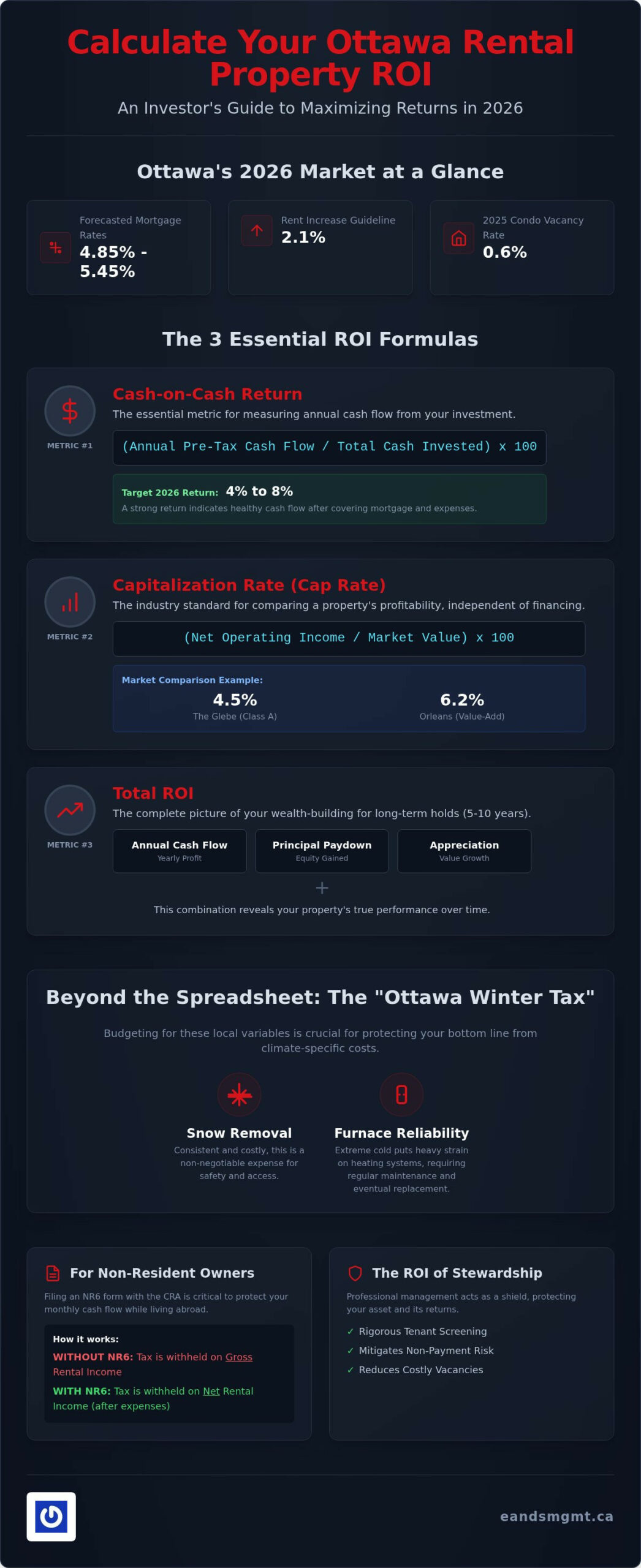
The 2026 market requires a more disciplined approach to your numbers. With mortgage rates forecasted to sit between 4.85% and 5.45%, the days of accidental profitability are over. You need to know exactly how to calculate rental property ROI Ottawa to ensure your bankable cash flow stays positive despite the 2.1% rent increase guideline for rent-controlled units. Tighter math accounts for the difference between paper profit, which looks good on a spreadsheet, and the actual cash that hits your account after the property taxes and maintenance are paid.
Ottawa’s Market Stability and Your Investment
Ottawa remains a safe haven for investors because of its unique economic floor. The heavy presence of the public sector and the thriving tech hubs in Kanata create a consistent demand for quality housing. Even with the current LTB backlog causing anxiety, the long-term fundamentals are strong. The 2025 condo vacancy rate of 0.6% proves that people need homes in this city. While the Residential Tenancies Act limits how much you can raise rent each year, the stability of the tenant base often offsets these restrictions, providing a predictable environment for long-term growth.
Passive vs. Active ROI: Setting Realistic Expectations
Many landlords fall into the trap of believing rental income is entirely passive. In Ontario, truly setting and forgetting a property often leads to deferred maintenance and lower resale values. Active stewardship, such as regular inspections and prompt repairs, preserves the integrity of your asset. This protective care ensures that when you eventually return or decide to liquidate, your property has maintained its competitive edge in the market. ROI is the balance of annual profit against total initial equity. By mastering how to calculate rental property ROI Ottawa, you ensure your property remains a source of relief rather than a burden.
The 3 Essential ROI Formulas Every Ottawa Investor Needs
Understanding how to calculate rental property ROI Ottawa requires looking at your asset through different lenses. Depending on whether you’re a local landlord or a Foreign Service officer stationed abroad, your primary goal might be monthly cash flow or long-term equity growth. Relying solely on market appreciation is a risky strategy in a high-interest environment. Instead, you need bankable metrics that reflect the reality of your bank account. These formulas provide the clarity needed to transition from homeownership to professional asset management.
1. Cash-on-Cash Return (The Cash Flow Metric)
This formula is vital for landlords carrying a mortgage, as it measures the actual cash income earned on the cash you’ve invested. It’s calculated as (Annual Pre-Tax Cash Flow / Total Cash Invested) x 100. If you’ve converted your primary home, your “total cash invested” includes your initial down payment and any renovation costs. In 2026, with mortgage rates forecasted between 4.85% and 5.45%, a “good” return often sits in the 4% to 8% range. This number tells you exactly how much money is returning to your pocket each year after the mortgage is paid.
2. Capitalization Rate (The Market Comparison Tool)
The Cap Rate is (Net Operating Income / Purchase Price or Current Value) x 100. It’s the industry standard for comparing property efficiency across different neighbourhoods. For example, a Class A multi-family property in the Glebe might show a cap rate of 4.5%, while a value-add property in Orleans could reach 6.2%. Because it ignores financing, it reveals how well the asset itself performs. Consult the CRA’s Rental Income Guide to ensure your Net Operating Income (NOI) calculations include all eligible deductions, such as insurance and property taxes.
3. Total ROI (The Wealth-Building Metric)
For those planning a 5 or 10-year hold, Total ROI is the most comprehensive measure of success. It combines your annual cash flow, mortgage principal paydown, and a conservative appreciation forecast of 2.5% to 4%. This “hidden” return of mortgage equity is often where the real wealth is built for Ottawa investors. When you’re living outside the city, having a clear financial reporting and accounting system helps you track these numbers without the stress of manual spreadsheets. These formulas also help you vet potential partners, as a professional manager should be able to explain how their services directly improve your bottom line.
Beyond the Spreadsheet: Factoring in Ottawa-Specific Expenses
While the formulas discussed earlier provide a solid foundation, they often miss the local realities that impact how to calculate rental property ROI Ottawa accurately. Ottawa’s climate and regulatory environment introduce unique costs that can erode your margins if you aren’t prepared. Successful landlords look past the “clean” math found in generic templates to account for the specific friction points of our local market.
One of the most significant variables is what we call the “Ottawa Winter Tax.” Snow removal isn’t just a courtesy; it’s a liability requirement. Similarly, furnace reliability is non-negotiable when temperatures drop to -30°C. A heating failure in January isn’t just a repair bill; it’s a high-stakes emergency that can lead to burst pipes and massive structural damage. You also need to consider property tax variations. A suburban home in Barrhaven faces a different tax profile than a heritage property in Rockcliffe Park, and these figures must be updated annually in your projections.
Insurance is another area where costs shift. Moving from a homeowner policy to a landlord policy typically increases your premiums, but it provides essential protection for your asset and liability. Finally, the current Landlord and Tenant Board (LTB) backlog requires a larger cash buffer. We recommend maintaining a vacancy reserve that exceeds the standard 5% to ensure a single delay doesn’t compromise your ability to cover the mortgage.
Maintenance and Capital Expenditures (CapEx)
Ottawa’s extreme freeze-thaw cycles are notoriously hard on roofs, driveways, and foundations. Planning for these big-ticket items is an ROI-protection strategy, not just an expense. We’ve seen that preventative maintenance, such as annual gutter cleanings and sump pump checks, saves thousands in the long run. You should also budget for “rental-ready” turnovers. Fresh paint and professional cleaning between tenants ensure you continue to attract the high-quality residents that Ottawa’s tech and government sectors provide.
Professional Fees and Administrative Costs
Managing a property effectively involves professional support, and these fees are often tax-deductible. If you’re managing your property from abroad, consulting the Non-Resident Rental Income Tax Guide is essential for understanding how these expenses interact with your Canadian tax obligations. You should also set aside a small legal reserve for lease reviews or potential LTB filings. Regarding utilities, many local landlords now structure agreements where tenants pay for heat and hydro. This approach insulates your ROI from fluctuating energy costs and encourages responsible consumption by the occupants.
The Non-Resident Variable: How Taxes Impact Your Net Return
When you move abroad for a professional posting, your tax status changes, and so does the math behind your investment. The Canada Revenue Agency (CRA) requires non-residents to pay a 25% withholding tax on gross rental income by default. This can be a heavy blow to your cash flow if you’re trying to figure out how to calculate rental property ROI Ottawa accurately. However, you can find relief by filing an NR6 form. This election allows you to withhold tax based on your estimated net income, which accounts for expenses like property management and repairs, rather than the total rent collected.
To manage this requirement, you must appoint a Canadian agent, often your property manager, who takes on the responsibility of remitting these taxes to the CRA on your behalf. Your agent will also issue annual NR4 slips and help ensure you meet the deadline for a Section 216 return. This return is your opportunity to reconcile what was withheld with your actual tax owing, often resulting in a refund and a much healthier net return.
Special Considerations for Foreign Service & DND
Managing your former primary residence while stationed in another country adds a layer of logistical complexity. Professional NR6 and NR4 tax filing support ensures that your management fees directly reduce your taxable non-resident income. Keeping meticulous records is essential for potential CRA audits, especially when claiming deductions for a property you intend to move back into one day. This specialized oversight transforms a potentially stressful tax season into a routine administrative process.
Tax Deductibility: Boosting Your Bottom Line
Maximizing your ROI involves knowing exactly what you can claim against your income. Common deductible expenses for Ottawa landlords include:
- Property insurance premiums and property taxes.
- Professional management and accounting fees.
- Repair and maintenance costs, including emergency furnace calls.
- Snow removal and landscaping services.
- Advertising and tenant placement costs.
Keep in mind that only the interest portion of your mortgage payment is deductible, not the principal amount. While the principal paydown builds your equity, the interest is the primary tax shield that protects your monthly cash flow. Professional tax administration prevents costly CRA penalties by ensuring every form is filed accurately and on time.
Optimizing Your Investment: The ROI of Professional Stewardship
Professional management is often viewed as a line-item expense, but for the successful investor, it’s a tool for revenue optimization. When you’re determining how to calculate rental property ROI Ottawa, it’s essential to factor in the cost of risk mitigation. The single greatest threat to your return isn’t a repair bill; it’s the “ROI-killer” of tenant non-payment. Rigorous, professional tenant screening acts as a filter, ensuring that only reliable residents occupy your home. In a climate where the LTB backlog can stretch for months, avoiding a single bad placement can save you tens of thousands of dollars in lost rent and legal fees.
The “Vacancy Gap” is another mathematical reality where professional oversight pays for itself. Every week your property sits empty represents a permanent loss of income that can never be recovered. By leveraging a dedicated team for tenant placement, properties are often filled weeks faster than a DIY approach could manage. This increased efficiency frequently covers the cost of the management fee for the entire year. Additionally, a seasoned manager provides access to a network of vetted contractors, often securing volume-discounted rates for essential maintenance that an individual landlord simply cannot access.
Beyond the ledger, there is an intangible ROI that comes from protecting your mental health. If you’re posted away from Ottawa, the stress of a midnight emergency call or a complex tax filing can be overwhelming. Delegating these burdens to a seasoned hand transforms your investment from a source of anxiety into a stabilizing financial force. You gain the freedom to focus on your career and family, knowing your asset is under the care of a dedicated steward.
E&S Property Management: 40+ Years of ROI Protection
E&S Property Management has acted as a protective guardian for Ottawa family homes since 1981. We specialize in the unique needs of Foreign Service officers and non-residents, providing a bridge between your goals and the local market’s demands. Our experience allows us to anticipate challenges before they escalate. We once managed a situation for a client posted in Europe where a potential C$10,000 pipe burst was averted because our regular property inspections caught a failing sump pump during a spring thaw. That proactive intervention saved the landlord’s entire profit margin for the year.
Your Next Steps: From Calculation to Commencement
Your journey from homeowner to investor should begin with clarity. Transitioning your property into a high-performing asset requires a clear understanding of current market values and a robust plan for the 2026 tax year. We recommend requesting a professional rental market assessment to ensure your starting figures are grounded in reality. Once your baseline is established, you can set up a financial dashboard that tracks your cash flow and equity growth with precision. Don’t let the complexities of how to calculate rental property ROI Ottawa hold you back from achieving long-term wealth.
Calculate your property’s potential with Ottawa’s residential experts.
Securing Your Financial Future in Canada’s Capital
Mastering the math behind your investment is the first step toward true financial peace of mind. By moving beyond generic spreadsheets to account for Ottawa’s unique winter maintenance costs and the 2.1% rent increase guideline, you ensure your property remains a source of strength rather than stress. Understanding how to calculate rental property ROI Ottawa is about more than just numbers; it’s about building a sustainable future for your family while you’re away.
You don’t have to navigate these complexities alone. With over 40 years of experience managing residential properties in Ottawa, we understand the specific anxieties of Foreign Service officers and local landlords alike. From our specialized knowledge of NR6 and NR4 tax compliance to our vetted network of 24/7 emergency contractors, we act as the dedicated steward your asset deserves. Our goal is to provide the professional oversight that transforms your property into a truly passive, high-performing asset.
Let E&S Property Management protect and optimize your Ottawa investment. We’re here to turn your uncertainty into confidence, ensuring your Ottawa home continues to work for you, no matter where in the world you are.
Frequently Asked Questions
What is a ‘good’ ROI for a rental property in Ottawa in 2026?
A “good” ROI in 2026 typically reflects a balance between consistent cash flow and steady equity growth. In the current interest rate environment, many Ottawa landlords aim for a cash-on-cash return of 4% to 8%. When you factor in the 2.5% to 4% forecasted market appreciation and mortgage principal paydown, a total annual ROI of 8% to 12% is considered a strong performance for a residential asset in our stable market.
Is it better to focus on cash flow or appreciation in the Ottawa market?
Focusing on cash flow is often the safer priority for most landlords, especially those carrying a mortgage at 2026 rates. While Ottawa’s long-term appreciation fundamentals remain robust due to population growth, cash flow provides the liquidity needed to handle unexpected repairs or vacancies. A balanced approach ensures you can cover monthly obligations while your equity grows quietly in the background, protecting your investment from short-term market fluctuations.
How do property management fees affect my overall ROI?
While management fees are an expense, they often improve your total return by reducing costly vacancies and preventing tenant non-payment. When you look at how to calculate rental property ROI Ottawa, you’ll see that faster tenant placement and professional maintenance oversight often pay for the fee itself. It shifts the burden of 24/7 emergency responses away from you, transforming the property into a more efficient and truly passive wealth-building tool.
Can I deduct my property management fees from my Canadian taxes?
Yes, professional property management fees are a fully deductible business expense on your Canadian tax return. This deduction reduces your taxable rental income, which effectively lowers the net cost of the service. For non-residents, these fees are particularly valuable as they can be used to lower the withholding tax required by the CRA when filing an NR6 election. This helps keep more bankable cash in your pocket throughout the year.
What is the difference between Cap Rate and Cash-on-Cash return?
Cap Rate measures the property’s intrinsic value and efficiency by comparing net operating income to the purchase price, completely ignoring financing. Cash-on-Cash return, however, measures the actual cash income earned on the specific amount of cash you’ve personally invested. For most individual landlords in Ottawa carrying a mortgage, Cash-on-Cash return is the more practical metric for understanding their monthly bank balance and actual out-of-pocket profitability.
How much should I budget for annual maintenance in an older Ottawa home?
You should typically budget between 1% and 2% of the property’s value annually for maintenance, though older homes in our climate may require more. The extreme temperature swings in Ottawa put significant stress on roofing and HVAC systems. Setting aside a consistent reserve ensures that a mid-winter furnace failure or a spring foundation leak doesn’t derail your annual ROI or force you to dip into personal savings.
Do I need to pay tax on my rental income if I am living outside of Canada?
Yes, the CRA requires non-residents to pay tax on income earned from Canadian rental properties. By default, this is a 25% withholding tax on gross rent, but filing an NR6 form allows you to pay tax on your net income instead. This process requires a Canadian agent to remit the funds. Professional support ensures you remain compliant with NR4 and Section 216 requirements while optimizing your net return.
How does the Ontario Landlord and Tenant Board (LTB) backlog affect my ROI?
The LTB backlog increases the financial risk of tenant non-payment, as resolving disputes can now take several months. This delay can significantly harm your cash flow if you don’t have a robust contingency fund. To protect your ROI, it’s more important than ever to prioritize rigorous tenant screening and maintain a larger vacancy reserve. This buffer helps bridge the gap during any potential legal delays in the provincial system.


